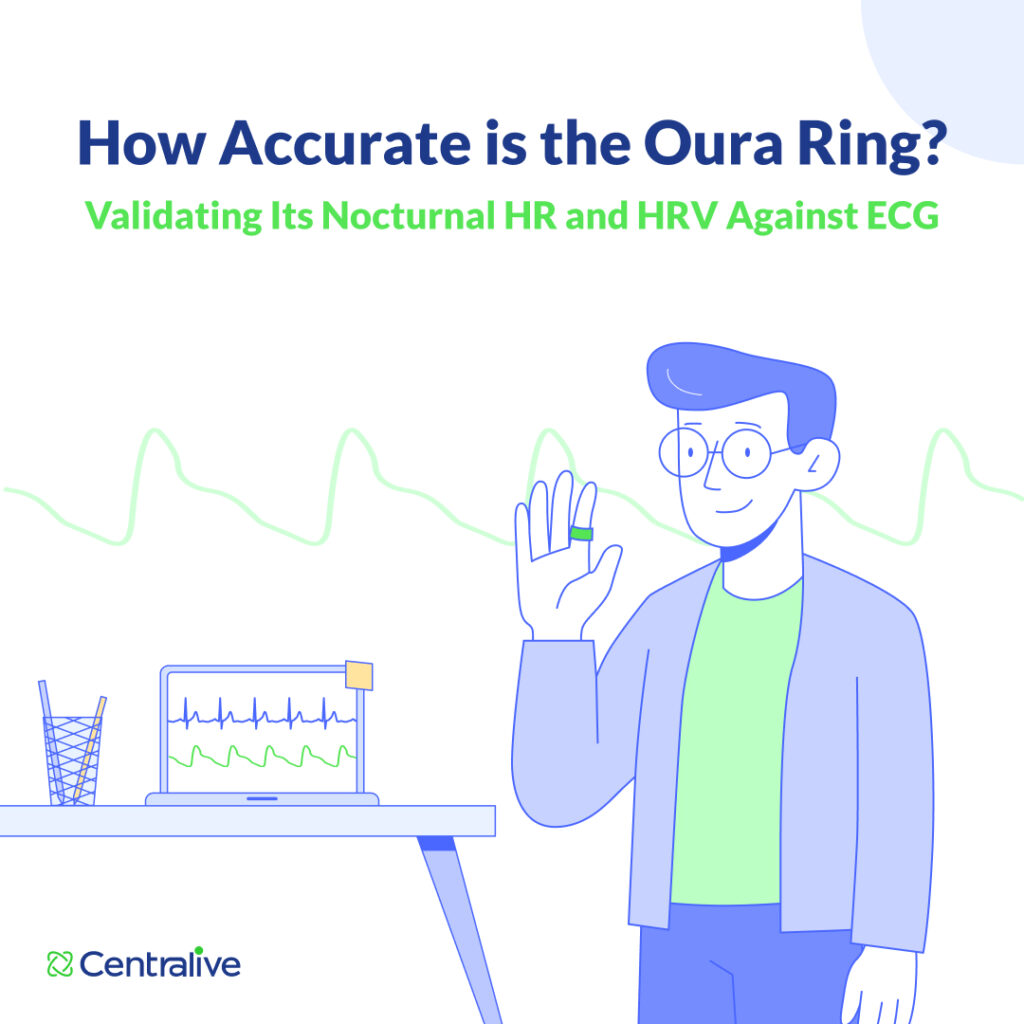
As wearable technology advances, understanding its accuracy becomes critical for health applications. A recent study published in the Journal of Medical Internet Research evaluates the Oura Ring, a photoplethysmography-based smart ring, against a medical-grade chest ECG for measuring nocturnal heart rate (HR) and heart rate variability (HRV).
Key Findings
- Strong Performance in HR and RMSSD
- The Oura Ring demonstrated low error variance and high correlations for HR and RMSSD in both short-term and overnight tests.
- These metrics are particularly relevant for sleep and stress monitoring.
- Improved Overnight Metrics
- Parameters like AVNN, pNN50, SDNN, HF, and LF improved in the average-per-night test, showing better reliability for longer-duration monitoring.
- Challenges with LF and LF:HF Ratio
- Both metrics exhibited higher error rates across all tests, suggesting a need for improved algorithms to handle these complex frequency-domain calculations.
The study underscores the potential of wearables like the Oura Ring for remote health monitoring, especially for tracking HR and HRV trends. While some metrics align closely with medical-grade devices, others require refinement for enhanced clinical reliability.
Implications:
The Oura Ring’s strengths make it a valuable tool for wellness monitoring, with promising applications in sleep and stress analysis. However, for clinical-grade precision, further innovation in motion artifact reduction and data processing is essential.
Authors: Rui Cao, Iman Azimi, Fatemeh Sarhaddi, Hannakaisa Niela-Vilen, Anna Axelin, Pasi Liljeberg, Amir M Rahmani