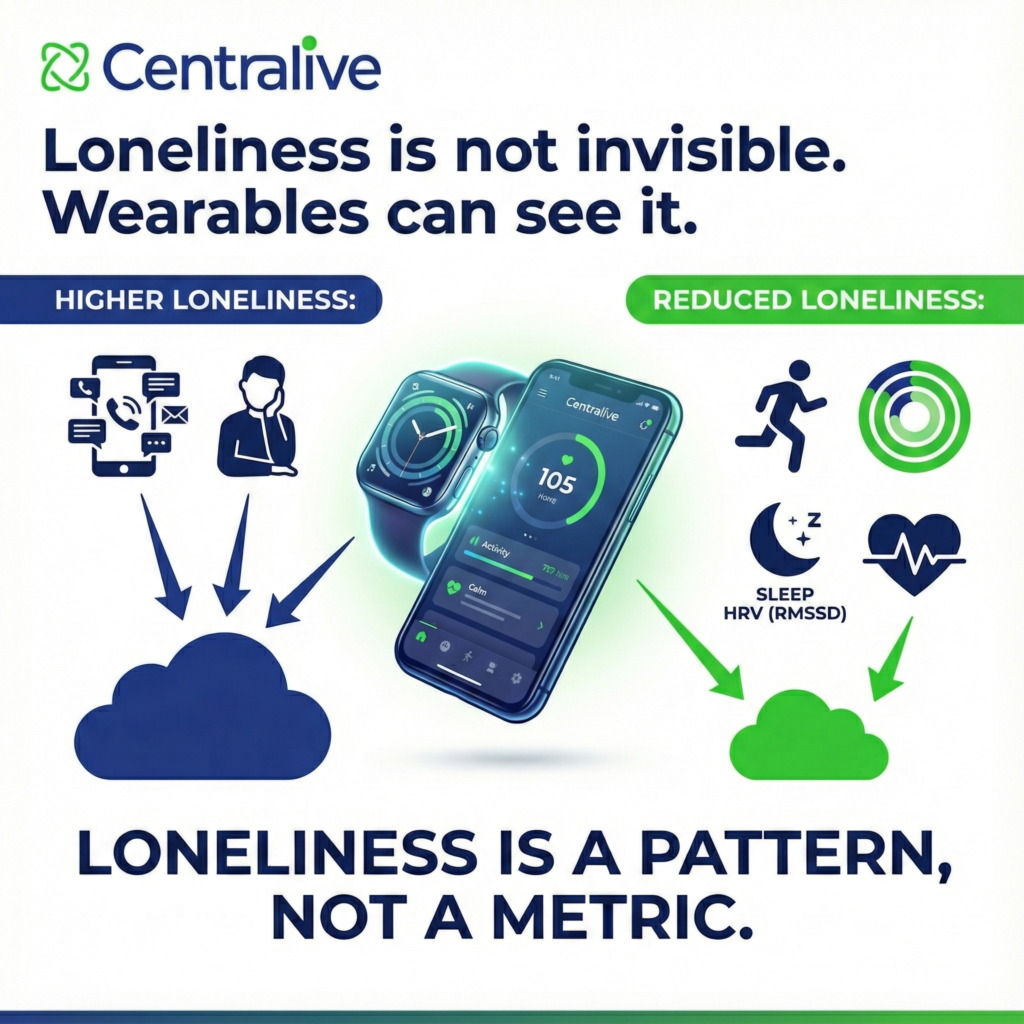
Loneliness is often treated as something abstract, emotional, and hard to measure. Yet for millions of people, especially immigrants adjusting to a new country, loneliness is embedded in daily routines, sleep, movement, and even heart rhythms.
A recent study published in PLOS One takes a new approach to understanding loneliness. Instead of asking only how lonely people feel, the researchers examined what people actually do and how their bodies respond throughout the day. Using smartphones, wearables, and causal machine learning, they identified daily-life features that do not just correlate with loneliness, but appear to causally influence it.
Studying loneliness in real life, not retrospectively
The study followed 39 first-generation immigrants living in Finland for 28 days. Participants wore a smartwatch and an Oura Ring and carried their phones as usual. Five times per day, they answered a simple question:
“How lonely do you feel right now?”
This ecological momentary assessment approach captured loneliness as it fluctuated across the day, rather than relying on a single retrospective score.
At the same time, the researchers continuously collected data on:
- Phone calls, messages, screen unlocks, and location
- Physical activity and inactivity
- Sleep duration, efficiency, and respiration
- Heart rate and heart rate variability, including RMSSD and LF/HF ratio
Crucially, the analysis did not stop at prediction. The team used causal machine learning methods to estimate the average treatment effect of each daily feature on loneliness. In other words, they asked, if this feature increases, does loneliness reliably increase or decrease afterward?
When more social contact increased loneliness
One of the most counterintuitive findings was that increased phone communication was linked to higher loneliness.
Longer outgoing call duration, more incoming calls, more messages, and even more screen unlocks all showed positive causal effects on loneliness. This does not mean that calling people causes loneliness in a simple sense. Instead, it suggests that increased phone activity may reflect unmet social needs, emotional strain, or attempts to compensate for isolation.
Interestingly, spending more time at home and visiting a greater number of distinct places were both associated with reduced loneliness. This highlights an important point: quantity of interaction is not the same as quality, and context matters more than raw counts.
Physical activity mattered more than many social signals
Among all features studied, physical activity showed one of the strongest protective effects.
Higher daily calories burned were associated with lower loneliness, while more minutes of inactivity increased loneliness. These effects were larger than many social interaction metrics.
This aligns with broader evidence that movement supports mental health not only through physiology, but also through structure, routine, and opportunities for incidental social exposure.
Sleep and loneliness: not as simple as “better sleep is better”
Sleep findings were nuanced. Longer total sleep time was associated with reduced loneliness. However, higher sleep efficiency and higher respiratory rate during sleep were linked to increased loneliness.
This challenges the assumption that improving sleep metrics always reflects better well-being. In some cases, higher sleep efficiency may reflect withdrawal, exhaustion, or depressive patterns rather than restoration. Without context, even objectively “good” sleep metrics can be misleading.
The role of heart rate variability during sleep
Cardiac features, especially during sleep, were among the most informative signals.
Higher sleep RMSSD, a marker of parasympathetic flexibility, was associated with lower loneliness. In contrast, higher sleep heart rate and higher LF/HF ratio were linked to increased loneliness.
These findings are consistent with the idea that chronic loneliness acts as a physiological stressor, shaping autonomic regulation over time. Importantly, daily heart rate variability behaved differently from sleep HRV, highlighting that timing and context are critical when interpreting these features.
Why causal analysis changes the conversation
Most digital mental health studies focus on prediction. This study went further by testing whether changes in daily behavior and physiology precede changes in loneliness.
The causal machine learning framework allowed the researchers to rule out many spurious associations and test robustness using refutation methods. While effect sizes were sometimes modest, they were consistent, interpretable, and grounded in real-life behavior.
This matters for screening and prevention. If loneliness leaves detectable traces in daily rhythms, it becomes possible to identify risk earlier, before someone reaches crisis.
What this means going forward
This study suggests that loneliness is not hidden. It is expressed through movement, sleep, communication patterns, and cardiac regulation.
At the same time, the findings are a reminder that numbers without context can mislead. A phone call is not always connection. Efficient sleep is not always restorative. High heart rate variability does not always mean resilience, especially during life transitions like immigration.
The future of loneliness detection will not rely on a single signal, but on patterns, timing, and individualized baselines. This paper represents an important step toward that future.
What this means for wearables
This study highlights a shift in how wearable data should be interpreted for mental health, especially for loneliness.
First, single metrics are rarely meaningful in isolation. Heart rate variability, sleep efficiency, or activity levels did not behave uniformly across contexts. For example, higher RMSSD during sleep was associated with lower loneliness, while daytime HRV metrics showed more complex or even opposite relationships. This reinforces that timing, sleep versus wake, matters as much as the metric itself.
Second, wearables capture stress and regulation indirectly, not emotions directly. Loneliness did not appear as a single physiological signature. Instead, it emerged as a pattern across systems: reduced activity, altered sleep physiology, changes in autonomic balance during sleep, and compensatory social behaviors such as increased phone calls.
Third, contextualized baselines matter more than population thresholds. Many of the observed effects were statistically robust but modest in size. This suggests that wearable signals may be most useful for detecting changes within an individual over time, rather than flagging someone as lonely based on absolute cutoffs.
Fourth, integration beats optimization. The strongest insights did not come from the “best” sensor, but from combining wearables, smartphones, and momentary self-report. Platforms like Centralive make this integration feasible by synchronizing passive sensing with real-time subjective experience, allowing causal relationships to be tested rather than assumed.
Finally, this work suggests a future where wearables support early screening and prevention, not diagnosis. Detecting shifts in sleep HRV, inactivity, and communication patterns could help identify rising loneliness risk days or weeks before it becomes chronic, especially in vulnerable populations such as immigrants navigating major life transitions.
In short, wearables are not loneliness detectors. They are pattern detectors. When paired with causal analysis and real-world context, those patterns become clinically meaningful.
👏 Congratulations to the authors:
Yuning Wang, Jennifer Auxier, Mark Amayag, Iman Azimi, Amir M. Rahmani, Pasi Liljeberg, Anna Axelin
Data collection for this study was powered by the Centralive platform, enabling continuous monitoring and real-world physiological insight.