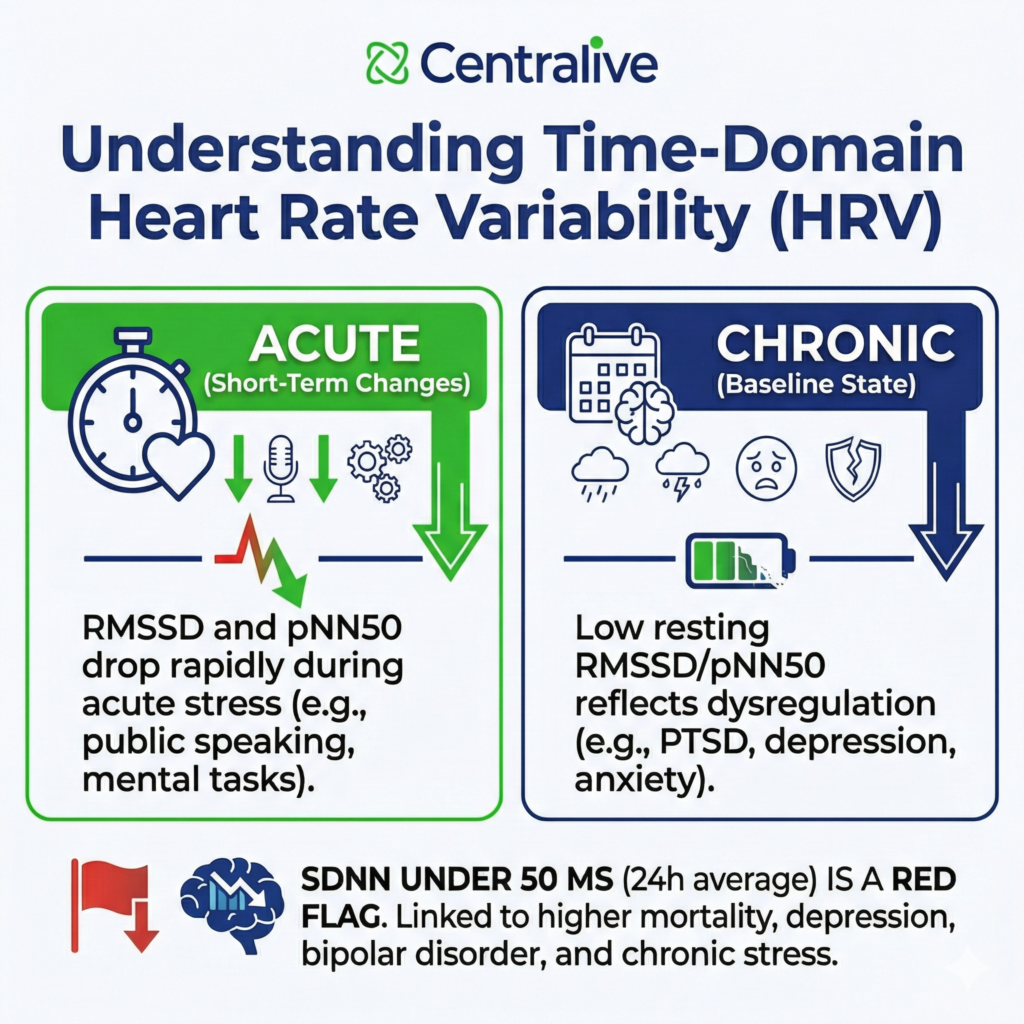
Heart rate variability (HRV) is widely used to study stress, recovery, and mental health, but not all HRV metrics respond to stress in the same way. Some change within seconds or minutes, others shift slowly across weeks or months. Mixing these signals can blur results and lead to the wrong conclusions.
If you want to understand whether someone is reacting to a moment, or carrying long term physiological strain, the timeline of the metric matters.
Two Stress Patterns, Two HRV Timelines
Stress generally shows up in two ways:
- Acute stress (spikes) such as public speaking, mental workload, conflict, or time pressure
- Chronic stress (drains) such as burnout, prolonged fatigue, depression, or long term autonomic imbalance
Different HRV features are sensitive to different parts of this timeline.
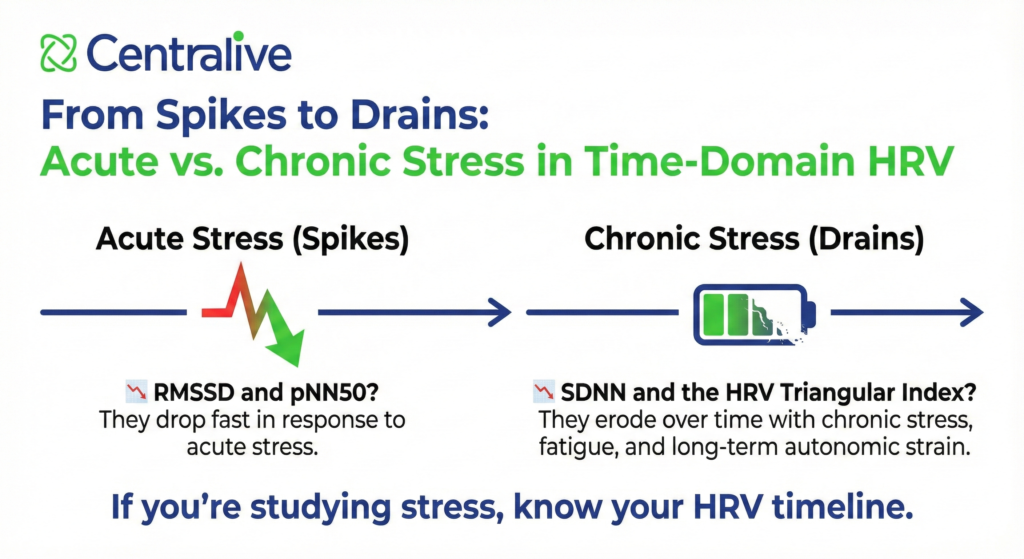
RMSSD and pNN50: Fast Responders to Acute Stress
RMSSD and pNN50 are time domain measures that primarily reflect parasympathetic (vagal) activity.
They are especially useful for detecting short term changes because they:
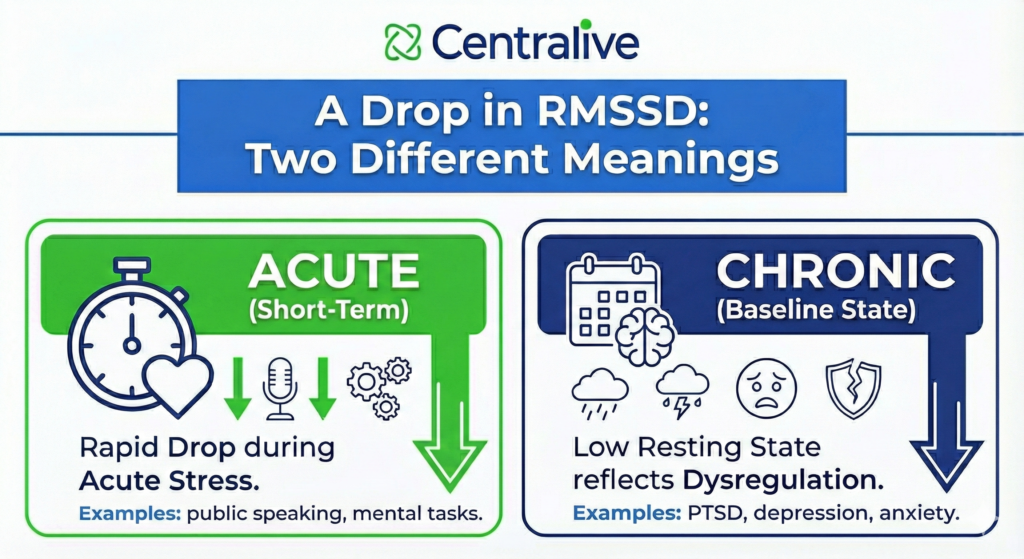
- Drop quickly during acute psychological or cognitive stress
- Reflect real time vagal withdrawal
- Increase during relaxation, slow breathing, and mindfulness practices
Because of this, they are well suited for:
- Stress reactivity experiments
- Intervention studies focused on immediate effects
- Biofeedback and moment to moment recovery tracking
However, low values during a brief recording do not automatically indicate chronic dysregulation. Context and baseline matter.
RMSSD and pNN50 as Baseline Markers of Chronic Load
When RMSSD or pNN50 are persistently low at rest across days or weeks, they may indicate:
- Chronic autonomic dysregulation
- Long term stress exposure
- Higher prevalence in conditions such as depression, anxiety, and PTSD, even without immediate stressors
In this case, the same metric is not describing a reaction, but rather a sustained physiological state. This is why interpretation depends on whether you are analyzing responses to events or long term averages.
SDNN: A Window into Total Variability
SDNN reflects overall HRV across the recording period, integrating both sympathetic and parasympathetic influences. It is the most widely reported time domain HRV metric in clinical research.
Key points about SDNN:
- It captures total variability, not just vagal tone
- It is most meaningful over long recordings, especially 24 hour monitoring
- It declines with chronic stress, fatigue, and long term autonomic strain
A commonly cited threshold is:
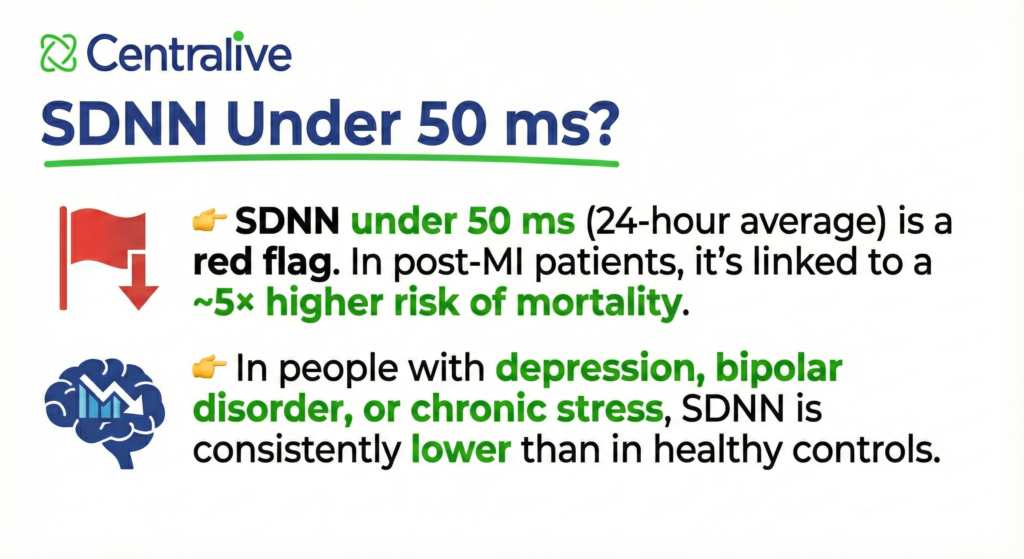
- SDNN below 50 ms (24 hour average), associated with elevated health risk in population studies, including higher mortality after myocardial infarction
It is important to note:
- This is not a diagnostic cutoff for individuals
- It is a population level risk marker
- Longitudinal trends are often more informative than single values
In mental health and chronic stress populations, SDNN is consistently lower on average compared to healthy controls, supporting its role as a marker of sustained physiological burden.
HRV Triangular Index: The Long View Metric Many Skip
The HRV Triangular Index is a geometric measure derived from the shape of the RR interval histogram. Instead of focusing on beat to beat changes, it reflects the overall distribution of heart rhythms.

What makes it useful:
- Captures long term variability across extended recordings
- Less sensitive to short term fluctuations and artifacts
- Represents overall autonomic flexibility
Lower HRV Triangular Index values are associated with:
- Chronic stress
- Fatigue and burnout
- Cardiac autonomic dysfunction
- Poorer long term cardiovascular outcomes
Higher values generally reflect:
- Greater variability
- More adaptive autonomic regulation
- Better long term recovery capacity
Because it summarizes the entire distribution of heart rhythms, it is especially valuable in 24 hour recordings and longitudinal monitoring, where short term metrics may miss slow physiological shifts.
Choosing the Right Metric for the Right Question
Each metric answers a different question:
- RMSSD and pNN50 help you see how someone reacts in the moment
- SDNN shows how much total variability the system has across time
- HRV Triangular Index provides a panoramic view of long term autonomic stability
Using only fast responding metrics to study chronic stress can miss slow deterioration. Using only long term metrics to study immediate stress reactions can hide meaningful short term effects.
Practical Takeaway
HRV does not give a single stress signal. It provides multiple layers of information across different time scales.
To interpret it well:
- Match the metric to the physiological process you are studying
- Separate acute reactivity from baseline state
- Track trends over time, not just isolated values
- Combine short term and long term metrics when possible
When studying stress, knowing the timeline of your HRV features is just as important as knowing their definitions.
References
- Kleiger RE et al. (1987). Decreased heart rate variability and its association with increased mortality after acute myocardial infarction. Circulation.
- Shaffer F, Ginsberg JP (2017). An overview of heart rate variability metrics and norms. Frontiers in Public Health.
- Peyron O et al. (2021). HRV and mental health, a systematic review. International Journal of Environmental Research and Public Health.
- Kim HG et al. (2018). Heart rate variability and psychiatric disorders, a systematic review. Psychiatry Investigation.
- Henry BL et al. (2019). Acute stress and vagal withdrawal measured by RMSSD. International Journal of Psychophysiology.
- Chalmers JA et al. (2014). Anxiety disorders and autonomic nervous system function. Frontiers in Psychiatry.
- Tang YY et al. (2009). Central and autonomic nervous system interaction during meditation. Proceedings of the National Academy of Sciences.
- Lehrer PM, Gevirtz R (2014). Heart rate variability biofeedback, how and why it works. Frontiers in Psychology.