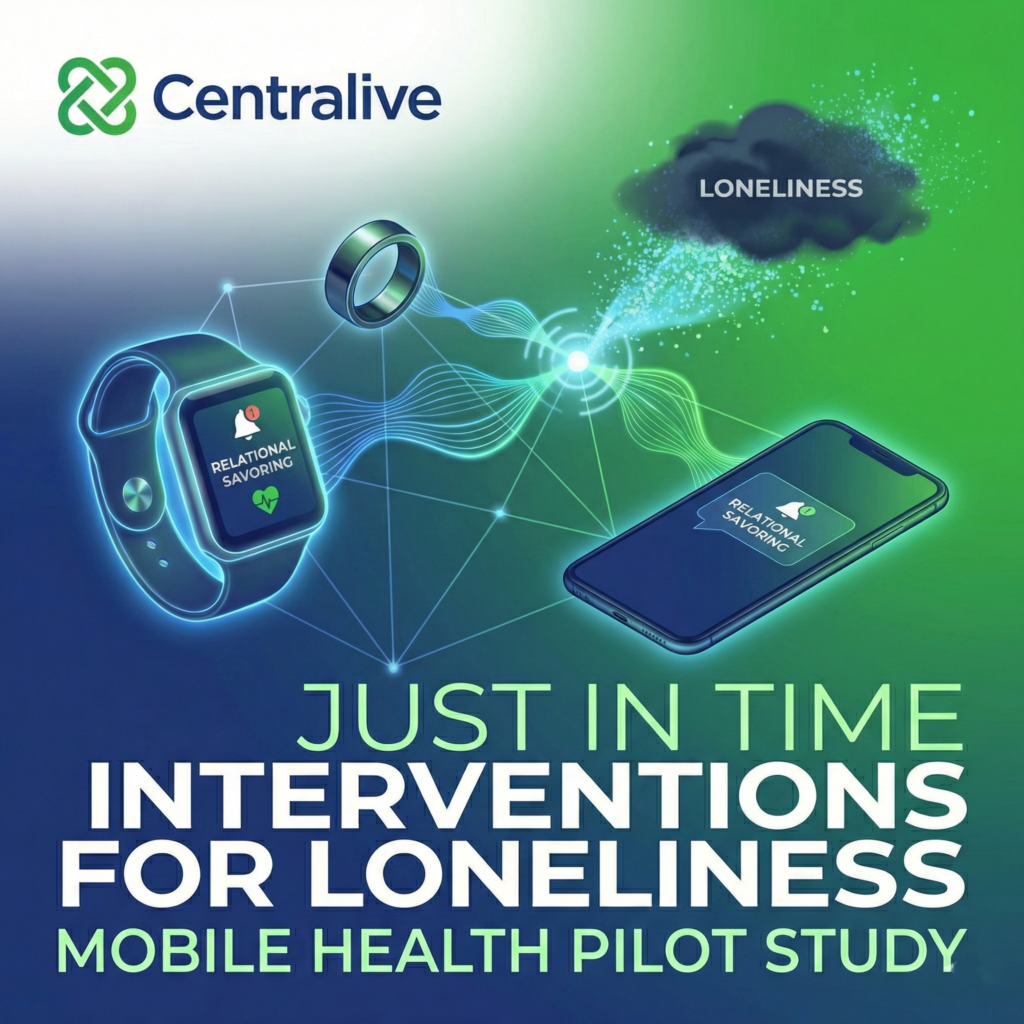
Loneliness among college students has become a growing public health concern, especially following disruptions caused by the COVID 19 pandemic. Traditional interventions often focus on increasing social interactions, yet evidence suggests that simply having more interactions does not always reduce the subjective experience of loneliness. A recent study published in JMIR Formative Research explored a different approach, strengthening the quality of existing relationships using a mobile, just in time intervention.
The Study at a Glance
Researchers conducted a mixed methods pilot study to evaluate mSavorUs, a mobile adaptation of a relational savoring intervention grounded in attachment theory and positive psychology. Relational savoring encourages individuals to reflect on meaningful, supportive moments with others, helping deepen feelings of connection and emotional security.
The study enrolled 29 college students and followed them over 22 weeks. Participants wore smart devices, including a smart ring and smartwatch, and completed ecological momentary assessments on their smartphones. These multimodal data streams were used to identify moments when students were likely experiencing elevated loneliness and to deliver relational savoring prompts in real time.
What the Researchers Found
From a feasibility and acceptability perspective, students consistently reported that the content of the relational savoring exercises was valuable. Participants described the intervention as calming, emotionally grounding, and helpful in shifting attention toward positive relational experiences. Many noted that writing and reflecting on meaningful memories made those connections feel more tangible and emotionally real.
However, the study also highlighted important challenges. Just in time prompts were sometimes delivered at inconvenient moments, such as during classes or busy periods, which reduced engagement. Technical friction and the frequency of prompts further contributed to participant burden. Quantitatively, the pilot did not demonstrate statistically significant improvements in loneliness or social connectedness at the group level, underscoring the importance of refining timing, delivery, and user control in future iterations.
Why This Work Matters
Despite mixed quantitative outcomes, this study provides critical insights into how mobile health interventions for loneliness can be designed, tested, and improved. The findings suggest that relationally focused interventions are meaningful to users, but that success depends heavily on seamless technology, adaptive delivery, and respect for real world context.
Powered by Centralive
This research was made possible by Centralive, the end to end digital health research platform that powered the study’s multimodal data collection, wearable integration, ecological momentary assessments, and real time intervention delivery. Centralive enabled researchers to deploy a complex mobile health study at scale, integrate data from smart rings, smartwatches, and smartphones, and operationalize personalized, sensing driven interventions without building custom infrastructure from scratch.
By supporting studies like this, Centralive helps bridge behavioral science and digital health, accelerating the development of scalable, evidence based interventions for mental and behavioral health.
👏 Congratulations to the authors:
Brenda Nguyen, Jocelyn Lai, Hana Qureshi, Christopher Marcotullio, Sina Labbaf, Yuning Wang, Salar Jafarlou, Nikil Dutt, Amir M Rahmani, Jessica L Borelli