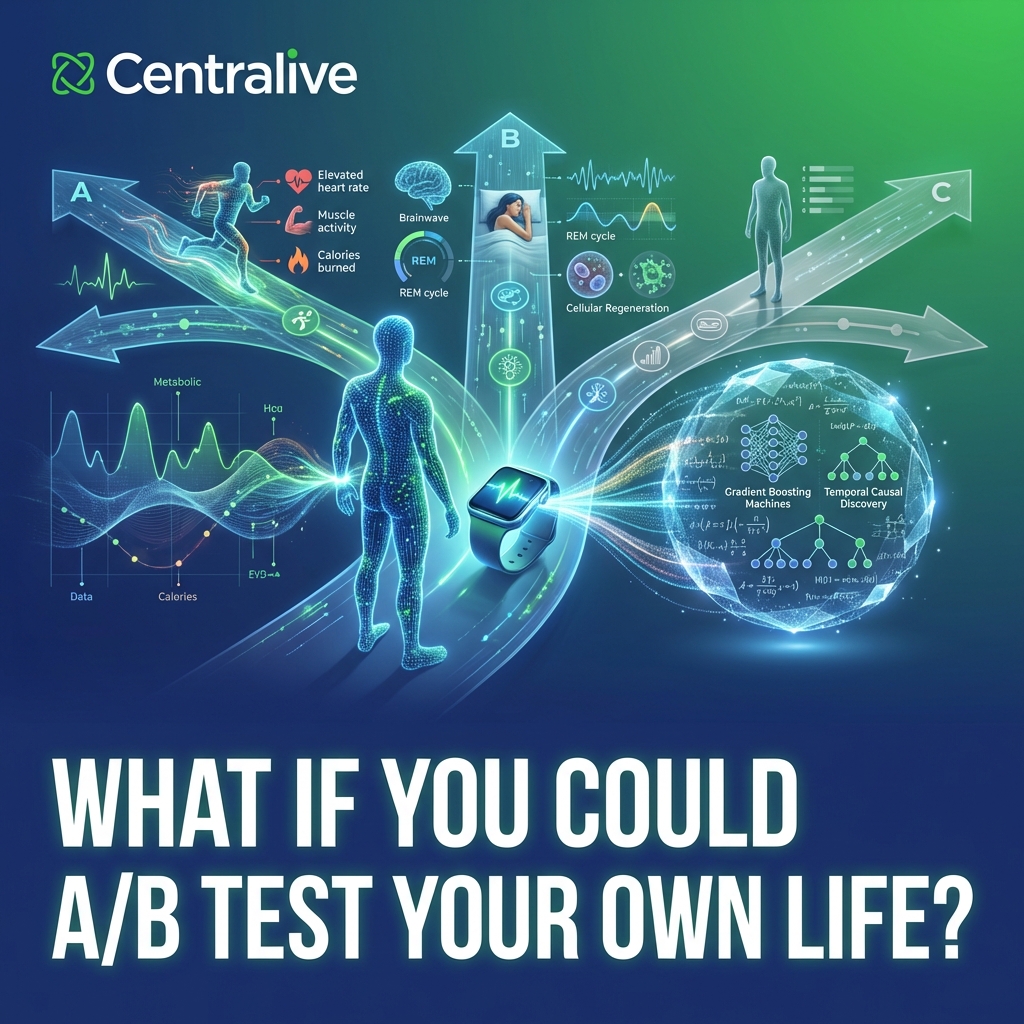
Wearable technology has revolutionized how we observe our bodies, providing us with a continuous stream of heart rate variability (HRV), sleep scores, and activity levels. However, observation is not the same as understanding. Most current technologies offer descriptive statistics—telling you what happened—rather than actionable foresight into what could happen.
A new paper, “Personalized Counterfactual Framework: Generating Potential Outcomes from Wearable Data,” introduces a sophisticated method to bridge this gap. By moving from correlation to causation, this framework allows us to ask personalized “what-if” questions about our health.
The Problem with Generalization
Traditional predictive models often rely on population averages. They might tell you that “exercise generally improves sleep.” However, effective personalized healthcare requires understanding specific individual responses. Does high exertion improve your sleep, or does it spike your cortisol and ruin your recovery? The study highlights that inter-individual variability is significant; the same lifestyle change can trigger vastly different physiological responses in different people.
How It Works: The Counterfactual Framework
To solve this, the authors developed a four-stage pipeline designed to generate plausible future health trajectories:
- Dataset Augmentation via Similarity: Since individual historical data is often limited, the system identifies “similar peers” based on multi-modal analysis and augments the patient’s dataset. This stabilizes the model without losing personal specificity.
- Causal Structure Discovery: Utilizing a temporal PC (Peter-Clark) algorithm, the model identifies which variables from yesterday (t-1) actually cause physiological changes today (t), rather than just correlating with them.
- Personalized Modeling: Gradient Boosting Machines (GBMs) are trained on these discovered relationships to quantify the effects of specific variables, such as how deep sleep impacts readiness scores.
- Counterfactual Generation: Finally, the system runs Monte Carlo simulations to project outcomes under hypothetical scenarios. For example, it can predict the specific trajectory of your heart rate tomorrow if you choose to have a high-activity day today versus a sedentary one.
Why This Matters
The evaluation of this framework showed impressive accuracy, with a Mean Absolute Error (MAE) for heart rate predictions of just 4.71 bpm. But the real value lies in the heterogeneity of the results. The study found that a hypothetical “High Activity” intervention increased activity scores by an average of 14.8 points, but the range of responses was massive.
By validating these “what-if” scenarios, this framework lays the groundwork for the next generation of digital health: proactive, personalized nudges that help users navigate lifestyle choices before they make them.
👏 Congratulations to the authors: Ajan Subramanian and Amir M. Rahmani
🔗 Subscribe to Centralive Newsletter.