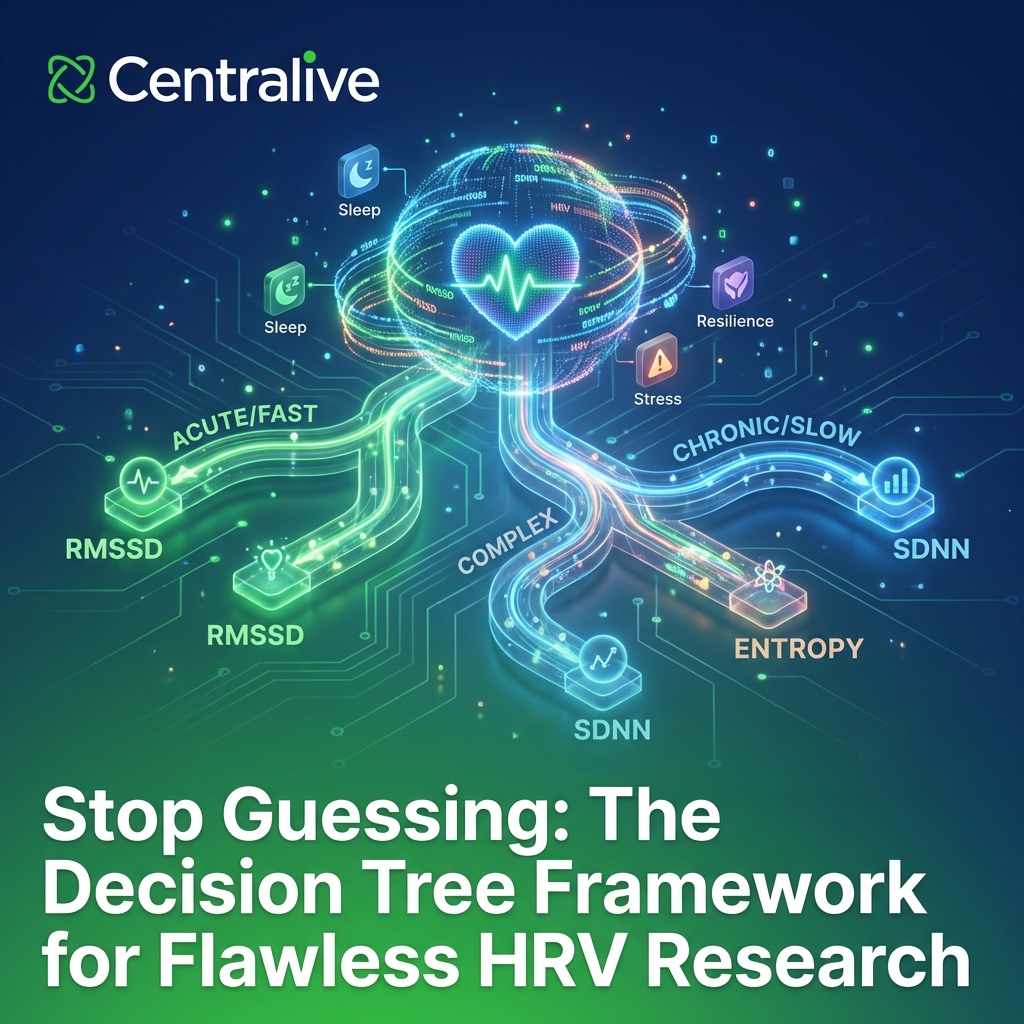
Stop Guessing: The Decision Tree Framework for Flawless HRV Research
Heart Rate Variability (HRV) has quickly become the gold standard biomarker in mobile health. From elite athletic recovery to monitoring clinical depression, its applications are vast. But there is a trap waiting for the unprepared researcher.
You sit down to design your study and are immediately bombarded with an alphabet soup of metrics: RMSSD, SDNN, pNN50, HF, LF.
The question isn’t just “What do these mean?” It is: “Which one actually measures what I am studying?”
Using a long-term metric for a short-term stress test is like trying to measure the speed of a sprinter using a calendar. You won’t get a signal; you will just get noise. To ensure your data is valid, I have developed a simple Decision Tree Framework to match your metrics to your specific study design.

1. The “Acute” Study: Capturing the Spark
Are you studying immediate reactions? (e.g., a mindfulness session, a Stroop test, or a sudden scare).
If the phenomenon happens in minutes, you need metrics that track rapid vagal shifts. Long-term averages will wash out the very reaction you are trying to capture.
- Target: Fast-acting parasympathetic changes.
- The Metrics: RMSSD and HF Power.
- Duration: 1–5 minutes (pre/post or continuous).
2. The “Chronic” Study: The Big Picture
Are you examining stable traits? (e.g., burnout, general resilience, or depression).
A 5-minute snapshot is insufficient here. To understand a chronic state, you need to measure the system’s total capacity and global regulation.
- Target: Total autonomic variability.
- The Metrics: SDNN (The gold standard for total variability) and SD2.
- Duration: Ideally 24 hours or strictly controlled baselines.
3. The “Sleep” Study: Recovery Rhythms
Are you tracking training load or recovery?
This is where wearables like Oura and Whoop shine. The goal isn’t to see a reaction to stress, but to see how well the body repairs itself overnight.
- Target: Nightly vagal dominance.
- The Metrics: RMSSD (for modulation) and SDNN (for chronic profile).
- Duration: Overnight (4+ hours). Tip: Aggregate multiple nights to reduce noise.
4. The Golden Rule of HRV Research
If you remember nothing else, remember this alignment rule:
- Is the phenomenon FAST? → Use RMSSD.
- Is the phenomenon SLOW? → Use SDNN.
- Is the phenomenon COMPLEX? → Use Entropy.
By aligning your hardware and your metrics with the timescale of the phenomenon you are studying, you turn noisy data into a powerful, credible signal of human health.
Want to master health data? Join the Centralive community for weekly insights.
Subscribe to the Centralive Newsletter here.