Multitask Learning Approach for PPG Applications: Enhancing Smartwatch Vital Sign Monitoring
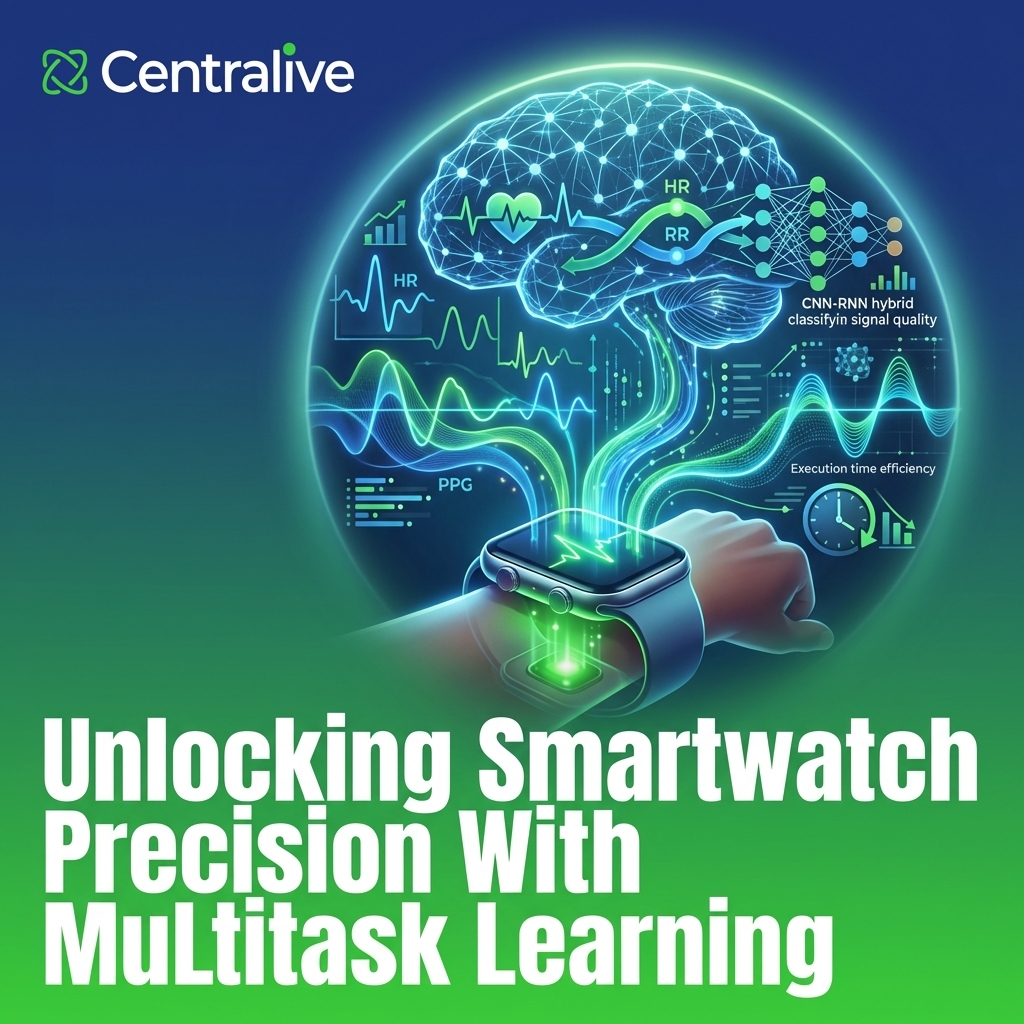
Current wearable technologies primarily focus on extracting single physiological parameters from photoplethysmography (PPG) signals. However, this single-task approach overlooks the inherent biological synergies between vital signs like heart rate, heart rate variability, and respiration rate. Our latest research explores how Multitask Learning (MTL) can overcome these limitations to deliver unprecedented accuracy in free-living conditions.
Methodology
The study developed customized multitask deep learning models utilizing hybrid CNN-RNN architectures. We evaluated these models on a robust dataset collected from 46 subjects wearing smartwatches during their daily, unrestricted activities. The models were tested across two primary case studies: PPG signal quality assessment and simultaneous heart rate (HR) and respiration rate (RR) estimation.
Findings
Our results demonstrate that MTL models significantly outperform baseline single-task models. First, the proposed MTL approach achieved superior predictive performance in Signal Quality Assessment (SQA), effectively distinguishing reliable from unreliable signals even amidst real-world motion artifacts. Second, estimating HR and RR concurrently yielded remarkably lower error rates, proving that leveraging shared physiological characteristics enhances overall algorithmic accuracy.
Impact
Beyond accuracy, the MTL model showcased remarkable computational efficiency. By combining tasks into a single network, execution times were slashed from over 20 milliseconds to just 5.24 milliseconds per sample. This leap in efficiency opens the door to real-time, on-device processing for low-powered edge wearables, minimizing battery drain while maximizing patient monitoring reliability.
This research was powered by the Centralive Platform.
Authors: Mohammad Feli, Kianoosh Kazemi, Iman Azimi, Pasi Liljeberg, Amir M. Rahmani
Read the full paper: https://www.sciencedirect.com/science/article/pii/S0010482525001489
Join our network for deeper insights: https://newsletter.centralive.health/signup