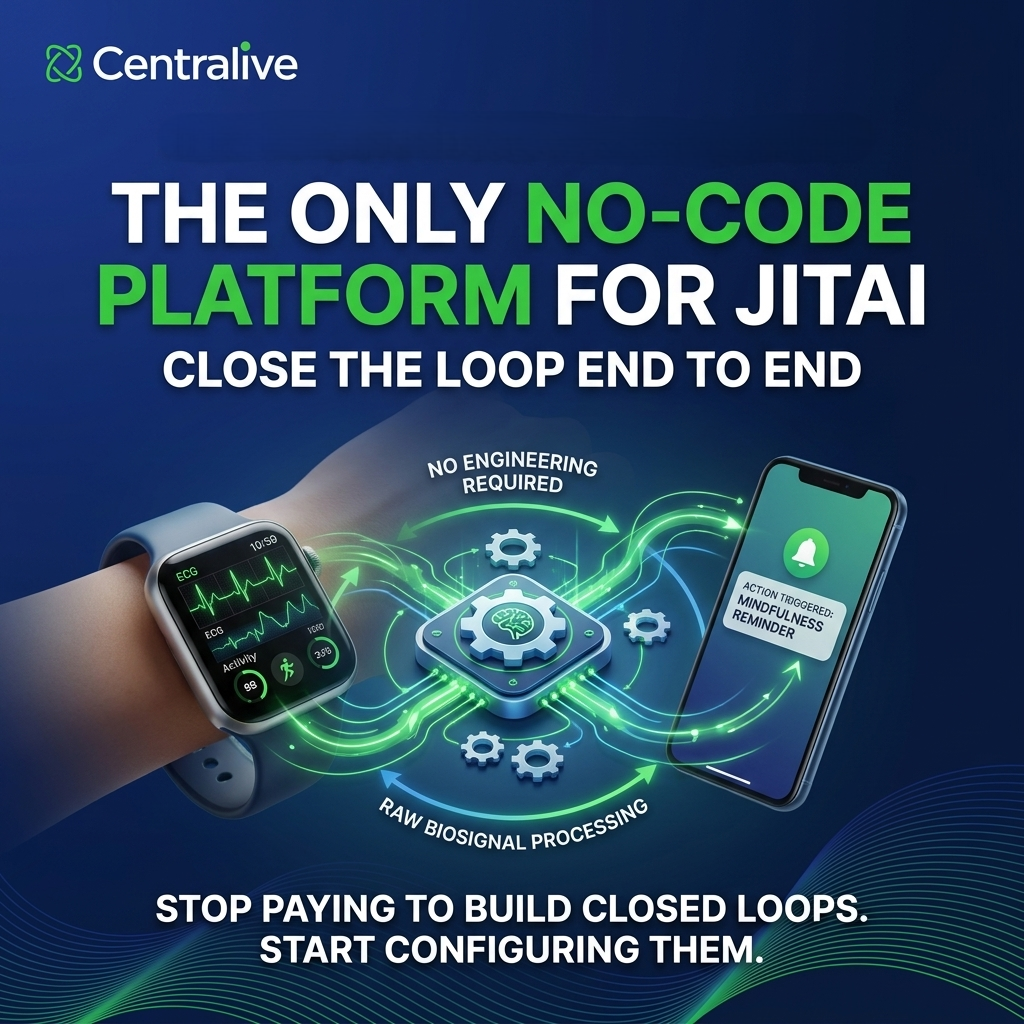
Many digital health team eventually wants the same thing. A wearable reads the patient’s real state, a decision is made in the moment, and the phone acts only when it should. A medication reminder that fires when blood pressure is actually elevated, not on a schedule the patient has already learned to ignore. That is the product researchers describe in their grant applications. It is also the one they almost never get to run. The reason is rarely the science. It is the quote that comes back when they ask an engineering team to build it.
First, name what you are really buying
In the literature this is a just-in-time adaptive intervention: the right support, at the right time, adapted to the person’s changing internal and contextual state.1 Strip away the acronym and what a researcher is buying is simple. Better adherence. Cleaner data. An intervention that arrives when it can actually change an outcome, instead of when a scheduled job happens to fire. That is the value. Hold onto it, because the moment the conversation turns to price, the value is the first thing that gets forgotten.
The price myth
Ask a development shop to build a sensor-triggered closed loop and you will hear a number. Industry estimates put a custom, clinical-grade mobile health app at tens to hundreds of thousands of dollars, before maintenance, hosting, and compliance audits are counted.2,3 A live closed loop sits at the top of that range, because it needs device integration, a real-time data pipeline, a decision layer, and intervention delivery all working at once and staying correct over time. In practice that is 10 to 20 times the cost and timeline of a tracking-only app.
Here is the part most teams miss. The price was never the real problem. The real cost is the study that never launches, the cohort that runs on a weaker protocol because the better one was ruled “too expensive,” and the discovery that goes to whoever did get their loop running. A six-figure quote feels expensive. A year of lost time and a study you had to water down is far more expensive, and it never shows up on an invoice.
So remove the build
Centralive is, to our knowledge, the only no-code platform built to close this loop end to end. There is no engineering project to fund and no pipeline to maintain. A researcher configures three things: the trigger, which is the signal and the condition to watch for, the decision rule, and the intervention to deliver on the phone. The 10 to 20 times multiplier does not get negotiated down. It gets deleted, because the custom build that created it no longer exists.
Why you can trust the loop
Conviction without proof is just noise, so here is the proof. Centralive reads raw biosignals directly through hardware SDKs, including beat-to-beat intervals and accelerometry from Garmin, rather than the processed outputs that closed APIs hand back. Two things follow that matter for any automated decision. Your trigger logic runs on transparent, inspectable inputs, and the loop does not quietly change its behavior when a vendor updates a proprietary algorithm behind an API. The same signal-processing methods are published in peer-reviewed venues, and the underlying tools are open source.4 You are not asked to trust a black box. You are invited to inspect it.
The cost of waiting is running right now
Every week spent scoping a custom build is a week your protocol is not collecting data. Every cohort that starts late starts late permanently. The teams that lead the next wave of wearable research will not be the ones with the largest engineering budget. They will be the ones who closed the loop first and spent their time on the science instead of the plumbing.
Make the decision
So make it. If you have a study that needs a sensor to trigger an action in real time, you can configure that intervention instead of commissioning it, and you can start this week. See the platform, bring your hardest trigger condition, and find out how fast the loop actually closes. The only thing standing between you and a running closed loop is the decision to stop paying to build one.
Sign up for the Centralive Newsletter: https://newsletter.centralive.health/signup
References
- Nahum-Shani I, Smith SN, Spring BJ, Collins LM, Witkiewitz K, Tewari A, Murphy SA. Just-in-Time Adaptive Interventions (JITAIs) in Mobile Health: Key Components and Design Principles for Ongoing Health Behavior Support. Annals of Behavioral Medicine. 2018;52(6):446-462. https://doi.org/10.1007/s12160-016-9830-8
- Pi Tech. Healthcare App Development Cost: 2026 Pricing Guide. https://pi.tech/blog/estimate-your-healthcare-app-development-cost
- NewAgeSysIT. How Much Does It Cost to Develop a Healthcare Mobile App? Key Factors and Budget Ranges. 2026. https://newagesysit.com/blog/how-much-does-it-cost-to-develop-a-healthcare-mobile-app-key-factors-budget-ranges/
- Example of peer-reviewed signal-processing methods underlying the platform: smartwatch respiration rate estimation via transfer learning, IMWUT 2025. https://doi.org/10.1145/3712280 . Open-source libraries: HealthSciTech, https://github.com/HealthSciTech