Heart disease remains the leading cause of death in the United States, yet half of U.S. counties lack a single cardiologist. The gap between available medical knowledge and accessible care is widening.
ARPA-H’s newest program, ADVOCATE (Agentic AI-EnableD CardioVascular CAre TransfOrmation), aims to bridge this gap not with more doctors, but with a new digital member of the clinical team.
Here is what you need to know about this high-impact funding opportunity and how Centralive partners can leverage it.
The “Why”: From Chatbots to Agents
Most medical AI today is passive—it analyzes data and offers a suggestion. ADVOCATE is different. It seeks Agentic AI: systems capable of autonomous action.
The goal is to create an FDA-authorized platform that can:
- Connect to patient records.
- Assist in scheduling.
- Provide diet/therapy recommendations.
- Write and modify prescriptions (under supervision).
The Scope: Three Technical Areas (TAs)
Proposals must address the complexities of autonomy, safety, and scale. The program is divided into three pillars:
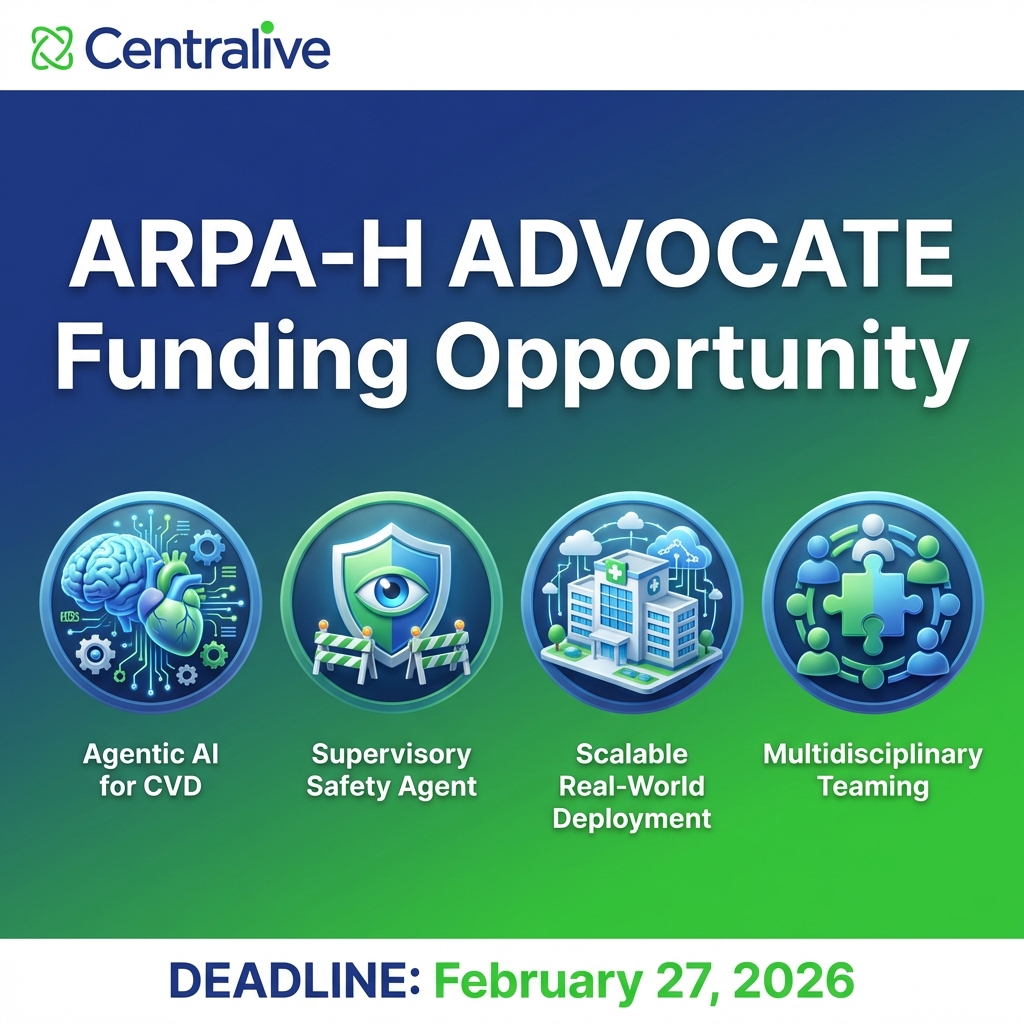
TA1: The Patient-Facing Clinical Agent
This is the core “AI Doctor.” It needs to interact directly with patients (Heart Failure and post-MI), perform clinical reasoning, and execute tasks traditionally done by clinicians. It must be empathetic, accurate, and available 24/7.
TA2: The Supervisory Agent
This is the “Safety Layer.” ARPA-H recognizes that autonomous AI is risky. TA2 focuses on a disease-agnostic overseer that monitors the TA1 agent in real-time, ensuring it never hallucinates a dangerous prescription or misses a critical signal.
TA3: Clinical Integration & Validation
Technology is useless if it doesn’t fit the workflow. This area focuses on the scalable deployment of these agents into real-world healthcare settings, ensuring interoperability with EHRs and wearables.
Eligibility & Deadlines
- Who can apply: Leaders in tech, academia, non-profits, and small businesses.
- Solution Summary Due: February 27, 2026
- Full Proposal Due: April 1, 2026
- Selection Method: ARPA-H operates with high-risk, high-reward agility. They are looking for “moonshots,” not incremental improvements.
How Centralive Partners Can Leverage This Call
For our ecosystem, ADVOCATE represents a strategic pivot point. Here is where you fit in:
- The “Teaming” Opportunity: Most organizations cannot do TA1 (Clinical AI) and TA2 (Safety/Audit) alone. Centralive can facilitate introductions between “Builders” (TA1) and “Breakers/Monitors” (TA2) to form the complete teams ARPA-H requires.
- Data Infrastructure: Training agentic models requires massive, longitudinal datasets. Partners with access to de-identified CVD patient registries are prime subcontractors.
- Regulatory Strategy: Since the goal is FDA authorization for an autonomous agent, partners with regulatory affairs expertise are essential to the proposal’s credibility.
Next Steps
The timeline is aggressive. If you have the capabilities to build or audit clinical AI:
- Review the full ISO on SAM.gov.
- Contact the Centralive Grants Team immediately to discuss potential consortiums.
- Prepare your Solution Summary before the Feb 27th cutoff.
🔗 Further details: https://arpa-h.gov/explore-funding/programs/advocate
🔗 Subscribe to Centralive Newsletter.