
Centralive Blog
Want to know more about the Centralive features? Read our blog posts here.

The “Stealing” Artery: Why Your Smartwatch Wrist Choice Matters More Than You Think
Think your left and right wrists provide the same health data? Think again. From “blood stealing” arteries to HRV errors, discover which hand creates the best data.
Read More
Is Your Smart Ring Finally Smart Enough to Listen? The Shift to Empathetic AI
Wearables are evolving from raw data to empathetic AI. ŌURA’s new model combines clinical science with your biometrics to explain *why* you feel the way you do.
Read More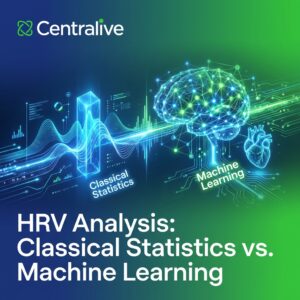
HRV Analysis: Classical Statistics vs. Machine Learning
Should you use standard HRV metrics or Machine Learning? Use standard features for physiological clarity and ML for prediction. Here is the decision framework.
Read More
When HRV Lies: 5 Populations Where Data Is Misleading
HRV isn’t for everyone. From AFib to pacemakers, discover the 5 specific populations where heart rate variability data becomes misleading or meaningless.
Read More
Is Your HRV Data Lying to You? The Truth About Normalization
𝐒𝐡𝐨𝐮𝐥𝐝 𝐘𝐨𝐮 𝐍𝐨𝐫𝐦𝐚𝐥𝐢𝐳𝐞 𝐇𝐑𝐕 𝐛𝐲 𝐇𝐞𝐚𝐫𝐭 𝐑𝐚𝐭𝐞?
It depends — and it matters more than most people think.

Stop Guessing: The Decision Tree Framework for Flawless HRV Research
Confused by RMSSD vs SDNN? Stop guessing. Use this simple decision tree framework to match the right HRV metrics to your specific research goals.
Read More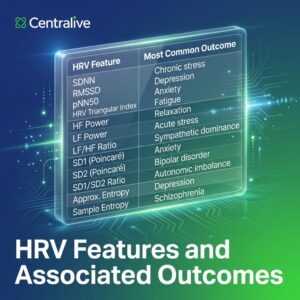
HRV Features and Associated Outcomes
Is your heart beating too perfectly? Discover how Heart Rate Variability (HRV) features reveal hidden insights into stress, anxiety, and mental health.
Read More
Why Your Heart Should Beat Like Jazz, Not a Metronome: The Science of Entropy
Think a regular heartbeat is healthy? Think again. Science shows why a resilient heart loves chaos—and why “perfect” rhythm predicts burnout and depression.
Read More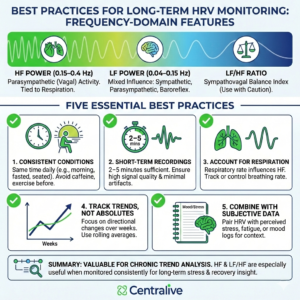
Best Practices for Long-Term Monitoring of HRV Using Frequency Domain Features
Frequency-domain HRV features offer a powerful, non-invasive way to track chronic stress and autonomic balance over time. This post outlines the key metrics—HF power, LF power, and LF/HF ratio—and best practices for consistent long-term monitoring in clinical and research settings.
Read More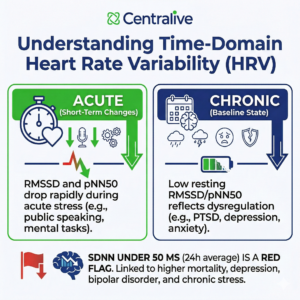
From Spikes to Drains: Using HRV to Tell Acute Stress from Chronic Stress
Acute stress shows up as rapid physiological spikes, while chronic stress appears as slow, cumulative drains on the nervous system. In HRV data, fast changing metrics like RMSSD and pNN50 capture immediate reactions, while SDNN and the HRV Triangular Index reflect long term autonomic strain and recovery.
Read More