
Beyond the Pulse: The New Science of Precision VO2 Tracking
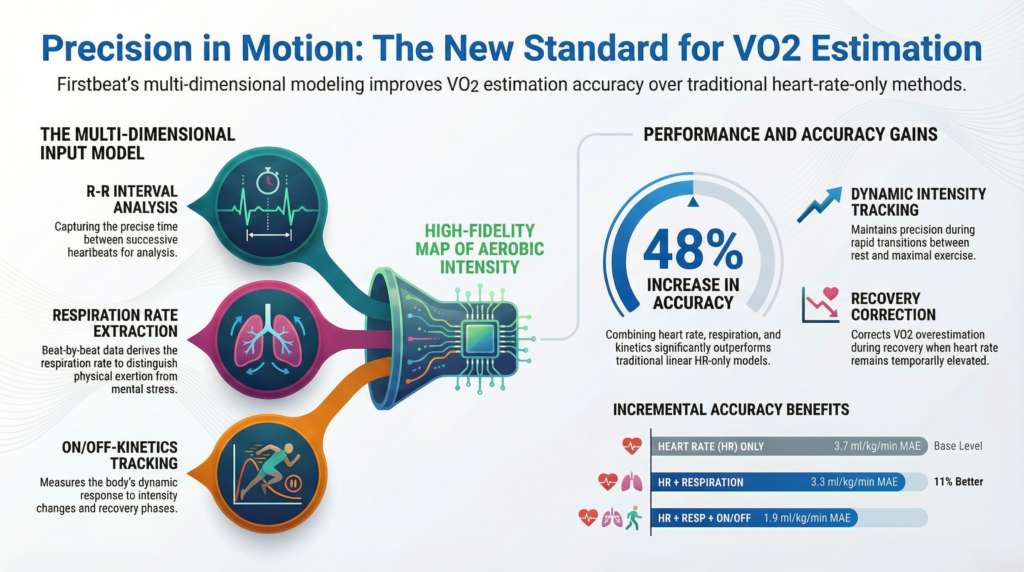
Heart rate monitoring has long been the primary tool for athletes to gauge metabolic intensity. However, standard pulse-based metrics often fail to capture the full physiological picture, especially during dynamic shifts or non-metabolic stress. A landmark white paper by Firstbeat Technologies introduces a more sophisticated approach: a neural network model that integrates R-R intervals to estimate oxygen consumption (VO2) with laboratory-level accuracy.
The Challenge with Standard Heart Rate Models
Traditional heart rate (HR) models assume a linear relationship between pulse and oxygen demand. This approach struggles to account for factors like “heart rate drift” during prolonged exercise or the elevated heart rate observed during mental stress. To overcome these limitations, the Firstbeat model utilizes three key data streams: heart rate, beat-by-beat respiration rate, and on/off-response kinetics. This multi-layered data set allows the system to distinguish between metabolic and non-metabolic cardiovascular increases.
Validation and Empirical Results
The model’s efficacy was tested in a study involving 32 healthy adults performing tasks ranging from household chores to maximal ergometer tests (Pulkkinen et al., 2004). The results were definitive: the inclusion of respiration rate and on/off kinetics reduced estimation error across the entire intensity spectrum. Specifically, the model achieved a 48% increase in accuracy compared to standard heart-rate-only methods. This improvement is critical for endurance athletes in sports like rowing and cross-country skiing, where precision in intensity is the difference between peak performance and overtraining.
Applications in Daily Life and Research
Beyond competitive coaching, this non-invasive method is revolutionizing ambulatory monitoring. By accurately tracking VO2 during low-intensity daily routines—such as climbing stairs or walking to work—it provides a comprehensive view of metabolic health without the need for cumbersome gas analyzers. This makes it an invaluable tool for exercise science research and long-term health tracking in large populations. Garmin uses Firstbeat Analytics to calculate VO₂ max.
The Future of Physiological Modeling
The transition from simple linear tracking to neural network-based modeling represents a significant leap in wearable technology. By understanding the intricate nuances of the heart’s rhythm and its relationship to the respiratory system, we can now access clinical-grade data in any environment.
Stay updated on the latest breakthroughs in metabolic health and physiology.