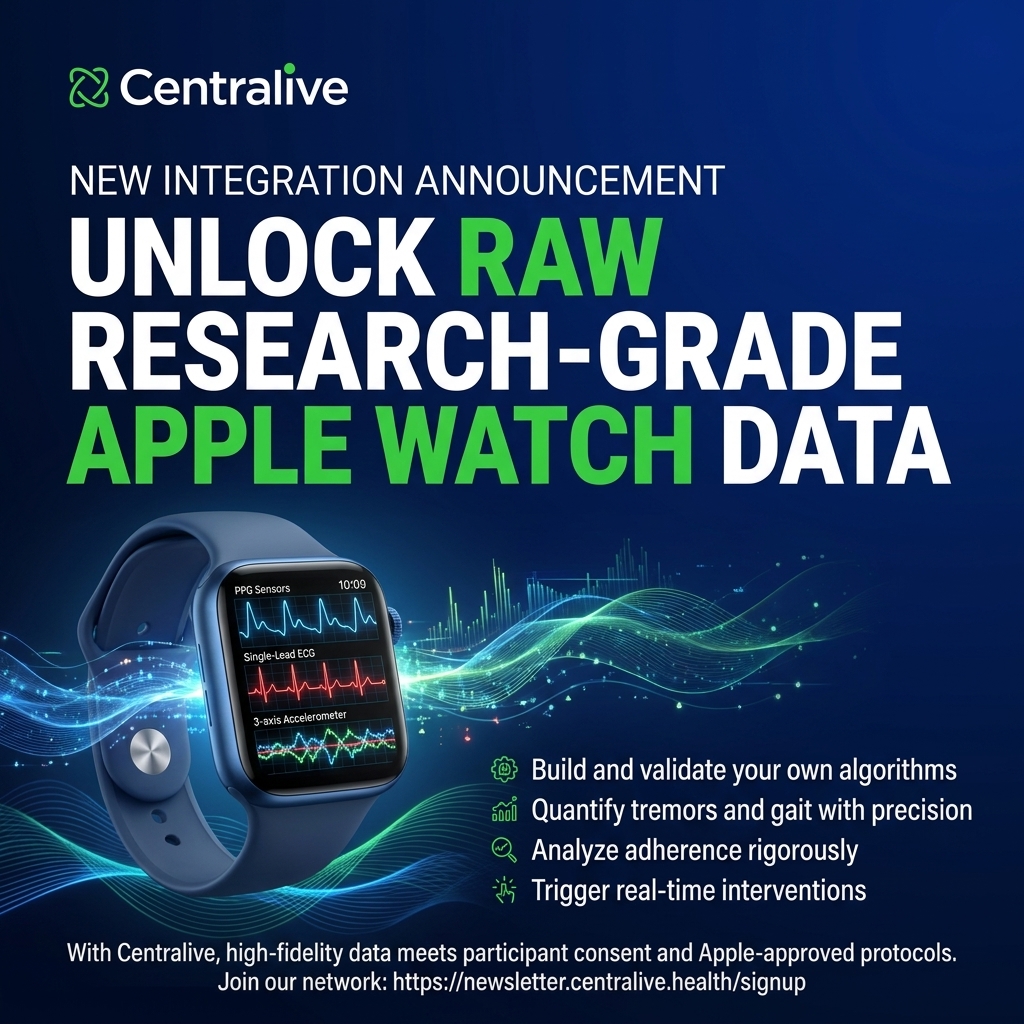
For years, Apple Watch has been one of the most widely worn pieces of health-tracking hardware in the world. The challenge for researchers has never been adoption. It’s been access. Most studies have had to settle for whatever summary metrics the consumer app surfaces, or build clunky workarounds to capture anything deeper.
That changes with the Centralive Apple Watch integration. Through Apple’s SensorKit framework, our platform now pulls raw, research-grade signals directly from participants’ wrists, with their explicit consent and Apple’s review and approval of the study protocol.
What “raw signals” actually means
A lot of digital health platforms claim to integrate with Apple Watch. Usually that means HealthKit: daily step totals, average heart rate, maybe a sleep stage summary. Useful, but pre-processed and aggregated.
SensorKit is different. It exposes the underlying sensor streams that the watch itself uses to compute those summaries. For a research team, that distinction matters. You can build your own algorithms, validate against reference standards, and ask questions the consumer-facing metrics weren’t designed to answer.
The signals Centralive can now collect from Apple Watch
Once a participant authorizes data sharing in the study app, Centralive can ingest any subset of the following.
| Signal | Category | What it captures | Example research uses |
|---|---|---|---|
| Photoplethysmogram (PPG) | Cardiovascular | Raw optical pulse waveform from the watch’s green LEDs, with sampling frequency, signal quality, and motion artifact flags | Heart rate variability, pulse wave analysis, arrhythmia detection |
| Electrocardiogram (ECG) | Cardiovascular | Single-lead ECG voltage samples with rhythm classification (sinus, AFib, high/low rate) | Rhythm classification, beat-to-beat interval analysis, symptom correlation |
| Heart rate | Cardiovascular | Continuous heart rate in BPM with confidence levels | Resting heart rate trends, exercise response, stress research |
| On-wrist state | Wear context | Whether the watch is being worn, which wrist, Digital Crown orientation, on/off timestamps | Adherence analysis, validity gating for other signals |
| Wrist temperature | Physiological | Overnight wrist temperature in Celsius with error estimates and measurement conditions | Cycle tracking, infection monitoring, circadian research |
| Accelerometer | Movement | Three-axis acceleration in G’s at high sampling rates | Activity recognition, gait analysis, tremor quantification, fall research |
| Rotation rate | Movement | Three-axis gyroscope data describing wrist rotation | Gesture recognition, movement disorder research, fine motor analysis |
| Pedometer data | Movement | Steps, distance, pace, cadence, floors ascended and descended | Daily activity quantification, mobility decline tracking |
| Odometer | Movement | Distance, speed, slope, altitude change with GPS-linked timing | Exercise physiology, outdoor activity profiling |
| Sleep sessions | Sleep | Time and duration of detected sleep periods | Sleep duration tracking, paired with PPG and wrist temperature for richer staging |
A closer look at each grouping below.
Cardiovascular signals (Apple Watch only)
- Photoplethysmogram (PPG). High-fidelity optical sensor data from the green LEDs on the back of the watch. This is the primary input for heart rate, but the raw waveform also opens the door to heart rate variability research, pulse wave analysis, and arrhythmia detection work.
- Electrocardiogram (ECG). Single-lead ECG capturing the timing and rhythm of heartbeats, suitable for rhythm classification and beat-to-beat interval analysis.
- Heart rate. Continuous heart rate measurements with confidence levels, useful as a baseline or alongside the raw PPG.
Wear and orientation context (Apple Watch only)
- On-wrist state. Whether the watch is actually being worn, which wrist it’s on, and the orientation of the Digital Crown. This is one of the most underrated signals in wearable research because it tells you when your other data is trustworthy and when it isn’t.
- Wrist temperature. Overnight wrist temperature during sleep, a signal that has become increasingly relevant in cycle tracking, infection monitoring, and circadian research.
Movement and physical activity (Apple Watch when worn)
- Accelerometer. Three-axis acceleration data, the foundation for activity recognition, gait analysis, tremor quantification, and fall research. SensorKit can also collect this from iPhone, but for wrist-based movement studies the watch is the relevant source.
- Rotation rate. Gyroscope data describing how the wrist rotates through space.
- Pedometer data. Step count, pace, cadence, and floors ascended or descended.
- Odometer. Distance, speed, slope, and altitude change during movement and workouts, helpful for exercise physiology studies.
Sleep
- Sleep sessions. Time and duration of detected sleep, which can be paired with PPG, accelerometer, and wrist temperature for a much fuller picture than a sleep duration value alone.
Why raw access changes what you can study
A few examples of the kinds of questions that get easier when you have the underlying signals rather than the dashboard-ready summaries.
Sleep researchers can run their own staging algorithms against PPG, accelerometer, and wrist temperature instead of accepting whatever black-box estimate the consumer app produces. Cardiology groups can validate novel arrhythmia detection methods against the same PPG and ECG streams that clinical-grade devices rely on. Movement disorder researchers can quantify tremor and bradykinesia from wrist accelerometer data on a watch the participant is already wearing, with no extra hardware shipped to homes and no compliance friction.
And because the on-wrist signal tells you exactly when the watch was being worn, you can analyze adherence rigorously rather than guessing.
Consent, transparency, and Apple’s review process
A note worth making explicit: SensorKit access is not casual. Every study requires Apple’s review and approval, and every participant authorizes each individual data type in the study app on their own iPhone before anything is collected. Centralive surfaces these authorizations clearly, and participants can revoke at any time. This is how it should work. Research-grade access shouldn’t mean opaque collection.
Where this fits in the Centralive stack
The Apple Watch integration plugs into the same closed-loop pipeline as the rest of our platform. Raw signals stream into the Centralive backend, where they can be processed alongside EMAs, passive smartphone sensing, and any other modalities a study is collecting. From there, just-in-time interventions can be triggered based on physiological state, a workflow that’s hard to build when your wearable data is locked behind a vendor dashboard.
If you’re running or planning a study where Apple Watch could play a role, we’d be glad to talk through what’s possible. The hardware is already on millions of wrists. The question now is what you want to learn from it.