The Quiet-Wake Problem: Why Your Sleep Tracker Struggles When You Are Most Awake
If you have ever woken up at 3 a.m., stared at the ceiling for forty minutes, and then checked your sleep app the next morning to find it claimed you slept straight through, you are not imagining things. You have discovered the most consistent blind spot in consumer sleep tracking, and it is a phenomenon that persists across every major device on the market today.
The Accuracy of Modern Sleep Detection
Modern wearables are genuinely impressive at one specific task: figuring out whether you are asleep or awake in a binary sense. For this basic judgment, devices like the Oura Ring, Apple Watch, Fitbit, WHOOP, and Garmin perform remarkably well against polysomnography (PSG), the EEG-based clinical gold standard. According to a 2021 head-to-head study by Chinoy and colleagues published in Sleep, the sensitivity for detecting sleep—correctly identifying sleep when PSG agreed—landed between 0.93 and 0.96 across all major brands. Subsequent research by Robbins and colleagues in 2024 at Brigham and Women’s Hospital confirmed that the latest hardware, including the Oura Ring Gen 3 and Apple Watch Series 8, maintains sensitivity above 95%.
Where the Technology Fails: The Specificity Gap
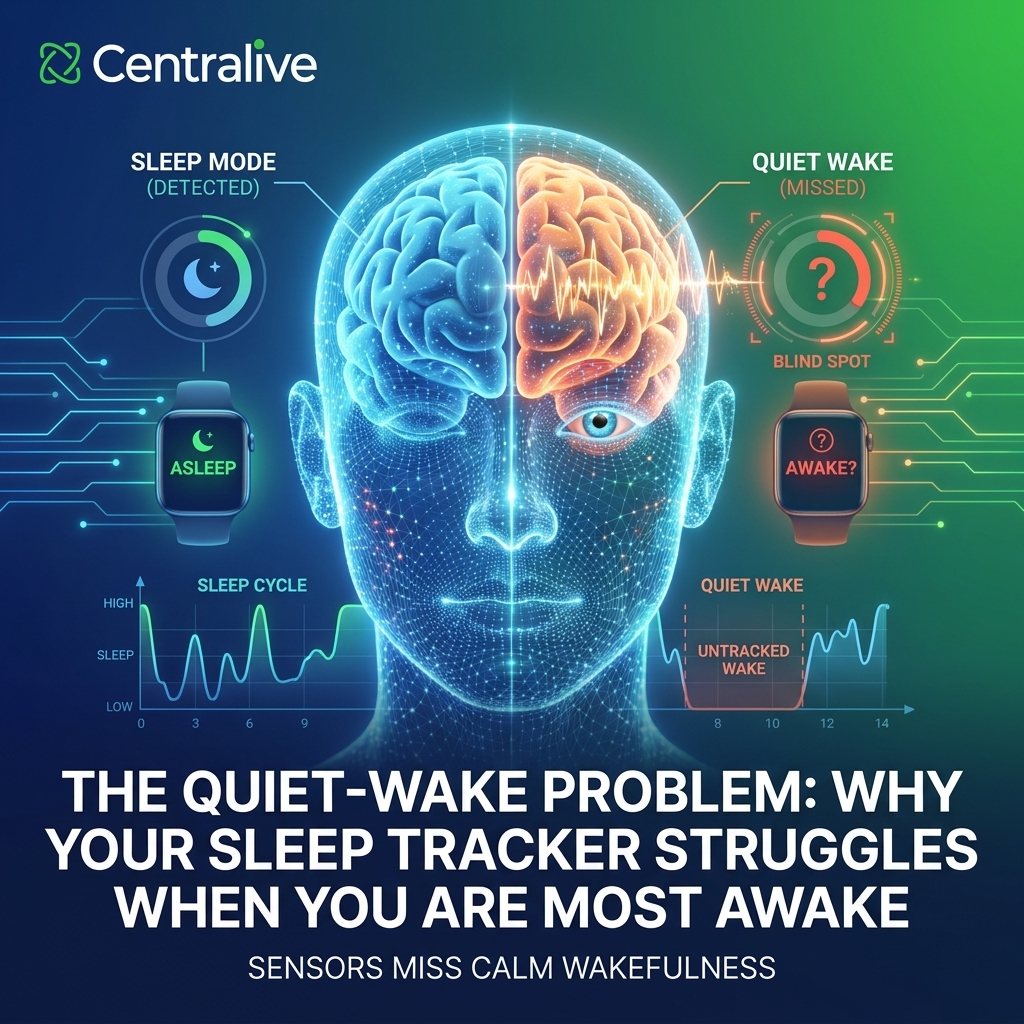
The marketing for these devices often omits a critical metric: specificity for wake. This is the ability of the device to correctly recognize when you are awake during the night. In the same 2021 study by Chinoy, wake specificity ranged from just 0.35 to 0.45. This means that two-thirds of the time, the devices missed periods of wakefulness. Robbins (2024) reported slightly better but still flawed numbers, with the Apple Watch flagging only 52.4% of wake epochs correctly. This asymmetry exists because trackers rely on motion (accelerometers) and pulse (PPG). If you lie still with a slow heart rate while trying to fall back asleep, the algorithm cannot distinguish your state from light sleep. This ‘quiet wake’ is the algorithm’s worst-case scenario.
Implications for Clinical and Fragmented Sleep
The practical result of this bias is that the more fragmented your sleep is, the more your device will overestimate your total sleep time and sleep efficiency while underestimating Wake After Sleep Onset (WASO). Svensson and colleagues demonstrated this in a 2024 study involving 96 participants and over 420,000 data epochs. They found that when true sleep efficiency dropped below 80%, the Oura Ring significantly over-reported the quality of sleep.
Conclusion for Health Professionals
For those with insomnia, sleep apnea, or high anxiety, these trackers are most inaccurate precisely when accuracy is needed most. Until consumer devices incorporate comfortable EEG technology, the quiet-wake problem will remain. Users and clinicians should treat ‘good sleep’ scores with skepticism if they contradict a patient’s subjective experience of wakefulness.
For more deep dives into the intersection of technology and health, subscribe to the Centralive Newsletter: https://newsletter.centralive.health/signup