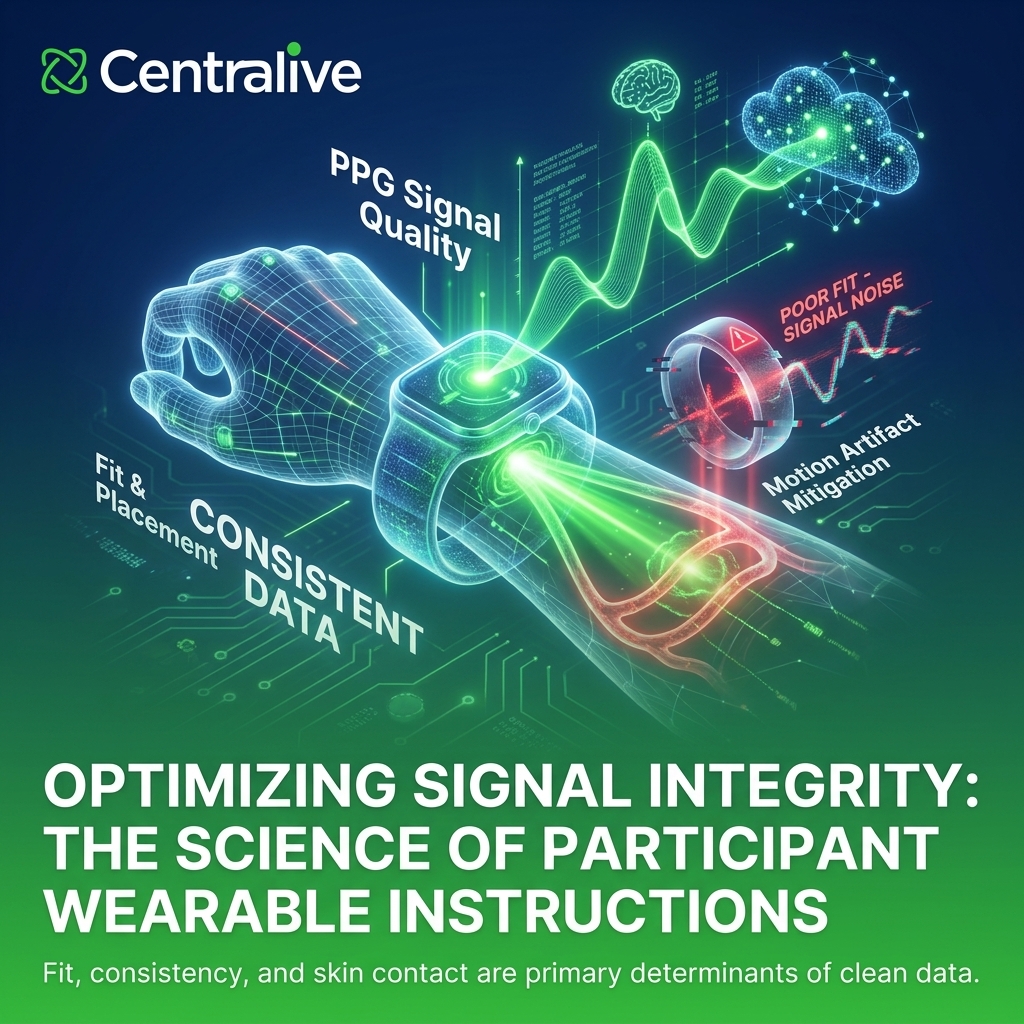
One of the most consequential decisions in a wearable sleep study is made before a single night of data is collected: the wording of the instructions you hand participants about how to wear the device to bed. Fit, wrist choice, charging habits, and skin care are not housekeeping details. They determine whether the photoplethysmography (PPG) signal is clean, whether non-wear can be detected, and whether the dataset survives your compliance thresholds. This post walks through what the peer-reviewed literature and manufacturer guidance actually support, then turns it into a staged, copy-ready instruction checklist for participants.
The research question
What should you tell participants about wearing a wrist wearable or ring to bed so that the resulting sleep data is complete, comparable across nights, and defensible under analysis? The answer breaks into three priorities: standardize placement and fit, sustain continuous wear without charging gaps, and protect skin and signal quality. Each priority maps to a specific failure mode in the recorded biosignal.
Why wear instructions matter for the signal
Wrist and ring wearables estimate sleep from two raw streams: accelerometry (movement) and PPG (optical heart rate and its derivatives). PPG depends on stable, direct contact between the optical sensor and well-perfused skin. A loose band introduces two distinct problems at once: motion artifact from the sensor shifting against the skin, and ambient-light leakage into the photodetector. An over-tight band compresses the capillary bed and starves the sensor of the perfusion it needs. Every downstream sleep metric inherits the quality of these two streams, which is why a badly worn device does not simply add noise; it can silently bias a hypnogram or a nightly score.
The corollary is that instructions only solve half the problem. The other half is being able to verify, per night, that the signal was clean and the device was actually worn. That verification requires access to the underlying waveform, a point we return to at the end.
What the evidence supports
Wrist choice is low-stakes, but standardize it
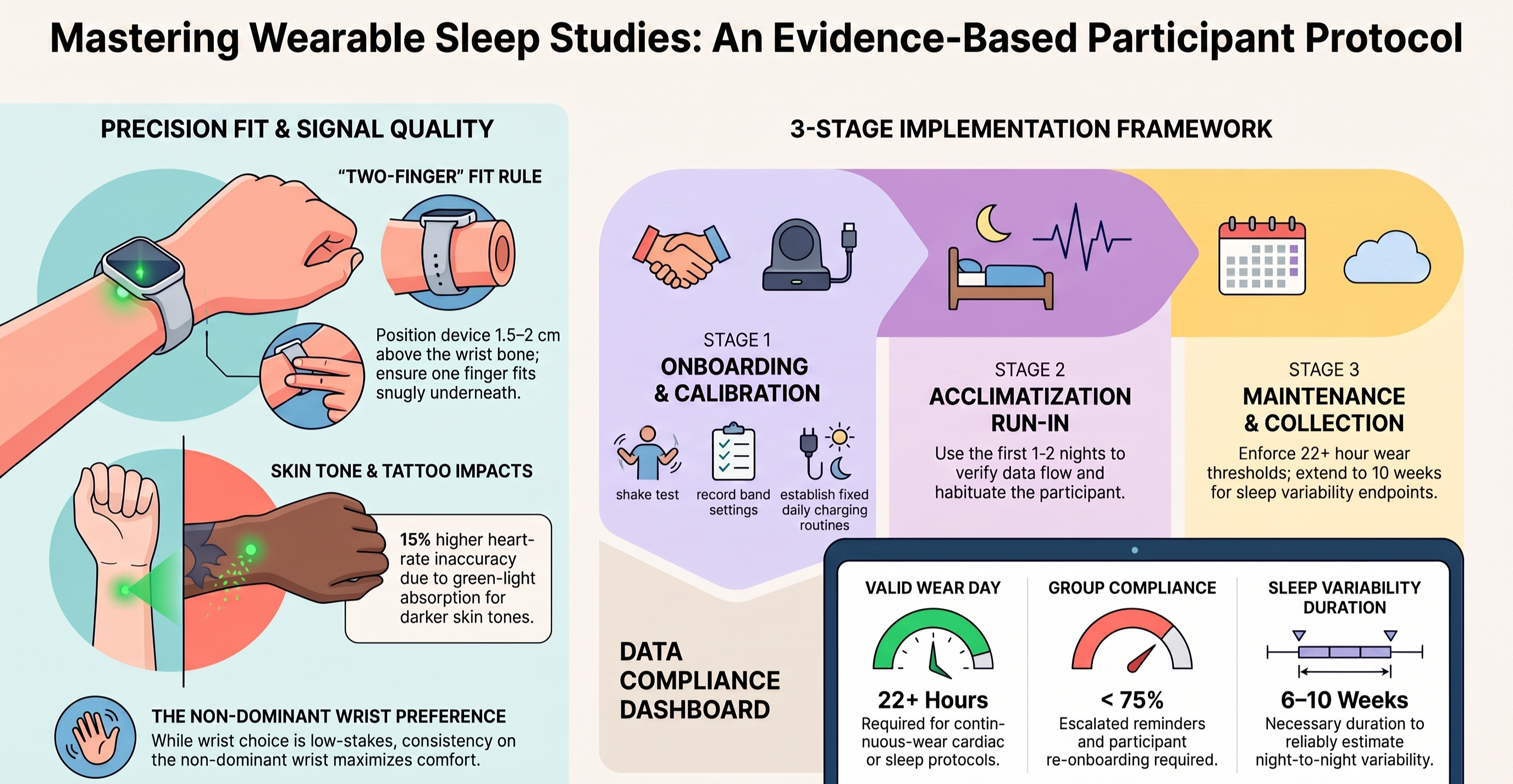
There is no clinical mandate for dominant versus non-dominant wrist, and the evidence suggests it makes little practical difference to summary sleep metrics. Driller and O’Donnell compared devices worn simultaneously on both wrists across 65 nights in 13 adults and found no significant differences for any measured sleep variable, with between-wrist correlations of 0.89 for sleep efficiency, 0.89 for sleep latency, and 0.76 for wake after sleep onset, and above 0.90 for the remaining variables.Convention still favors the non-dominant wrist because it is more comfortable and moves less during the day, which matters for continuous-wear protocols. The requirement that actually affects your data is consistency: each participant should use the same wrist every night, and you should record which wrist that is.
Fit drives PPG signal quality
Manufacturer guidance from Apple and Garmin converges on the same fit rules. The device sits above the wrist bone toward the elbow to maximize sensor-to-skin contact. Apple’s guidance is to wear the watch above the wrist bone so the sensors maintain contact, and to run a simple check: shake your wrist and turn your palm up, and if the back of the device loses skin contact, tighten the band.Garmin’s manuals specify wearing the device above the wrist bone, snug but comfortable, so it does not move during activity. Field practice adds two usable rules of thumb: position the device roughly one to two finger-widths (about 1.5 to 2 cm) above the wrist bone, and fit the band so you can slide one finger underneath with slight resistance. These are expert and manufacturer consensus rather than PSG-validated thresholds, so treat them as best practice, not calibrated values.
Skin tone, tattoos, and perfusion measurably affect PPG
Green-light PPG is absorbed by melanin, so optical measurement is not equally reliable across all participants. Bent and colleagues documented that inaccurate PPG heart-rate measurements occurred up to 15% more frequently in darker skin than in lighter skin, attributable to higher melanin content absorbing more green light.A subsequent systematic review of 10 studies covering 469 participants and 26 devices found a mixed picture: four studies showed no skin-tone effect, four showed reduced accuracy for darker skin, and two were mixed, indicating the field remains under-studied even though the direction of the optical effect is well established. Dark tattoos, dense hair, sweat, and cold-induced vasoconstriction degrade the signal by the same optical and perfusion mechanisms. No instruction eliminates these limitations, but three mitigations help: ensure snug, stable contact; if the signal is erratic over a tattoo, move the device higher on the forearm or switch wrists; and retain the raw PPG so signal quality can be flagged per night rather than trusted blindly. The FDA’s guidance on digital health technologies explicitly names skin color and sensor-placement variation as factors that a sleep measurement should be shown to be robust against.
The first-night effect is minimal for wrist wearables
The classic first-night effect seen in polysomnography, with elevated sleep latency and suppressed REM on night one, is largely a laboratory and electrode artifact. In a home setting with wrist wearables, Driller and O’Donnell examined 240 healthy adults across 1,200 nights and found no significant first-night differences on any sleep variable, all with trivial effect sizes, concluding that a familiarization period may not be necessary in healthy adults while noting the response is highly individual.In practice this means a formal run-in is optional for healthy cohorts, but one to two acclimatization nights remain a sensible, conservative choice for clinical, older, or anxious populations, and they double as an onboarding and compliance checkpoint.
Duration requirements are longer than most protocols assume
How long participants need to wear the device depends entirely on the target estimate. Averages of sleep duration, timing, and fragmentation stabilize within roughly three to seven nights. Estimating night-to-night variability is a different matter. An analysis of 3.7 million person-nights reported that reliable variability estimation required on the order of 6 to 10 weeks of data, with 7 nights yielding variability correlations of only about 0.50 to 0.58 and 14 nights only about 0.61 to 0.67 against a long reference of several hundred nights per participant. If your endpoint is variability, your wear instructions and retention plan need to reflect weeks, not days. (This study sits at the recent edge of the literature and is industry-affiliated, so confirm the exact figures against the primary source before you rely on them in a protocol.)
Compliance is achievable but must be measured
Well-run free-living studies routinely achieve strong adherence when wear is defined and monitored. A large continuous-wear cardiac cohort reported median long-term adherence of 88.2% over six months using a valid-day definition of at least 22 hours of wear. Charging behavior and discomfort are the main threats to that figure, and both are addressable through instructions and reminders. The just-in-time adaptive intervention framework formalizes delivering the right prompt at the right moment using tailoring variables and decision rules, which maps directly onto nudging a participant whose device shows a missed sync or a detected non-wear night.Automated wear-time detection from the accelerometer stream, using established algorithms, is what makes those triggers possible in the first place, and it depends on having the raw acceleration data rather than a processed summary.
Skin care prevents the most common dropout cause
Contact dermatitis from bands is well documented, and it is predominantly irritant rather than allergic, driven by trapped sweat, salt, soap residue, friction, and moisture. The mitigations are simple and belong in every consent and instruction sheet: keep the band clean and dry, rinse with water or wipe with a small amount of rubbing alcohol rather than soaps, dry the device fully before re-donning, and alternate wrists if irritation appears.
A note on the ring form factor
Rings sit where PPG is optically favorable: the finger has thinner tissue, a dense capillary bed, and a compact bony structure that stabilizes the sensor. The structural trade-off is that ring platforms are typically API-only, exposing processed sleep outputs rather than the raw accelerometer and PPG waveforms, which constrains independent non-wear detection and per-night quality auditing. Even a well-fitted ring inherits the wake-detection weakness common to all movement and PPG based trackers: the foundational ring validation reported epoch-by-epoch sensitivity to sleep of 95.5% but specificity to wake of only 48.1%. For ring studies, size participants with the official sizing kit, have them wear it on the same finger each night with the sensor toward the palm, and be explicit that this constraint is structural, not a judgment of any product.
A staged participant-instruction framework
Stage 1: Onboarding
- Fit the device on the non-dominant wrist, one to two finger-widths above the wrist bone, sensor flat against bare skin. Record the wrist used and the band setting.
- Run the shake test and the one-finger test together, and have the participant demonstrate both back to you.
- For rings, size with the official kit, same finger every night, sensor toward the palm.
- Teach a fixed daily charging window tied to an existing routine, such as showering or breakfast, and confirm the participant can state it back.
- Provide a one-page illustrated wear card and the skin-care instructions.
Stage 2: Run-in (days 1 to 2, up to 14)
- Optionally exclude one to two acclimatization nights, advisable for clinical, older, or anxious cohorts.
- Verify data are flowing and that non-wear detection is working.
- Intervene early on low compliance, since habituation gains are largest in the first two weeks.
Stage 3: Main collection
- Enforce a priori thresholds: a valid day at 22 or more hours of wear for continuous protocols, and a minimum of 4 valid nights for stable averages.
- If the endpoint is sleep variability, plan for 6 to 10 weeks of wear.
- Send reminder prompts triggered by missed syncs or detected non-wear nights.
- Report wear definitions and thresholds per CONSORT or STROBE and against the DiMe V3 and V3+ framework for digital measures.
Thresholds that change the plan
- If group wear compliance falls below about 75%, escalate reminders and re-onboard; below about 60%, reconsider the device or the participant burden.
- If a participant shows recurrent low PPG quality from darker skin, a tattoo, or a cold room, move the device higher on the forearm or switch wrists and flag those nights.
- If skin irritation appears, alternate wrists and change the band material; if it persists, pause wear and consult the study team.
Why raw-signal access underwrites all of it
Every failure mode above, whether undetected non-wear, ambient-light leakage, motion artifact, melanin or tattoo signal loss, or a charging gap, is only auditable if you can see the underlying biosignal. A processed-output-only API returns a hypnogram or a nightly score with no way to check whether a light-sleep epoch reflected a clean PPG trace or a loose-band artifact, and typically without the exposed accelerometer stream needed to run standard non-wear detection. Hardware SDKs, such as the Garmin Health Companion SDK and the Apple SDK, expose the raw accelerometer and PPG data, which enables per-night quality control, independent wear-time detection, custom epoch scoring against polysomnography using the standardized framework of Menghini and colleagues, and transparent handling of skin-tone and tattoo signal degradation. This is not a theoretical advantage. Walch and colleagues used raw acceleration and PPG heart rate from a consumer smartwatch to reach roughly 90% sleep-wake accuracy, an analysis that is simply impossible with a score-only interface.
Good wear instructions reduce the number of bad nights. Raw-signal access lets you prove which nights were good. A defensible sleep study needs both, and this is the structural reason a raw-signal pipeline produces more auditable endpoints than an API-only one. The ring form factor is a useful illustration of the API-only constraint, not a criticism of any product.
References
- Driller MW, O’Donnell S. The agreement between wrist-worn actigraphy devices worn on the dominant and non-dominant wrist. Sleep Science. 2017;10(3):132-135. doi:10.5935/1984-0063.20170023
- Apple Support. Wearing your Apple Watch. Available at: https://support.apple.com/en-us/118234
- Garmin. Wearing the device and heart rate (device owner’s manual). Available at: https://www8.garmin.com/manuals/
- Bent B, Goldstein BA, Kibbe WA, Dunn JP. Investigating sources of inaccuracy in wearable optical heart rate sensors. npj Digital Medicine. 2020;3:18. doi:10.1038/s41746-020-0226-6
- Koerber D, Khan S, Shamsheri T, Kirubarajan A, Mehta S. Accuracy of heart rate measurement with wrist-worn wearables across skin tones: a systematic review. Journal of Racial and Ethnic Health Disparities. 2023;10(6):2851-2860. doi:10.1007/s40615-022-01446-9 (verify citation details before publication)
- U.S. Food and Drug Administration. Digital Health Technologies for Remote Data Acquisition in Clinical Investigations (guidance). Available at: https://www.fda.gov/
- Driller MW, O’Donnell S, Tavares F. What is the current status of the first-night effect using wrist actigraphy in healthy adults? Journal of Sleep Research. 2021. doi:10.1111/jsr.13413 (verify volume and page numbers before publication)
- Leota J, Messman BA, Le F, Jasinski S, Capodilupo ER, Facer-Childs ER, Wiley JF. How many nights are needed to reliably estimate sleep variability? Sleep. 2026;49(6):zsag040. doi:10.1093/sleep/zsag040 (near-cutoff citation; confirm DOI, volume, and figures against the primary source before publication)
- SafeHeart study investigators. Long-term adherence to continuous wrist-worn wearable monitoring in a cardiac population. European Heart Journal – Digital Health. 2024. (verify full citation and DOI before publication)
- Nahum-Shani I, Smith SN, Spring BJ, et al. Just-in-time adaptive interventions (JITAIs) in mobile health: key components and design principles for ongoing health behavior support. Annals of Behavioral Medicine. 2018;52(6):446-462. doi:10.1007/s12160-016-9830-8
- Knaier R, Hoye A, Vollenweider P, et al. Validation of automatic wear-time detection algorithms in a free-living setting of wrist-worn and hip-worn ActiGraph GT3X+. BMC Public Health. 2019;19:244. doi:10.1186/s12889-019-6568-9 (verify author list before publication)
- Litchman G, Atkinson H, Rietschel RL. Contact dermatitis from wearable devices: mechanisms and management. Clinical Reviews in Allergy and Immunology. 2019;56(1):99-109. (verify full citation before publication)
- de Zambotti M, Rosas L, Colrain IM, Baker FC. The sleep of the ring: comparison of the OURA sleep tracker against polysomnography. Behavioral Sleep Medicine. 2019;17(2):124-136. doi:10.1080/15402002.2017.1300587
- Goldsack JC, Coravos A, Bakker JP, et al. Verification, analytical validation, and clinical validation (V3): the foundation of determining fit-for-purpose for biometric monitoring technologies. npj Digital Medicine. 2020;3:55. doi:10.1038/s41746-020-0260-4
- Menghini L, Cellini N, Goldstone A, Baker FC, de Zambotti M. A standardized framework for testing the performance of sleep-tracking technology: step-by-step guidelines and open-source code. Sleep. 2021;44(2):zsaa170. doi:10.1093/sleep/zsaa170
- Walch O, Huang Y, Forger D, Goldstein C. Sleep stage prediction with raw acceleration and photoplethysmography heart rate data derived from a consumer wearable device. Sleep. 2019;42(12):zsz180. doi:10.1093/sleep/zsz180
Sign up for the Centralive Newsletter: https://newsletter.centralive.health/signup