When you design a wearable sleep study, you will spend weeks on device selection, sampling strategy, and analysis pipelines. The one-page instruction sheet you hand participants at enrollment rarely gets the same scrutiny. It should. How a participant positions the band, when they charge it, and whether they wear it consistently across the protocol determine how much usable signal you actually collect, and the quality of the beat-to-beat intervals and accelerometry your algorithms depend on. This post lays out an evidence-based wear protocol for nocturnal data collection, grounded in the sleep-technology validation and signal-quality literature, and closes with a staged framework you can adapt to your own study.
Wear guidance is a measurement decision, not a courtesy
Optical wearables estimate heart rate, heart rate variability (HRV), and sleep from photoplethysmography (PPG) and accelerometry. Both modalities are sensitive to how the device sits on the body. PPG requires firm, continuous optical coupling to skin; loose fit, movement, and low peripheral perfusion all degrade the pulse signal and the beat-to-beat intervals (BBI) derived from it. Accelerometry-based sleep-wake scoring and non-wear detection assume the device is actually on the wrist. On top of these signal-quality issues sit two data-completeness problems that are almost entirely behavioral: participants charge devices during the sleep window, and participants stop wearing devices that are uncomfortable. Clear wear instructions are the cheapest available intervention against all four failure modes.
Device fit and placement
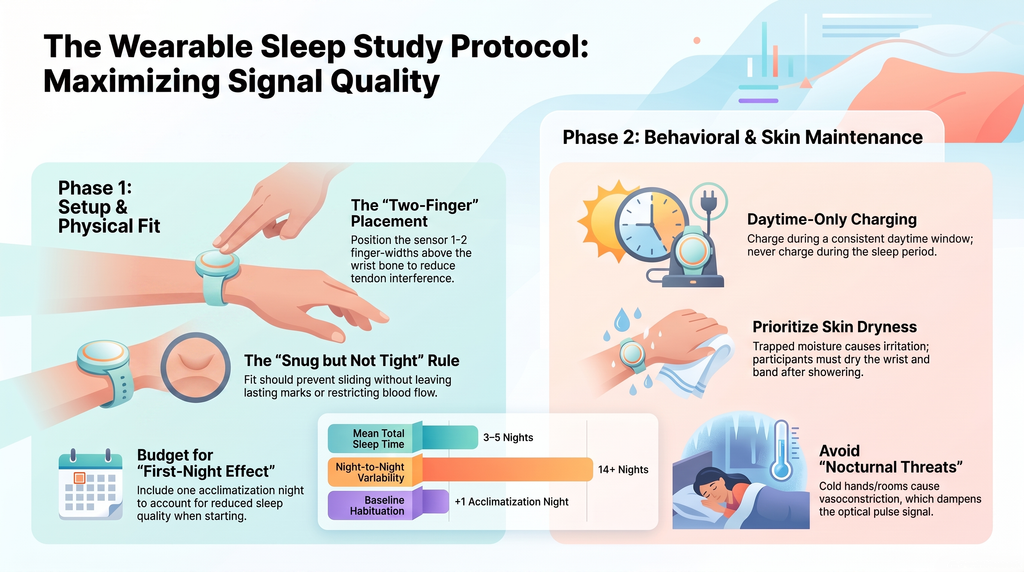
For wrist devices, position the optical sensor on the dorsal wrist, roughly one to two finger-widths proximal to the ulnar styloid (the wrist bone), snug enough that the device does not slide during normal movement but not tight enough to leave lasting marks. A small amount of movement is healthy for skin; excessive sliding is the signal to tighten. Positioning the sensor slightly up the forearm, away from the joint, reduces interference from tendons and improves contact, and consistent, firm sensor placement is a recognized determinant of signal quality.The physics is straightforward: the optical assembly must stay pressed against skin so that ambient light and optical crosstalk do not overwhelm the small pulsatile component of the signal.
Posture and sensor height dominate PPG quality, and this works in a sleep study’s favor. In an analysis of 1,142 subjects, signal-to-noise ratio was highest in the supine position (18.6 dB), lower when sitting with the arm resting (13.7 dB), and lowest standing with the arm hanging (9.0 dB), improving as the arm rose toward heart height.A person lying in bed with the wrist near heart level is close to the optimal condition for wrist PPG, which means fit is the main controllable variable at night.
Which wrist matters less than researchers often assume. Wearing an actigraph on both wrists across 65 nights produced no significant between-wrist differences for any sleep variable, with sleep efficiency, sleep latency, and wake after sleep onset correlating 0.89, 0.89, and 0.76 respectively, and all other variables above 0.90.4 Research convention still favors the non-dominant wrist to reduce daytime motion artifact, but the decision that actually matters is consistency: assign one wrist and keep it for the whole protocol.
Strap contact and nocturnal PPG quality
Beat-to-beat interval and HRV estimation are the most fragile nocturnal metrics because they require clean, artifact-free pulse morphology. PPG is highly susceptible to motion artifact, and intervals falling outside physiological range often indicate that the device has lifted off the wrist and must be discarded. Nighttime is favorable precisely because the participant is at rest, but that advantage is lost the moment the band slips or the wearer moves against a loose strap.
A specific nocturnal threat is low perfusion. Peripheral vasoconstriction and cold extremities reduce blood flow to the skin and dampen the pulsatile signal; controlled cooling significantly reduces PPG signal amplitude and quality.Practical guidance for participants: use a snug silicone or breathable fabric band that keeps the sensor flush against skin, avoid positioning the sensor directly over tattoos, scars, or dense hair, keep the sensor window clean and free of lotion, and avoid going to bed with cold hands in a cold room. Each of these preserves the fraction of the night that survives signal-quality filtering.
Charging strategy
Charging behavior is a dominant and almost entirely avoidable cause of missing nights. The instruction is simple: charge during a consistent daytime window and never during the sleep period. Registered trial protocols codify this by telling participants to charge during a period of daytime inactivity and explicitly not during sleep.Manufacturer guidance for ring devices aligns: use short daytime top-ups rather than a single long charge, keep a reasonable charge before bed, and recognize that if the battery fully depletes overnight the entire night’s data is lost.
Match the charging cadence to the form factor. Ring devices and many multi-day wrist wearables hold a charge for roughly a week and only need a short top-up every few days, which fits neatly into a morning routine such as showering. Some smartwatches require daily charging, which makes them the highest-risk form factor for missing overnight data and makes a fixed daytime charge window non-negotiable. A recurring behavioral failure is placing the device on the charger before bed and then forgetting to put it back on, so build an explicit “charge, then re-don before you leave the house” step into onboarding.
Acclimatization and the first-night effect
The first-night effect, reduced total sleep time and REM with longer latencies on the first night of recording, has been recognized since the 1960s.It can persist beyond a single night; in one home polysomnography study the adaptation of REM sleep extended up to the fourth night.The effect is attenuated but not absent with unobtrusive home wearables, and an unfamiliar device on the wrist or finger is itself a novel stimulus. The prudent design choice is to include at least one acclimatization night and either discard or flag it, rather than treating the first night of wear as habitual sleep.
Consistency and number of nights
Tell participants to wear the same device on the same wrist or finger for the entire protocol. Swapping wrists or devices introduces avoidable between-site variance into non-wear detection and sleep-wake scoring. Whether to instruct 24/7 wear or sleep-only wear depends on your analysis: continuous wear supports accelerometry-based non-wear detection, for example a sliding-window standard-deviation threshold across axes, and rest-activity rhythm metrics, at the cost of higher skin-contact burden. Sleep-only wear lowers burden but complicates automated non-wear and sleep-window detection.
Set the required number of nights against the metric you care about. Means stabilize far faster than variability: roughly three to five usable nights are needed for good to very good reliability of a weekly mean total sleep time, whereas night-to-night variability metrics can require two weeks or more of data to estimate reliably. Budget an acclimatization night on top of whatever your target reliability requires, and set an a priori rule for how many missing nights trigger exclusion or replacement.
Skin health, comfort, and adherence
Discomfort and skin reactions are leading, under-appreciated drivers of missing data. Contact dermatitis from wrist wearables is well documented, with both allergic (for example nickel) and irritant (trapped moisture, sweat, and friction) mechanisms; a widely reported tracker recall cited skin irritation across a small but non-trivial fraction of users. A band worn too tight traps moisture and restricts airflow, while one too loose causes friction. Give participants concrete skin-care instructions: fit snug but not tight, keep the wrist and band dry (dry both after showering), rotate the device slightly from time to time to avoid constant pressure on one spot, clean the band and skin regularly, and, for sensitive skin, use a hypoallergenic band. Any persistent rash warrants a temporary break and a message to the study team.
Adherence also decays over time and around disruptions. In a one-year actigraphy study, the proportion of missing data rose from a mean of 4.8% in the first week to 23.6% by the end of twelve months. Structured onboarding counteracts this: written instructions plus a hands-on fitting demonstration plus periodic reminder nudges outperform verbal instruction alone, and trust built during onboarding measurably motivates continued wear. Provide a troubleshooting contact, monitor battery and wear where feasible, and time reminders around known drop-off points such as weekends, holidays, and exam periods.
A staged wear protocol you can adapt
Design stage, before recruitment
- Assign one device and one wrist or finger per participant, defaulting to the non-dominant wrist unless comfort dictates otherwise, and document the choice.
- Decide continuous versus sleep-only wear based on whether you need accelerometry non-wear detection and rest-activity rhythms.
- Budget at least one acclimatization night plus enough usable nights for your target metric, and set an a priori missing-data rule.
Onboarding stage
- Demonstrate the fit in person or by guided video: sensor one to two finger-widths proximal to the ulnar styloid, snug so it does not slide, not tight enough to mark. Pair this with a one-page illustrated guide.
- Assign a fixed daytime charging window and confirm the participant can charge and re-don the device without missing a night.
- Teach skin care: keep the wrist and band dry, rotate slightly, clean regularly, and report any rash.
Collection stage, during the study
- Send reminder nudges, especially after the first week and around weekends, holidays, and exams.
- Monitor battery and wear daily where feasible, and inspect early data to catch fit or charging failures before they compound.
- Provide a troubleshooting contact, and when a night looks anomalous, check whether it reflects poor sleep or a wear problem.
Why raw signal access makes wear instructions enforceable
Even a well-designed instruction sheet cannot rescue data you cannot inspect. Wear quality is only auditable if you can see the underlying signal. A processed-output-only API returns a nightly summary or hypnogram with no access to the raw photoplethysmography, beat-to-beat intervals, or accelerometry that would let you confirm the band was worn, coupled to skin, and artifact-free. When a night looks anomalous, you cannot tell whether the participant slept poorly or the device slipped, and you cannot apply your own signal-quality thresholds.
Centralive is built on raw signal access. Through the Garmin Health Companion SDK, studies collect raw beat-to-beat intervals and tri-axial accelerometry directly, with no subscription and at an accessible hardware price point, which makes Garmin a practical first-class platform for real-world sleep research. The Apple SDK provides comparable raw-signal access on iOS. Raw accelerometry lets you run your own non-wear detection rather than trusting an opaque wear flag; raw beat-to-beat intervals let you apply your own signal-quality assessment and artifact rejection before computing HRV, so that the wear-quality problems described above become measurable rather than invisible. An API that exposes only processed outputs, as some ring platforms do, is a structural constraint on this kind of verification, independent of how capable the underlying device is. The wear instructions in this post protect your data at the point of collection; raw signal access is what lets you confirm, night by night, that they worked.
References
- Charlton PH, et al. Determinants of photoplethysmography signal quality at the wrist. PLOS Digital Health. 2025. DOI 10.1371/journal.pdig.0000585. journals.plos.org/digitalhealth
- Optimization and pre-use suitability selection for wrist photoplethysmography-based heart rate monitoring in patients with cardiac disease. European Heart Journal – Digital Health. 2025;6(5):1024. academic.oup.com/ehjdh
- Analog Devices. Guidelines for the opto-mechanical integration of heart-rate monitors in wearable wrist devices. Technical article. analog.com
- Driller MW, O’Donnell S, Tavares F. What wrist should you wear your actigraphy device on? Analysis of dominant vs non-dominant wrist. Sleep Science. 2017;10(3):132-135. DOI 10.5935/1984-0063.20170023.
- A comprehensive accuracy assessment of Samsung smartwatch heart rate and heart rate variability. PLOS One. 2022. PMCID PMC9731465. ncbi.nlm.nih.gov/pmc/articles/PMC9731465
- Analysing the effects of cold, normal, and warm digits on transmittance pulse oximetry. Biomedical Signal Processing and Control. DOI 10.1016/j.bspc.2015.09.006. sciencedirect.com
- ClinicalTrials.gov protocol NCT04078178. Charging guidance for wearable data collection (charge during daytime inactivity, not during sleep). clinicaltrials.gov/study/NCT04078178
- Oura Support. Troubleshooting gaps in sleep data; ring battery tips. support.ouraring.com
- Agnew HW, Webb WB, Williams RL. The first night effect: an EEG study of sleep. Psychophysiology. 1966;2(3):263-266. DOI 10.1111/j.1469-8986.1966.tb02650.x.
- Le Bon O, et al. The first-night effect may last more than one night. Journal of Psychiatric Research. 2001;35(3):165-172. PMID 11461712.
- van Hees VT, et al. GGIR accelerometer processing, including non-wear detection. R package documentation and associated methods. cran.r-project.org/package=GGIR
- Chua XY, et al. Minimum number of nights for reliable estimation of habitual sleep using a consumer sleep tracker. PMCID PMC10104388. ncbi.nlm.nih.gov/pmc/articles/PMC10104388
- United States Consumer Product Safety Commission. Recall notice: activity tracker skin irritation (allergic contact dermatitis), 2014. cpsc.gov/Recalls
- Slyepchenko A, et al. A standardized workflow for long-term longitudinal actigraphy data processing. Scientific Reports. 2023. PMID 37714910.
- Menghini L, Cellini N, Goldstone A, Baker FC, de Zambotti M. A standardized framework for testing the performance of sleep-tracking technology. Sleep. 2021;44(2):zsaa170. DOI 10.1093/sleep/zsaa170.
- Chinoy ED, et al. Performance of four commercial wearable sleep-tracking devices tested under unrestricted conditions at home. Nature and Science of Sleep. 2022;14:493-516. DOI 10.2147/NSS.S348795.
- Depner CM, et al. Wearable technologies for developing sleep and circadian biomarkers: a summary of workshop discussions. Sleep. 2020;43(2):zsz254. DOI 10.1093/sleep/zsz254.
Sign up for the Centralive Newsletter: https://newsletter.centralive.health/signup