
Centralive Blog
Want to know more about the Centralive features? Read our blog posts here.
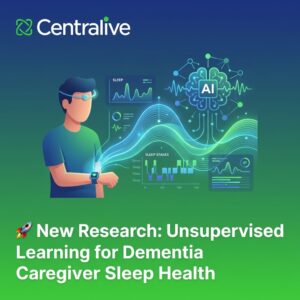
Unsupervised Learning Identifies Sleep Disturbance Subtypes Among Dementia Caregivers
AI-driven clustering of wearable data reveals 3 distinct sleep subtypes in dementia caregivers, enabling tailored health interventions. Read the full study.
Read More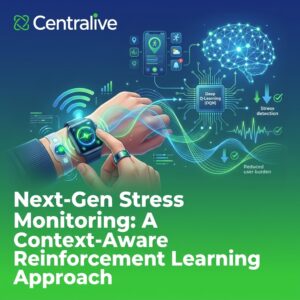
Enhancing Performance and User Engagement in Everyday Stress Monitoring: A Context-Aware Active Reinforcement Learning Approach
New research uses Deep Q-Learning to slash user burden in stress monitoring by 88% while boosting detection accuracy via context-aware EMA triggers. 🚀
Read More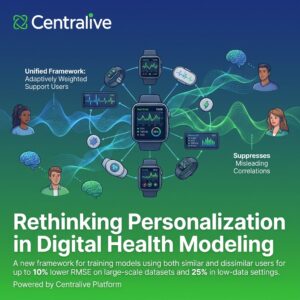
Personalized Digital Health Modeling with Adaptive Support Users
Discover how using ‘dissimilar’ user data boosts personalized digital health models, reducing prediction errors by up to 25% in low-data settings. Read more!
Read More
Biosignal Processing at Centralive: Turning Raw Sensor Data into Trustworthy Physiology
Transform noisy wearable recordings into validated physiology. Centralive offers research-grade biosignal processing for HRV, sleep staging, and multi-sensor data.
Read More
Wearable As Graph: A Smarter Way to Make LLMs Reason Over Months of Personal Sensor Data
Unlock the power of wearable data with WAG, a new graph-based RAG framework that boosts LLM reasoning by dynamically retrieving personalized health contexts.
Read More
Multitask Learning Approach for PPG Applications: Enhancing Smartwatch Vital Sign Monitoring
New research shows multitask learning (MTL) boosts smartwatch PPG accuracy for heart & respiration rate tracking while reducing compute time. Read more!
Read More
Can Wearable IoT Technology Improve Sleep for Dementia Caregivers?
Wearable IoT effectively monitors sleep in diverse dementia caregivers. Interventions improved REM sleep and onset latency, particularly in adult children.
Read More
Detection of Depressive Symptoms Using Multimodal Passive Sensing
Can wearables predict depression? New study uses Oura & Samsung data to detect symptoms with 74% accuracy. Passive sensing is the future of mental health.
Read More
Beyond Tracking: Simulating Your Health Future with Causal AI
New research utilizes causal AI to simulate personalized ‘what-if’ health scenarios, proving that identical lifestyle changes yield vastly different physiological results.
Read More
Just in Time Interventions for Loneliness, Lessons From a Mobile Health Pilot Study
Just in time interventions promise support at the moment it matters most, but real world timing can make or break their impact. This mobile health pilot reveals what happens when theory meets daily life, and what it takes to deliver mental health support that truly fits.
Read More