You submitted a wearable study and the reviews came back. The objection is not about your hypothesis or your effect size. It is about your Methods section. A reviewer wants to know which firmware version ran on the watch, how you defined non-wear, which epoch produced your activity estimates, and whether anyone could reproduce your sleep stages from the raw signal. These are not nuisance comments. They are the questions the field has agreed to ask, and most manuscripts cannot answer them.
The encouraging part is that reviewer pushback on wearable methodology is predictable. Reviewers rarely reject a paper because the device was consumer-grade. They reject it when the Methods do not let them trace the path from sensor to outcome. This post lays out that path, the reporting frameworks reviewers measure you against, the specific elements to report with the numbers that justify them, and a staged checklist you can run before you submit.
The underlying problem: a broken data supply chain
Every wearable outcome is the end of a supply chain. A raw signal is sampled at some frequency, filtered and summarized by an algorithm, bucketed into epochs, screened for non-wear, aggregated into valid days or nights, and finally compared against a reference. A weak link anywhere in that chain changes the result, and a link you do not report is a link the reviewer cannot check. When the chain is invisible, the reviewer has no choice but to assume the worst.
Underreporting is the norm, which is exactly why reviewers have learned to look for it. In a systematic review of 195 physical-activity intervention manuscripts, only 7 (4 percent) reported every recommended component of accelerometer use, and only 68 percent reported more than half. Reporting completeness barely improved over time (correlation with publication year r = 0.24).5 A guideline-focused review of heart-rate wearables names device type, firmware version, and sampling rate as the elements most often missing, and warns that two studies of the same device running different firmware can reach different conclusions.6
The frameworks reviewers measure you against
Organize your Methods around the evaluation vocabulary the field already uses, then add the checklist that matches your study design. Doing this signals to a reviewer that you know the standards before they have to raise them.
V3 and V3 plus: the evidence chain
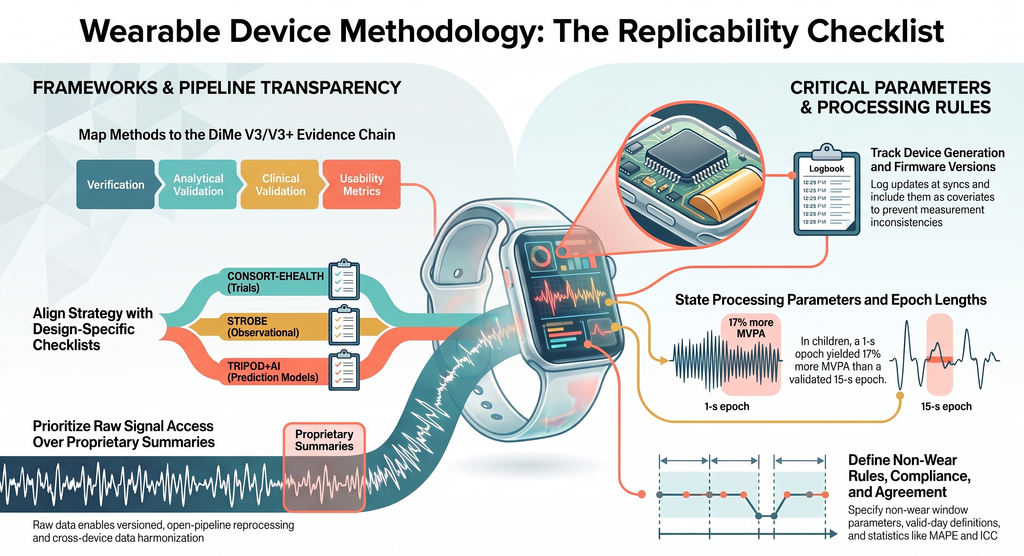
The Digital Medicine Society V3 framework splits evaluation of a biometric monitoring technology into three stages: verification (sensor output against a technical specification, often on the bench), analytical validation (algorithm output against a reference measure in humans), and clinical validation (the measure reflects a clinical or functional state in a defined context of use). Two details from the original paper are worth borrowing. V3 defines an algorithm broadly, to include processing embedded in firmware and software, which is why firmware is a methodological variable and not a footnote. And it places the term gold standard in quotation marks, describing it as nothing more than the best available measurement by consensus, which gives you honest language for justifying an imperfect comparator.
The V3 plus update keeps those three components unchanged and adds usability validation as a fourth: a use specification, a use-related risk analysis, formative evaluation, and summative evaluation against pre-specified success criteria. For a study that uses a marketed device, the practical usability evidence is your wear instructions, charging burden, user errors, and adherence. Report them as data, not as logistics.
The design-specific checklist
- Trials of a digital or wearable-delivered intervention: CONSORT-EHEALTH asks for intervention versioning, changes made during the trial, usage and adherence metrics, and an attrition diagram.
- Observational studies: STROBE, supplemented by a wearable-specific reporting checklist, because no dedicated STROBE extension for wearables exists yet.
- Prediction models built on wearable data: TRIPOD plus AI, which replaces the 2015 TRIPOD statement, applies whether you used regression or machine learning, and expects predictor definitions that name the device and pipeline, a missing-data plan, calibration as well as discrimination, and code availability.
Domain checklists make these concrete. For accelerometry, use the Montoye reporting recommendations. For heart rate, use the Nelson guidelines for design, cleaning, analysis, and reporting. For sleep, use the Menghini standardized testing framework, which ships open-source code, alongside the Sleep Research Society consensus recommendations.
Regulatory language reviewers now echo: fit-for-purpose
The 2023 FDA guidance on digital health technologies for remote data acquisition in clinical investigations defines fit-for-purpose as a level of validation sufficient to support the use and interpretability of the data in the investigation.7 Its verification and validation definitions line up with V3, and its guidance on updates is directly useful even outside regulated trials. The guidance advises sponsors to keep a record of the timing and nature of any updates for each device, to compare data before and after an update when measurements may have changed, and it cautions that significant post-update changes may invalidate results.7 It also asks for confirmation that measurements are consistent when a protocol permits more than one brand or model, for evaluation of placement such as wrist versus hip, and for a concrete missing-data plan. The document is non-binding and written for medical-product trials, but academic reviewers increasingly adopt its vocabulary, so meeting it preempts a line of criticism.
The elements to report, and the numbers that justify them
Device identification
Report manufacturer, model, and hardware generation; firmware or operating-system version, plus the companion app version for phone-paired devices; sensor types and sampling frequency in hertz for accelerometry and photoplethysmography; wear location and side; and the data-access route (SDK, cloud API, or export file). Firmware earns a column of its own because V3 treats firmware-embedded processing as part of the algorithm, so a silent update can move your measurement.1 Consumer release notes rarely tell you whether a change was neutral, so record version numbers at each sync and either model firmware as a covariate or run a pre-update and post-update sensitivity analysis.
Signal provenance: raw versus derived
For every outcome, state whether it came from raw sensor samples (triaxial acceleration in milligravity at a stated hertz, or beat-to-beat intervals in milliseconds) or from a device-derived or cloud-derived summary (vendor sleep stages, windowed heart-rate variability, step counts). For a derived output, name the vendor algorithm and its version or date and say plainly that it is proprietary. This single distinction resolves a large share of reviewer confusion, because a proprietary summary cannot be reprocessed and a raw signal can.
Non-wear detection
Name the algorithm and every parameter. The Troiano count-based rule flags at least 60 consecutive minutes of zero counts, allowing up to 2 minutes of low non-zero counts.The Choi rule extends the window to 90 minutes with a 30-minute upstream and downstream stream frame and a 2-minute spike tolerance.Raw-data methods such as those in GGIR detect non-wear from the standard deviation and range of the raw signal over moving windows, and the exact defaults have changed across releases, so cite the version you ran. The choice is not cosmetic. On a triaxial device, a 90-minute window classified wear and non-wear better than a 60-minute window, and the Choi rule outperformed both Troiano and the manufacturer algorithm. Justify your rule for your population and your wear protocol.
Epoch length
Report the epoch at collection and at analysis, and confirm your cut-points match that epoch. Epoch choice alone can swing your headline number. In 268 children with overweight or obesity, moderate-to-vigorous activity was 17 percent higher at a 1-second epoch and 21 percent lower at a 60-second epoch than at the validated 15-second epoch, using the same cut-points and non-wear algorithm.11 A reviewer who knows this figure will not accept an unreported epoch.
Agreement statistics and benchmarks
Report more than one statistic, because no single number is sufficient. Give Bland-Altman mean bias and 95 percent limits of agreement, and test for proportional bias and heteroscedasticity rather than assuming they are absent.12 For heart rate, the ANSI CTA-2065 standard treats a mean absolute percentage error at or below 10 percent against electrocardiography as acceptable for consumer monitors, and that standard also sets recruitment quotas for body-mass index, skin type, and sex in validation samples.18 Pair the percentage error with an intraclass correlation coefficient and state the model you used (for example, two-way, absolute agreement). For sleep, report epoch-by-epoch accuracy, sensitivity for sleep, specificity for wake, and Cohen kappa against polysomnography, plus summary bias for total sleep time, sleep onset latency, wake after sleep onset, and sleep efficiency.12 Specificity for wake is the usual weak point of consumer devices, so reporting it builds credibility rather than undermining it.
Reference standard, compliance, and missing data
Justify the comparator in the language of best available measurement by consensus: polysomnography for sleep, electrocardiography for heart rate and heart-rate variability (wrist optical sensors measure pulse rate, not electrical heart rate), and indirect calorimetry or a research-grade accelerometer for activity. Define a valid day (at least 10 hours of wear is common for waking-wear protocols) and a minimum number of valid days or nights, and show the share of participants who met the rule in a flow diagram.5 For missing data, distinguish missing by design, non-wear, device or transmission failure, and account or subscription lapse, then report the imputation method and a sensitivity analysis. The FDA guidance explicitly asks sponsors to describe scenarios for missing part of a day, a whole day, or a week.
Demographic and device generalizability
Report skin tone (Fitzpatrick type, and an objective measure where possible), body-mass index, age, sex, and wrist dominance and circumference. Green-light optical sensing has good motion robustness but limited tissue penetration, which is the mechanism behind concerns about darker skin tones.6 The evidence here is genuinely mixed, and saying so is the strong move. One large analysis found no statistically significant difference in optical heart-rate accuracy across Fitzpatrick types, with activity type mattering more than skin tone; errors were higher during movement than at rest. A published response argued that the Fitzpatrick scale, built to predict sunburn, is too coarse to detect such effects at all.The defensible position is to report skin tone, stratify where power allows, and avoid claiming equivalence you did not test.
Pipeline transparency
Name every software package and version and list the non-default parameters, then deposit the configuration. GGIR, for instance, performs automatic calibration, non-wear and clipping detection, and Euclidean-norm-minus-one computation, and accepts custom input from other sensors, which makes a published configuration file a complete processing record.A data-availability statement that is honest about vendor terms costs nothing and closes off a reproducibility objection.
Why raw-signal access is a methodological argument, not a preference
Several of the problems above share a single root cause: who controls the algorithm. If you hold the raw signal, you control the processing. You can fix it, version it, apply it identically across devices and firmware generations, and reprocess it when methods improve. If you only receive processed output through an API, the algorithm is a moving target owned by the vendor, and neither the V3 analytical-validation step nor the FDA before-and-after-update comparison can be repeated independently.
The evidence for this is strong but indirect, and it is more honest to say so than to overclaim. The migration from proprietary counts to raw accelerations is credited with increasing measurement accuracy, transparency, and the potential for data harmonization.14 When wrist data from different research-grade brands are processed identically in a single open pipeline, the derived outcomes for wear time, activity, and sleep are similar and the ranking of individuals is highly consistent, although small systematic differences in mean acceleration remain.That last clause matters: identical processing narrows between-device differences, it does not erase them, because hardware, placement, and sampling rate still contribute. No definitive head-to-head trial has shown that a raw-plus-open-pipeline approach yields better clinical validity than a tuned vendor algorithm for a given endpoint, and consumer algorithms can themselves be very accurate.The defensible claim is about reproducibility and comparability, not about superior accuracy.
This is where the data-access architecture of your device becomes a line in your Methods. A platform that exposes raw accelerometry and beat-to-beat intervals through a hardware SDK, as Garmin does through its Health Companion SDK, lets you route every participant through one versioned pipeline and report that pipeline in full. A platform that provides only processed summaries through a cloud API, as Oura does, is a methodological constraint: you can still run an excellent study, but you must describe the vendor algorithm as a fixed, versioned black box, state that reprocessing was not possible, and limit your cross-study comparison claims accordingly. Framing the constraint honestly in the manuscript is itself a mark of methodological care, and it is far better than letting a reviewer discover the limitation for you. Centralive is built around this distinction, giving research teams raw-signal access where the hardware allows it so the processing chain stays in the researcher’s hands.
Adherence to these standards is still low across the literature, which is both the problem and the opportunity. A living meta-analysis of smartwatch accuracy found that adherence to validation guidelines was low and that statistical procedures were sometimes inadequately described. A review of recent sleep-technology publications concluded that the evidence base has not kept pace with the devices and urged careful review of the software used within studies. A manuscript that reports the full chain will stand out to a reviewer precisely because so few do.
A pre-submission checklist
| Domain | Minimum to report | Anchor |
|---|---|---|
| Framework | V3 and V3 plus stage evidence, plus CONSORT-EHEALTH, STROBE, or TRIPOD plus AI | 1, 2, 3, 4 |
| Device | Make, model, generation, firmware and app version per participant, wear site and side | 6, 7 |
| Signal | Raw versus derived, hertz, access route, vendor algorithm and version | 1 |
| Processing | Software and version, non-default parameters, epoch, cut-points matched to epoch | 5, 14 |
| Non-wear | Algorithm name plus window, tolerance, and threshold values | 8, 9, 10 |
| Compliance | Valid hours per day, valid days or nights, exclusions in a flow diagram | 5 |
| Missing data | Mechanisms, imputation, sensitivity analyses, update-related sensitivity analysis | 7 |
| Validation | Reference standard and its justification, bias and limits of agreement, percentage error, intraclass correlation model, epoch-by-epoch sensitivity, specificity, kappa | 12, 18 |
| Population | Fitzpatrick type, body-mass index, age, sex, wrist dominance and circumference | 6, 16, 17 |
| Openness | Code repository, data-availability statement reflecting vendor terms | 4 |
Four moves preempt most reviewer objections. Lock firmware where you can, or log it at every sync and treat it as a variable. Pre-specify your agreement thresholds before you look at the validation data. If you must use a processed-output-only device, name the algorithm version, say reprocessing was impossible, and scope your comparisons to match. And if you hold raw data, publish the full pipeline configuration as supplementary material. The common thread is simple: make the whole chain from sensor to outcome visible, and the reviewer has nothing left to assume.
References
- Goldsack JC, Coravos A, Bakker JP, et al. Verification, analytical validation, and clinical validation (V3): the foundation of determining fit-for-purpose for Biometric Monitoring Technologies (BioMeTs). npj Digital Medicine. 2020;3:55. doi:10.1038/s41746-020-0260-4
- Bakker JP, Barge R, Centra J, et al. V3 plus extends the V3 framework to ensure user-centricity and scalability of sensor-based digital health technologies. npj Digital Medicine. 2025. doi:10.1038/s41746-024-01322-2 (PMID 39856145)
- Eysenbach G; CONSORT-EHEALTH Group. CONSORT-EHEALTH: improving and standardizing evaluation reports of web-based and mobile health interventions. Journal of Medical Internet Research. 2011;13(4):e126. doi:10.2196/jmir.1923
- Collins GS, Moons KGM, Dhiman P, et al. TRIPOD plus AI statement: updated guidance for reporting clinical prediction models that use regression or machine learning methods. BMJ. 2024;385:e078378. doi:10.1136/bmj-2023-078378
- Montoye AHK, Moore RW, Bowles HR, Korycinski R, Pfeiffer KA. Reporting accelerometer methods in physical activity intervention studies: a systematic review and recommendations for authors. British Journal of Sports Medicine. 2018;52(23):1507-1516. (PMID 27539504)
- Nelson BW, Low CA, Jacobson N, Arean P, Torous J, Allen NB. Guidelines for wrist-worn consumer wearable assessment of heart rate in biobehavioral research. npj Digital Medicine. 2020;3:90. doi:10.1038/s41746-020-0297-4
- US Food and Drug Administration. Digital Health Technologies for Remote Data Acquisition in Clinical Investigations: Guidance for Industry, Investigators, and Other Stakeholders. December 2023. fda.gov
- Troiano RP, Berrigan D, Dodd KW, Masse LC, Tilert T, McDowell M. Physical activity in the United States measured by accelerometer. Medicine and Science in Sports and Exercise. 2008;40(1):181-188.
- Choi L, Liu Z, Matthews CE, Buchowski MS. Validation of accelerometer wear and nonwear time classification algorithm. Medicine and Science in Sports and Exercise. 2011;43(2):357-364.
- Choi L, Ward SC, Schnelle JF, Buchowski MS. Assessment of wear/nonwear time classification algorithms for triaxial accelerometer. Medicine and Science in Sports and Exercise. 2012;44(10):2009-2016. (PMID 22525772)
- Banda JA, Haydel KF, Davila T, et al. Effects of varying epoch lengths, wear time algorithms, and activity cut-points on estimates of child sedentary behavior and physical activity from accelerometer data. PLoS One. 2016;11(3):e0150534. doi:10.1371/journal.pone.0150534
- Menghini L, Cellini N, Goldstone A, Baker FC, de Zambotti M. A standardized framework for testing the performance of sleep-tracking technology: step-by-step guidelines and open-source code. Sleep. 2021;44(2):zsaa170. doi:10.1093/sleep/zsaa170
- de Zambotti M, Goldstein C, Cook J, et al. State of the science and recommendations for using wearable technology in sleep and circadian research. Sleep. 2024;47(4):zsad325. doi:10.1093/sleep/zsad325
- Migueles JH, Rowlands AV, Huber F, Sabia S, van Hees VT. GGIR: a research community-driven open source R package for generating physical activity and sleep outcomes from multi-day raw accelerometer data. Journal for the Measurement of Physical Behaviour. 2019;2(3):188-196. doi:10.1123/jmpb.2018-0063
- Rowlands AV, Yates T, Olds TS, Davies M, Khunti K, Edwardson CL. Raw accelerometer data analysis with GGIR R-package: does accelerometer brand matter? Medicine and Science in Sports and Exercise. 2016;48(10):1935-1941. doi:10.1249/MSS.0000000000000978
- Bent B, Goldstein BA, Kibbe WA, Dunn JP. Investigating sources of inaccuracy in wearable optical heart rate sensors. npj Digital Medicine. 2020;3:18. doi:10.1038/s41746-020-0226-6
- Colvonen PJ. Response to: investigating sources of inaccuracy in wearable optical heart rate sensors. npj Digital Medicine. 2021;4:38. doi:10.1038/s41746-021-00408-5
- Consumer Technology Association. ANSI/CTA-2065: Physical Activity Monitoring for Heart Rate. 2018.
- Lambe R, Baldwin M, O’Grady B, Schumann M, Caulfield B, Doherty C. A living systematic review and meta-analysis of consumer smartwatch accuracy. npj Digital Medicine. 2026;9:63. doi:10.1038/s41746-025-02238-1
- Holfinger S, Schutte-Rodin S, Ratnasoma D, et al. Clinical and research review of consumer sleep technology publications. Journal of Clinical Sleep Medicine. 2025;21(5):891-905. doi:10.5664/jcsm.11562
Sign up for the Centralive Newsletter: https://newsletter.centralive.health/signup