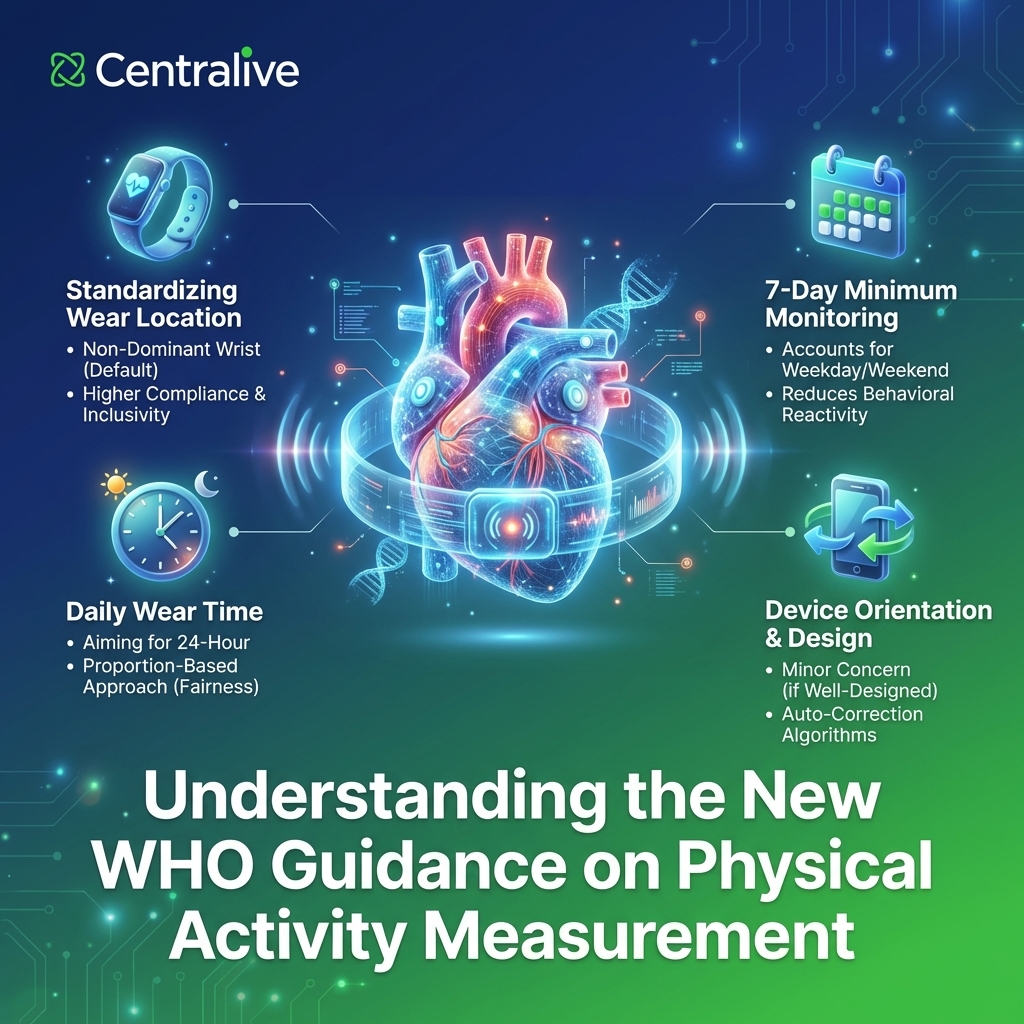
Understanding the New WHO Guidance on Physical Activity Measurement
Wearable devices have become ubiquitous in both consumer health and clinical research. However, the transition from smartwatches to research-grade data collection has been hampered by inconsistencies in how these devices are worn and used. A recent scientific meeting convened by the World Health Organization (WHO) has addressed these discrepancies, providing a much-needed framework for standardizing physical activity measurement. Here is a deep dive into the recommendations from Annex 3 regarding wear protocols.
Why Standardization is Essential
The core challenge in wearable data is variability. Even with identical hardware, differences in wear location, duration, and consistency can lead to vastly different datasets. Without standardized protocols, comparing physical activity levels across different populations or countries becomes nearly impossible. Reliable surveillance requires clear, consistent rules.
1. Standardizing Wear Location to the Wrist
The WHO now recommends the wrist—specifically the non-dominant hand—as the minimum standard for wear location. Different body parts move in distinct ways; while hip and wrist data are often correlated, they are not directly comparable. The wrist was selected for several practical reasons:
- High Compliance: Participants are more likely to wear a wrist-bound device consistently over long periods.
- Inclusivity: It is a practical solution for diverse groups, including the elderly and individuals with certain physical disabilities.
Practical Takeaway: For any future surveillance systems, non-dominant wrist placement should be the default instruction, and the actual wear location must be recorded to account for participant variation.
2. The Seven-Day Minimum for Data Monitoring
To capture a stable and representative picture of an individual’s activity, the WHO recommends a minimum of 7 consecutive days of wear. Physical activity varies significantly between weekdays and weekends. Furthermore, the presence of a wearable can temporarily induce a behavioral shift (reactivity), where participants are more active simply because they are being observed. A full week accounts for these fluctuations and aligns with established global monitoring practices.
3. The Evolution of Daily Wear Time
While a single global standard for daily wear time has not yet been finalized, the guidance suggests aiming for 24-hour monitoring. Defining a “valid day” is complex because waking hours vary (typically between 10 to 20 hours). To address this, the expert panel discussed a proportion-based approach. This reduces bias and improves fairness across individuals with different sleep-wake cycles.
4. Device Orientation and Design
Interestingly, device orientation on the wrist was found to be a minor concern compared to location and duration, provided the device is well-designed. The goal is to use devices that have an intuitive “correct” orientation and data processing algorithms capable of detecting and correcting minor orientation errors automatically.
Conclusion: Better Data for Better Policy
These protocols move the field of public health toward stronger global surveillance and more reliable research outcomes. By standardizing the ‘how’ and ‘when’ of wearable use, we ensure that data becomes a powerful tool for informed global health decisions. Consistency is the bridge between raw data and actionable insights.
For more updates on health technology and research standards, visit the Centralive Newsletter: https://newsletter.centralive.health/signup