DARPA VITAL: Advancing Cardiovascular Care through High-Fidelity Digital Twins
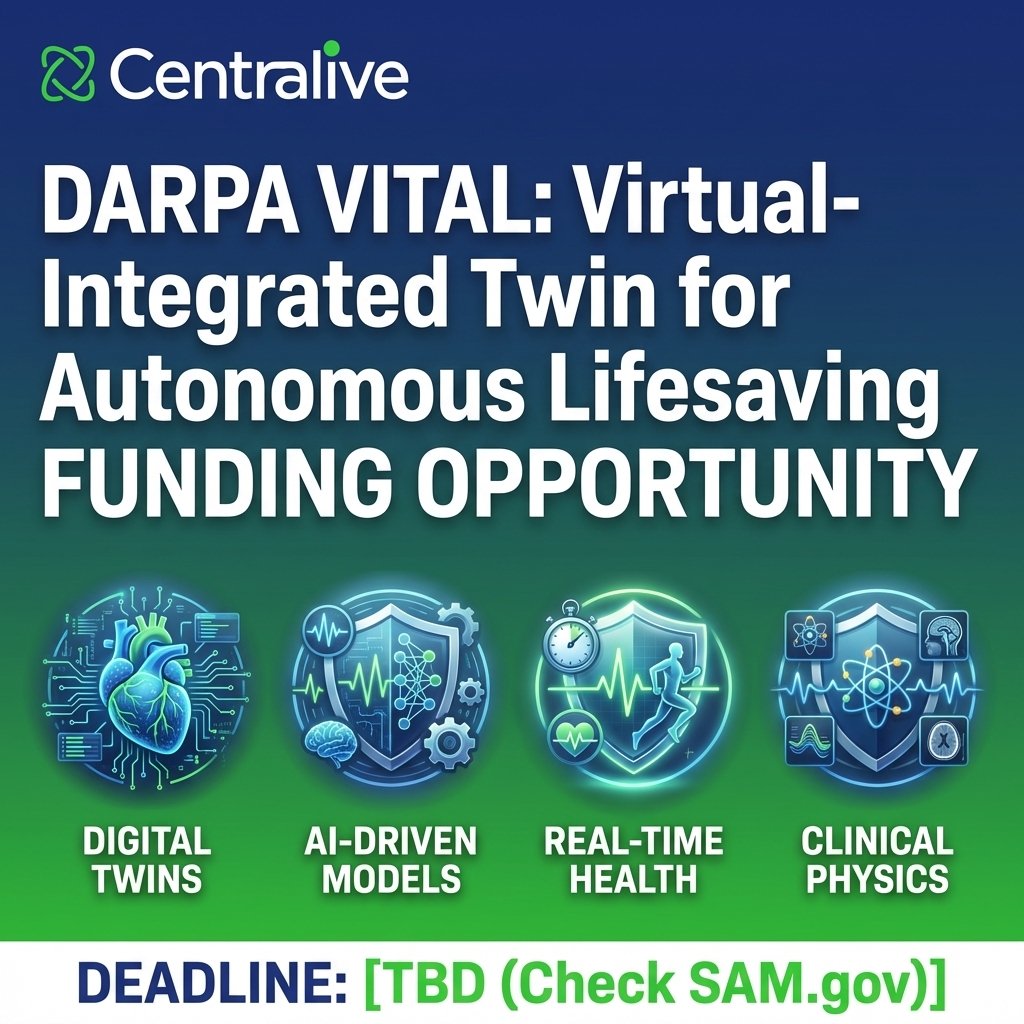
The Defense Advanced Research Projects Agency (DARPA) Biological Technologies Office (BTO) has announced a forthcoming program: Virtual-Integrated Twin for Autonomous Lifesaving (VITAL). This initiative seeks to develop continuously updating computational models of the cardiovascular system that integrate patient data with biological physics to predict outcomes in real time for both acute and chronic pathologies.
Scope of Work
VITAL centers on creating an Image-to-Physics-to-Twin pipeline. This pipeline will automatically integrate multimodal clinical imaging—including MRI, CT, and ultrasound—with sparse physiological measurements. The program is structured into two phases: Phase 1 focuses on establishing technical credibility through high-fidelity (HF) models, while Phase 2 aims to transition these into reduced-order models (ROMs) using AI techniques that remain physics- and physiology-aware. These models are intended to provide causal, prediction-driven decision support for clinicians. Current research underscores that the integration of multi-scale modeling with clinical data is a cornerstone of modern digital twin development in cardiology (Chakshu et al., 2021).
Eligibility and Participation
While specific eligibility criteria will be detailed in the upcoming formal solicitation, DARPA programs generally engage a broad spectrum of research institutions, including universities, private companies, and government laboratories. Deadlines: A formal solicitation is forthcoming and will be posted on sam.gov. Interested parties are encouraged to monitor the platform and contact technical POC Roozbeh Jafari, PhD, at VITAL@darpa.mil for inclusion in future updates.
Partnership and Teaming
DARPA strongly encourages teaming to ensure the necessary breadth of expertise. Successful projects will likely require collaboration between experts in:
- Cardiovascular physiology and biomechanics
- Artificial intelligence and physics-informed machine learning
- Multimodal clinical imaging and segmentation
- Computational fluid dynamics and reduced-order modeling
Stay updated on the latest health tech funding: https://newsletter.centralive.health/signup