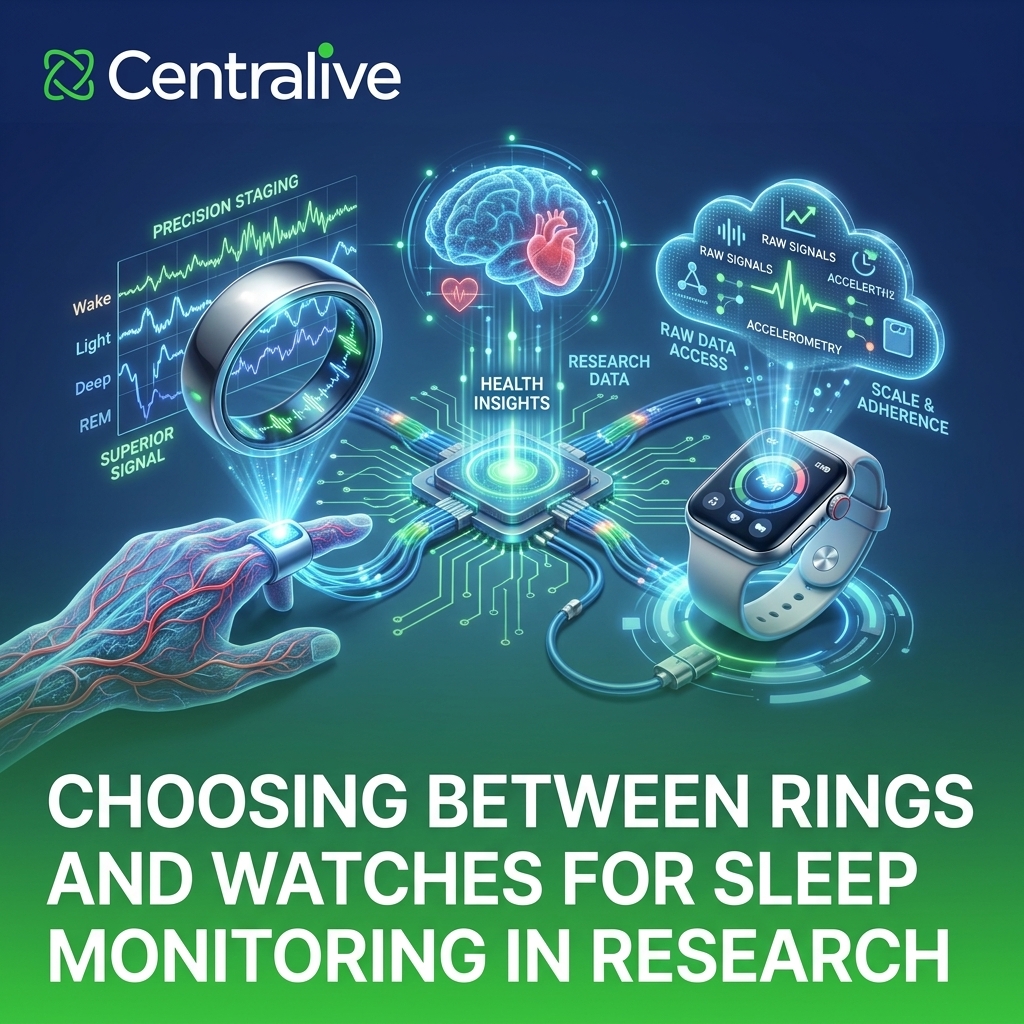
Smart rings have gone from niche curiosity to credible competitor in just a few years. For sleep monitoring in particular, the question is no longer “are they real?” but “are they better?” , and the answer, as with most things in digital health, depends on what you’re measuring, who you’re measuring it in, and what trade-offs you can absorb.
Below is a practical, citation-backed comparison of ring form factors (Oura, RingConn, Ultrahuman, Samsung Galaxy Ring) versus wrist-worn devices (Apple Watch, Fitbit, Garmin, Withings ScanWatch) across the dimensions that actually matter for research and deployment decisions: PSG-validated accuracy, signal-quality biology, adherence, feature breadth, data access (including raw signals), and total cost across a multi-year study.
1. Accuracy Against Polysomnography
The most direct comparison comes from a 2024 Brigham and Women’s Hospital study published in Sensors, which placed 35 healthy adults under simultaneous polysomnography (PSG), an Oura Ring, a Fitbit Sense, and an Apple Watch for a single in-lab night [1].
All three devices performed well on the basic sleep-vs-wake question , sensitivity at or above 95% , which now exceeds the performance of many older research-grade actigraphy devices [1]. The story diverges on four-stage classification (wake, light, deep, REM):
- Oura Ring: sensitivity 76.0–79.5%, precision 77.0–79.5%; not significantly different from PSG on any individual stage [1]
- Apple Watch: sensitivity 50.5–86.1%, precision 72.7–87.8% (high variance across stages) [1]
- Fitbit: sensitivity 61.7–78.0%, precision 72.8–73.2% [1]
Cohen’s kappa, adjusted for chance, came in at 0.65 for Oura, 0.60 for Apple Watch, and 0.55 for Fitbit [2]. Translated: in healthy young-to-middle-aged adults, the Oura Ring edges out the Apple Watch by roughly 5 percentage points on four-stage accuracy, and Fitbit by about 10.
A 2025 systematic review and meta-analysis across six studies and 388 participants reached a consistent conclusion for the Oura Ring: strong agreement with medical-grade sleep studies on total sleep time, sleep efficiency, and sleep onset latency [3]. A separate multi-night ambulatory PSG validation across 96 participants and over 421,000 epochs found 91.7–91.8% epoch-by-epoch accuracy for sleep vs. wake [4].
2. The Clinical-Population Caveat
Here’s where the picture changes. A 2025 study in Scientific Reports evaluated three ring trackers (Oura, SleepOn, Circul) against PSG in a university sleep-lab population with a diverse mix of sleep-related and unrelated medical conditions [5].
All-stage classification accuracy for the Oura Ring dropped to approximately 53% in this clinical sample, and the direction of bias for REM sleep duration flipped sign compared to healthy-cohort studies [5]. The authors explicitly noted that previous validation work has focused almost exclusively on healthy individuals, leaving a significant evidence gap precisely where clinical utility would matter most.
This is not a ring-specific problem. The same critique applies to wrist-worn devices, whose proprietary algorithms are similarly trained on healthy young adults. But it does mean that any claim of “ring beats watch” should be qualified: “in healthy adults, in lab conditions, on a single night.”
3. Signal Quality: Why the Finger Has a Physical Advantage
The form-factor difference isn’t just ergonomic. Several lines of evidence suggest the finger is a fundamentally better site for photoplethysmography (PPG) than the wrist.
A 2020 study comparing simultaneously acquired wrist-PPG and finger-PPG against ECG ground truth found significantly different signal quality between the two locations, with downstream consequences for pulse rate variability estimates [6]. A 2019 multi-site comparison spanning six body locations (finger, upper and under wrist, arm, earlobe, forehead) found the finger superior overall for HR and SpO2 extraction [7].
The mechanistic explanation is straightforward:
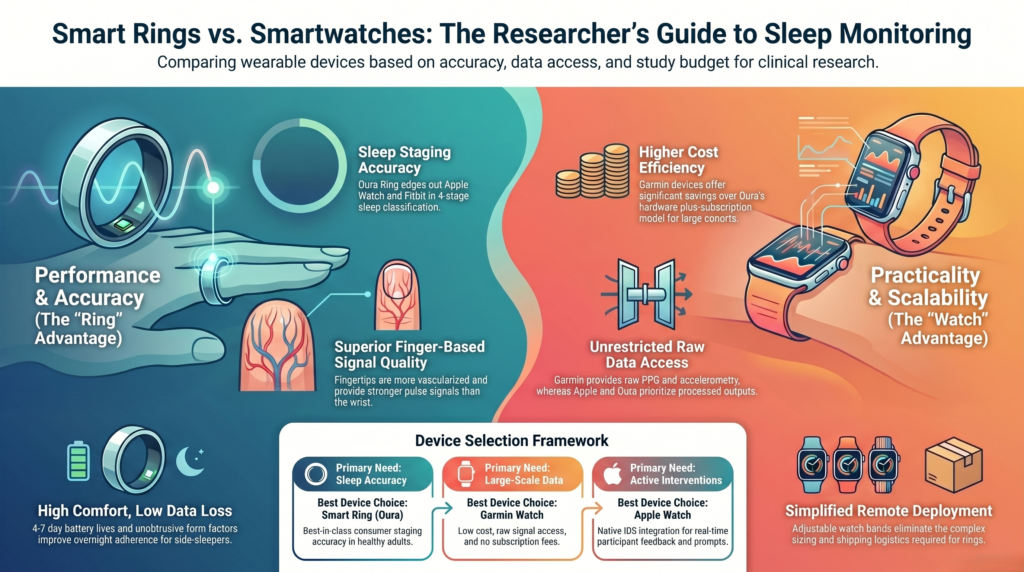
- Perfusion: Fingertips are densely vascularized, producing a stronger PPG waveform amplitude than the wrist [8].
- Geometry: A ring forms a closed optical chamber around the finger, blocking ambient light interference , wrists are oval and tend to gap, especially during movement.
- Motion artifact: Wrist-worn PPG accuracy degrades meaningfully during arm movement, finger gripping, or wrist flexion [9]. Finger motion during sleep is typically lower and more localized.
For a clinical cardiac-rehabilitation cohort, even an optimally positioned wrist PPG achieved high baseline accuracy (MAPE under 10% for at least 70% of training time) in only 66.7% of patients [9] , a reminder that wrist-PPG performance varies considerably by individual factors like age, BMI, and skin characteristics.
4. Adherence, Comfort, and Real-World Wear Time
Accuracy on a single lab night is one thing. Wearing the device for six months is another. A 2025 systematic review of smart rings in clinical medicine reported a sobering adherence pattern: roughly 80% wear-time at 3 months, declining to 43% by 12 months [10]. That’s still a notable concern, but anecdotally and in deployment data, rings tend to outperform wrist devices for sleep specifically because:
- They don’t interfere with watches that participants already wear daily.
- They are unobtrusive for side-sleepers and people who find wrist devices uncomfortable in bed.
- Battery life is typically 4–7 days versus 18 hours to 2 days for full-feature smartwatches, reducing the “I took it off to charge and forgot” failure mode that disproportionately costs sleep data.
Wrist devices have their own adherence advantage: most users already own one, removing the friction of issuing a study device. Apple Watches in particular benefit from existing wear habits, though the same Brigham study noted that the Apple Watch failed to record data for 6 of 35 participants on study night, and Fitbit failed for 2 , a reliability footnote that rarely shows up in headline accuracy numbers [2].
There’s also a deployment-logistics issue specific to rings that watches simply don’t have: sizing. Rings need to fit a specific finger, and finger circumference varies enough across adults that vendors typically offer 8–12 size options. For an in-person enrollment site this is a minor inconvenience. For fully remote trials, it’s a meaningful operational burden: you have to ship a sizing kit, wait for the participant to confirm fit, then ship the actual device, and maintain a multi-size inventory across the active enrollment window. Finger size can also change with weather, pregnancy, weight change, or time of day, occasionally requiring re-sizing mid-study. Watches, by contrast, ship in one or two case sizes with adjustable bands and work out of the box for nearly everyone. For studies aiming for fully remote, low-friction enrollment, this logistical asymmetry adds up , both in calendar time to first data point and in the per-participant operational cost that rarely shows up in the device-cost line of a budget.
5. Feature Breadth and Behavioral Integration
Where wrist devices clearly win is everything that isn’t sleep. Smartwatches handle GPS-based exercise, automatic workout detection, ECG (Apple Watch, certain Withings and Samsung models), notifications, and on-device intervention delivery. If your study uses ecological momentary assessment, just-in-time adaptive interventions, or in-the-moment feedback, the watch is a stronger platform , rings have no screen and most have no notification capability.
For sleep-focused work where the device is essentially a passive overnight sensor, the ring’s lack of screen is irrelevant or even an advantage (no sleep-disrupting light).
6. Data Access and Research Feasibility
This is the dimension most often overlooked in head-to-head comparisons, and it’s where the calculus has shifted meaningfully in the last 18 months.
- Apple Watch: HealthKit gives processed outputs only. No raw accelerometry or raw PPG without building a custom watchOS app, which most academic groups don’t have the engineering bandwidth to maintain.
- Oura Ring: Cloud API provides processed sleep stages and physiological summaries. Raw signal access is limited and typically requires a formal research partnership negotiated with Oura.
- Fitbit: Web API provides processed metrics; Sense and Versa lines expose limited raw access via the SDK.
- Garmin: The Garmin Health Companion SDK and Health API now expose raw streams (beat-to-beat intervals, raw accelerometry, raw PPG samples) alongside processed metrics. At Centralive we’ve integrated directly with Garmin’s SDKs and pull raw BBI, raw ACC, and physiological summaries from the same device , meaning we can run processed-summary intervention logic and archive raw signals for downstream method development in a single deployment.
- Research-grade rings (Ultrahuman research SDK, RingConn): Varying levels of raw access; check current vendor agreements.
The Garmin position is structurally interesting because it collapses the usual trade-off. With Oura you generally choose either polish-of-app-experience-with-processed-data or you negotiate a research partnership for raw access; with Apple Watch you accept processed-only unless you can build a watchOS data pipeline. With Garmin you get both layers out of the box, which matters disproportionately for longitudinal studies where firmware drift in the proprietary algorithm is a known threat to internal validity.
7. Cost Structure
Cost is where the ring story gets harder to defend at scale.
- Oura Ring: $300–500 hardware plus a roughly $70/year subscription (Oura Membership) required to unlock full data including detailed sleep staging, readiness scores, and historical access. Over a 12-month study, that’s effectively ~$370–570 per participant.
- Apple Watch: $250–800+ hardware, no subscription, but often already owned by participants (which transfers cost to convenience but reduces study budget).
- Garmin smartbands and watches: Entry-level models in the Vivosmart and Forerunner lines start around $100–150 with no subscription, full Health API access included. Higher-end Fenix and Epix models go up to $1,000+, but they aren’t needed for sleep and HRV work.
- Fitbit: $100–250 hardware; Fitbit Premium subscription ($10/month) is required for advanced sleep insights and detailed metrics.
For a 200-participant, 12-month deployment, the math is unforgiving. Issuing Oura rings with subscriptions can run $75,000–115,000. The same study on entry-level Garmin devices with full raw-data access costs roughly $20,000–30,000. That’s a 3–4x cost differential, often without a corresponding 3–4x scientific gain , especially if the primary endpoint is total sleep time, sleep efficiency, HRV, or activity, all of which Garmin captures well at both raw and processed layers.
This isn’t an argument that rings are overpriced. They’re impressive devices, and the form factor genuinely matters for some populations. But for grant-funded research where every device-dollar trades off against participant compensation, statistical power, or study duration, the Garmin price-to-data-access ratio is hard to ignore.
8. Quick Decision Framework
Pick a ring when:
- Sleep is the primary endpoint, the budget can absorb hardware-plus-subscription costs, and you need the best available consumer-grade staging accuracy in healthy adults.
- Participants will not reliably wear a wrist device overnight.
- You want unobtrusive 24/7 wear without screens, notifications, or watch-style social signaling.
- HRV during sleep is a meaningful secondary outcome and you don’t need raw-signal access.
Pick a Garmin smartband or watch when:
- You need raw signal access (BBI, raw accelerometry, raw PPG) alongside processed summaries for reproducibility, method development, or longitudinal robustness against firmware drift.
- Cost-per-participant matters and the study population is large.
- You want a single device that supports both passive sleep monitoring and active intervention delivery without locking the data behind a subscription paywall.
- The study runs long enough that vendor algorithm changes become a real internal-validity threat.
- The trial is fully remote and you can’t manage ring-sizing logistics across a large enrollment window.
Pick an Apple Watch when:
- Most of your target population already owns one, reducing study cost and friction.
- You need tight iOS-native intervention delivery (notifications, EMA prompts, on-device feedback).
- You can accept processed-only data and won’t need to defend against firmware-drift concerns from reviewers.
Pick more than one when:
- You’re running a digital biomarker study where ring-derived sleep precision and watch-derived behavioral signals are both useful.
- You’re harmonizing across devices and want one consistent sleep signal (ring) alongside the rich daytime stream and raw-signal archive from a Garmin.
The Bottom Line
In healthy adults under laboratory conditions, rings , particularly the Oura Ring , currently lead the consumer field for sleep-stage accuracy [1][3][4]. That advantage is real but bounded: it shrinks or disappears in clinical populations [5], comes with recurring subscription costs, and rarely includes raw-signal access for research use.
The right answer for most digital health research in 2026 isn’t “ring vs. watch” in the abstract. It’s: do you need raw data and cost-efficiency at scale (Garmin), best-in-class consumer sleep staging in healthy populations with budget to spare (Oura), or behavioral integration on devices participants already own (Apple Watch)? At Centralive we’ve largely standardized on Garmin SDK-based integrations for the studies we support, because the combination of raw signal access, no subscription, and entry-level hardware at ~$100 makes the cost-to-evidence ratio difficult to beat for most research designs. The ring stays in the toolkit for studies where sleep-staging precision in healthy adults is the explicit primary endpoint.
References
- Chee, N. I. Y. N., Ghorbani, S., Golkashani, H. A., Leong, R. L. F., Ong, J. L., & Chee, M. W. L. (2024). Accuracy of three commercial wearable devices for sleep tracking in healthy adults. Sensors, 24(20), 6532. https://www.ncbi.nlm.nih.gov/pmc/articles/PMC11511193/
- Robbins, R., et al. (2024). Performance of consumer sleep-tracking devices against polysomnography. Presented at Sleep Europe 2024; reported in Sleep Review. https://sleepreviewmag.com/sleep-diagnostics/consumer-sleep-tracking/wearable-sleep-trackers/oura-ring-apple-watch-fitbit-face-off-sleep-accuracy-study/
- Khan, M. S., et al. (2025). The Oura Ring versus medical-grade sleep studies: a systematic review and meta-analysis. OTO Open, 9(4). https://aao-hnsfjournals.onlinelibrary.wiley.com/doi/full/10.1002/oto2.70181
- Altini, M., & Kinnunen, H. (2024). Validity and reliability of the Oura Ring Generation 3 with Oura Sleep Staging Algorithm 2.0 against multi-night ambulatory polysomnography: a validation study of 96 participants and 421,045 epochs. Sleep Medicine. https://www.researchgate.net/publication/377738198
- Concheiro-Moscoso, P., et al. (2025). Performance of wearable finger ring trackers for diagnostic sleep measurement in the clinical context. Scientific Reports, 15. https://pmc.ncbi.nlm.nih.gov/articles/PMC11923143/
- Nardelli, M., Vanello, N., Galperti, G., Greco, A., & Scilingo, E. P. (2020). Assessing the quality of heart rate variability estimated from wrist and finger PPG: a novel approach based on cross-mapping method. Sensors, 20(11), 3156. https://doi.org/10.3390/s20113156
- Longmore, S. K., Lui, G. Y., Naik, G., Breen, P. P., Jalaludin, B., & Gargiulo, G. D. (2019). A comparison of reflective photoplethysmography for detection of heart rate, blood oxygen saturation, and respiration rate at various anatomical locations. Sensors, 19(8), 1874. https://doi.org/10.3390/s19081874
- de Zambotti, M., et al. (2024). The accuracy advantages of finger-worn wearable devices. Oura Research Blog / supporting peer-reviewed literature. https://ouraring.com/blog/accuracy-of-finger-worn-wearables/
- Verbrugge, F. H., et al. (2025). Optimization and pre-use suitability selection for wrist photoplethysmography-based heart rate monitoring in patients with cardiac disease. European Heart Journal – Digital Health, 6(5), 1024. https://academic.oup.com/ehjdh/article/6/5/1024/8211204
- Various authors. (2025). Smart ring in clinical medicine: a systematic review. PMC. https://www.ncbi.nlm.nih.gov/pmc/articles/PMC12730986/
Sign up for the Centralive Newsletter: https://newsletter.centralive.health/signup