The honest answer is that there is no single number. The required monitoring window depends on which metric you care about and, more decisively, on whether you are estimating a person’s habitual average or their night-to-night variability. Conflating those two questions is the single most common design error in the current literature, and it routinely leaves studies under-powered by a factor of five to ten.
This post walks through the mechanism behind night-count requirements, the concrete peer-reviewed evidence broken down by metric, and a staged decision framework you can pre-register. Throughout, the practical lens is study design: how many nights to schedule, how much to oversample for data loss, and how the raw-signal access model of your chosen platform governs what “a night of data” even means.
The one distinction that changes the answer: means versus variability
Sleep is a repeated measurement. Any single night is a noisy sample of an underlying process, and the goal of multi-night monitoring is to average out that noise until the estimate reflects the person rather than the particular night. The statistical question is one of reliability: how many repeated observations does it take before the aggregated estimate correlates strongly with the person’s true, stable value? Reliability is typically indexed with the intraclass correlation coefficient (ICC) and extrapolated across night counts using the Spearman-Brown prophecy formula, with a conventional threshold of ICC or test-retest r at or above 0.80 for a “very good” estimate, and 0.60 to 0.70 for “good” or “adequate”.
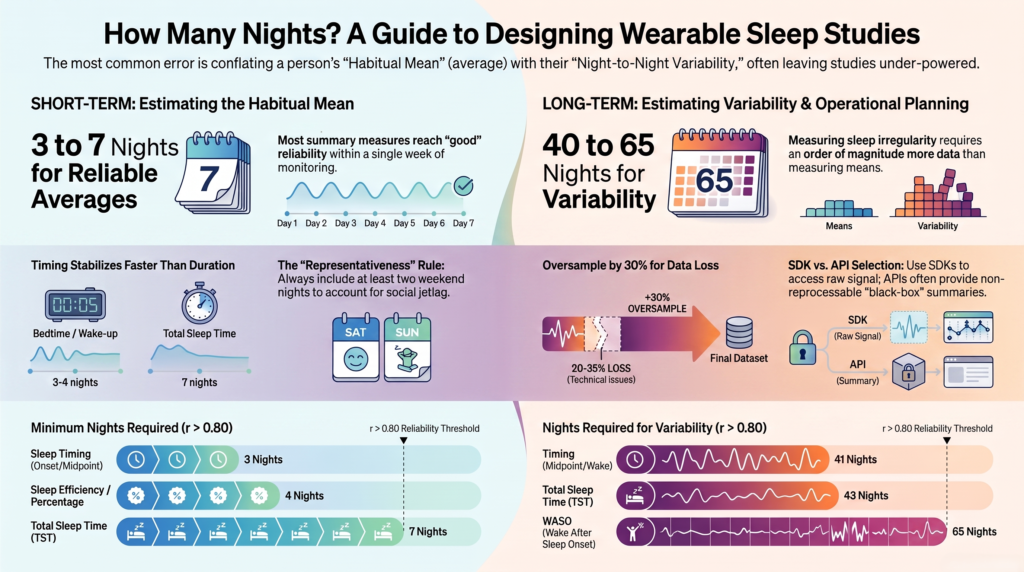
Here is the crucial part. Estimating a mean is statistically cheap: a handful of nights averages out most of the noise. Estimating a variance (how much someone’s sleep swings from night to night) is expensive, because you first have to estimate each night’s deviation and then the spread of those deviations. As a rule of thumb, reliably estimating variability requires roughly an order of magnitude more nights than reliably estimating the corresponding mean. So a study asking “what is this person’s typical sleep duration?” and a study asking “how irregular is this person’s sleep?” have completely different sampling requirements, even when they collect the exact same variable.
How many nights for the habitual mean
The foundational actigraphy work by Acebo and colleagues established that five or more usable nights are required for reliable sleep estimates in children and adolescents, with sleep duration among the slowest measures to stabilize and potentially needing seven or more nights.In working adults, Aili and colleagues applied ICC and the Spearman-Brown formula across seven nights and found that sleep percentage stabilized in about two nights, sleep efficiency in about five, and total sleep time needed more than seven nights; self-reported diary sleep needed at least six.An independent 28-day diary study corroborated the diary figure, reaching adequate reliability at around seven consecutive nights including weekends.
Modern consumer-wearable data tell the same story at scale. Analyzing more than 100,000 nights from over 1,000 working adults, Lau and colleagues reported that a weekly mean of total sleep time reached “good” reliability in three nights and “very good” reliability in five, and concluded that roughly six nights covers most commonly tracked sleep measures over a one-week window, rising to about 19 nights for a one-month characterization.Consistent with the older literature, sleep timing measures (bedtime, wake time, midpoint) required fewer nights than sleep duration. The largest study to date, drawing on more than 3.7 million person-nights across a full year, put precise numbers on the mean requirement per metric, summarized below.
| Metric | Nights for a reliable MEAN (r > 0.80) |
|---|---|
| Sleep onset time | 3 |
| Sleep midpoint | 3 |
| Wake time (sleep offset) | 4 |
| Sleep percentage / efficiency | 4 |
| Wake after sleep onset (WASO) | 5 |
| Total sleep time | 7 |
The pattern is consistent across every dataset: sleep timing stabilizes fastest, efficiency and fragmentation sit in the middle, and total sleep time is the slowest of the common summary measures. A clinical anchor sits underneath all of this. The American Academy of Sleep Medicine guideline on actigraphy recommends recording a minimum of 72 hours up to 14 consecutive days, which is the range clinical practice has settled on for a defensible habitual estimate.
How many nights for variability and regularity
This is where most study designs quietly fail. If your primary endpoint is night-to-night variability (an intraindividual standard deviation, the Sleep Regularity Index, social jetlag, or a fragmentation-instability measure), a week is nowhere near enough. The same year-long, 3.7 million-night analysis found that reaching r > 0.80 for variability estimates of the identical metrics required between 41 and 65 nights.
| Metric | Nights for a reliable VARIABILITY estimate (r > 0.80) |
|---|---|
| Sleep midpoint variability | 41 |
| Wake time variability | 41 |
| Total sleep time variability | 43 |
| Sleep onset variability | 44 |
| Sleep percentage variability | 62 |
| WASO variability | 65 |
At seven nights, the reliability of these variability estimates was only about 0.50 to 0.58, and the 95% limits of agreement for total sleep time variability spanned roughly plus or minus 50 minutes. The authors state the implication plainly: many accelerometry-based studies rely on 7 to 14 nights, and for variability endpoints that window yields poor reliability. Exploratory findings add nuance for study planning: women and younger adults needed substantially more nights to pin down fragmentation variability, and lower-compliance participants needed on the order of 10 to 17 additional nights.
Regularity metrics deserve a specific caution. The Sleep Regularity Index is defined over multiples of seven consecutive days, and consensus methodological guidance recommends at least seven days to compute a stable daily-variability measure.But “stable and low-bias” is not the same as “reliable”. A week may yield a roughly unbiased regularity value while the test-retest reliability of that value (its ability to recover a person’s true trait regularity) remains poor until many weeks of data accrue, and some regularity metrics carry known bias at assessments of seven days or fewer. The systematic review that formalized the “beyond the mean” framing recommends standardizing on the term intraindividual variability and treating it as a distinct construct with its own sampling demands.
Weekday, weekend, and representativeness
Reliability is about noise; representativeness is about bias. A Monday-to-Thursday sample can be highly reliable and still systematically wrong, because work-day and free-day sleep differ. Social jetlag, the difference between mid-sleep on free days and on work days, is highly prevalent, with a large fraction of adults in industrialized settings shifting their sleep timing between the working week and the weekend. A representative habitual estimate therefore has to include free nights, which mechanically requires a window of at least a full week (to capture two weekend nights) and ideally two weeks (to capture four).
There is a tension worth naming. Restricting to weeknights raises reliability, because weeknights are more homogeneous, but it biases the estimate as a measure of true habitual sleep.The resolution is to capture free nights for representativeness and, where schedules are non-standard, to analyze work versus free days directly rather than defaulting to the calendar weekend.
The first-night effect and the compliance tax
In laboratory polysomnography, the first night in an unfamiliar environment produces longer sleep-onset latency, reduced total sleep time and REM, and more awakenings, which is why lab protocols discard an adaptation night. In home and wearable settings this first-night effect is substantially reduced, because the participant sleeps in their own bed with an unobtrusive device. That is a genuine advantage of consumer wearables for habitual estimation, but it is paid for in data loss.
The classic actigraphy work warned that up to 28% of intended weekly recordings can be unusable because of illness, technical problems, and non-adherence, and explicitly advised recording for at least a full week to secure five clean nights. At-home signal-based studies report loss on the same order. The operational consequence is straightforward: plan for attrition. If you need 14 usable nights, do not schedule 14. The practical implications are worth stating as a rule, which appears in the framework below.
Sleep stages are limited by accuracy, not just night count
If your metric of interest is a stage percentage (REM, deep, or light sleep), night count is only half the problem. The other half is epoch-level device accuracy against polysomnography, which for consumer wearables is moderate at best. Multi-device validations report four-stage agreement (Cohen’s kappa) roughly in the 0.2 to 0.5 range depending on the device and form factor, with systematic over-estimation of light sleep and under-estimation of deep sleep on some wrist devices.
There is a hard ceiling here that no amount of averaging removes. Even expert human scorers disagree: the American Academy of Sleep Medicine inter-scorer reliability program reports overall stage agreement around 83%, falling to about 67% for deep sleep and about 63% for the lightest stage, and a meta-analysis puts overall inter-scorer kappa at about 0.76 but the lightest stage at only about 0.24.Two consequences follow for study design. First, stage percentages need more nights than sleep-wake summaries, because stage composition swings more from night to night. Second, and more important, averaging more nights reduces random error but cannot correct a device’s directional bias against the reference standard. Reliability and validity are separate questions, and both must be reported for any stage-level claim.
Where signal processing changes the night budget
Improving per-night staging fidelity is a complementary lever to collecting more nights: a lower noise floor per night means fewer nights are needed to reach a stable stage-percentage estimate. This is where Centralive’s biosignal work is directly relevant. A CNN-BiLSTM architecture combining photoplethysmography (PPG) with respiration reported accuracy and kappa of 92.7% and 0.768 for two-stage classification, 80.2% and 0.714 for three-stage, and 76.7% and 0.616 for five-stage, demonstrating that adding a respiration channel materially improves stage discrimination, particularly for REM, which cardiac signals alone struggle to resolve.A companion approach estimated respiration rate from wrist PPG and accelerometry via transfer learning, outperforming several state-of-the-art baselines and making that respiration channel available on consumer-grade hardware.A hybrid Transformer and Hidden Markov model for sleep-stage detection extends this line of work, reported at up to 90.0% accuracy and kappa 0.831.
The design takeaway is that the night budget is not fixed by biology alone. Better per-night algorithms raise reliability per night, which is why the accuracy of the pipeline you deploy is part of the same conversation as how many nights you schedule.
SDK versus API: what “a night of data” actually means
A frequently overlooked determinant of multi-night study quality is the data-access architecture of the platform you choose. Hardware software development kits (SDKs) that expose raw or high-resolution signal, such as the Garmin Health Companion SDK and Apple’s frameworks, let you capture raw beat-to-beat intervals and accelerometry for every night and re-run your own algorithms across the whole recording. That is what makes true multi-night re-processing, algorithm auditing, and reproducibility possible.
Closed, processed-output-only APIs return only vendor-computed summaries. Oura is the standing structural counterexample here, and this is a design fact rather than a criticism: in its published validation, researchers were given summary measures and 30-second epochs but not the raw accelerometer, temperature, or PPG signal. When the raw stream is unavailable, “14 nights of data” means 14 nights of the vendor’s algorithm output, with nights that the vendor deems invalid silently dropped and no ability to apply your own quality control or re-derive metrics under the reliability targets above. Garmin is positioned as a first-class research platform precisely because it offers raw beat-to-beat interval and accelerometry access without a subscription model and on accessible entry-level hardware. The choice is a protocol-design decision, not an afterthought, because it governs whether your multi-night dataset is re-analyzable signal or a black-box summary.
A staged decision framework
Stage 1: minimum viable (rough central tendency only)
Three nights reliably capture sleep timing (bedtime, midpoint, wake time) and give a rough duration estimate. This is acceptable only for low-stakes screening or chronotype and timing questions. Do not report sleep efficiency, WASO, or any variability metric from three nights.
Stage 2: standard (habitual means)
Seven consecutive nights, collected over a window that guarantees at least two free (weekend) nights. This reliably estimates the mean of total sleep time (about seven nights), sleep efficiency (four to five), WASO (about five), and timing (about three), and it matches the clinical actigraphy floor. This is the default for most observational and cross-sectional wearable sleep studies.
Stage 3: rigorous (variability, regularity, stages)
Fourteen nights at an absolute minimum, and four to nine weeks (roughly 30 to 65 nights) when night-to-night variability, the Sleep Regularity Index, or reliable stage percentages are primary endpoints. Use the metric-specific targets above: about 43 nights for total sleep time variability, about 44 for onset, about 62 for sleep-percentage, and about 65 for WASO variability. For younger adults and for women studying fragmentation variability, add two to three weeks.
Cross-cutting operational rules
- Oversample by about 30%. If you need 14 usable nights, schedule roughly 18 to 20, given the 20% to 35% loss typical of home wearable data.
- Pre-register thresholds and per-metric night counts. State your reliability bar (r at or above 0.80 for “very good”) and which metrics clear it at your chosen night count.
- Always capture free nights for representativeness, and analyze work versus free days rather than pooling when social jetlag is plausible.
- Decide SDK versus API at protocol design. If you may need to re-process raw signal or audit night-level validity, secure raw or SDK access; if a processed-only API is used, accept that valid nights are vendor-defined and non-reprocessable.
- Report compliance and missingness explicitly, and use analytic methods that tolerate missing nights (mixed models, multiple imputation) rather than listwise deletion.
Caveats
- Population dependence. Most night counts come from specific populations (working adults, children and adolescents, subscriber cohorts). Clinical and irregular-sleeping populations need more nights, and in some clinical groups the variability of sleep timing shows poor reliability at every practical recording length.
- Threshold choice drives the numbers. “Reliable” at ICC 0.70 versus 0.80 changes the required night count substantially, so always state your threshold up front.
- Device is not interchangeable with device. Research actigraphs and different consumer wearables vary in accuracy and in which nights they count as valid, so night counts from one platform do not transfer cleanly to another, especially for stages and WASO.
- Means and variability must never be conflated. This is the single most common and most consequential design error in the literature.
- Reliability is not validity. More nights improve test-retest reliability but cannot correct a device’s systematic bias against polysomnography; report both for any stage-level work.
References
- Acebo C, Sadeh A, Seifer R, et al. Estimating sleep patterns with activity monitoring in children and adolescents: how many nights are necessary for reliable measures? Sleep. 1999;22(1):95-103. DOI: 10.1093/sleep/22.1.95. https://pubmed.ncbi.nlm.nih.gov/9989370/ ↩
- Aili K, Astrom-Paulsson S, Stoetzer U, et al. Reliability of actigraphy and subjective sleep measurements in adults: the design of sleep assessments. J Clin Sleep Med. 2017;13(1):39-47. DOI: 10.5664/jcsm.6384. https://jcsm.aasm.org/doi/10.5664/jcsm.6384 ↩
- Rowe M, McCrae C, Campbell J, et al. Actigraphy in older adults: comparison of means and variability of three different aggregates of measurement. Behav Sleep Med. Reliability of multi-night sleep diaries. PMC7347374. https://pmc.ncbi.nlm.nih.gov/articles/PMC7347374 ↩
- Lau H, Gooley JJ, et al. How many nights of wearable data are needed to reliably estimate sleep? SLEEP Advances. 2022;3(1):zpac026. DOI: 10.1093/sleepadvances/zpac026. https://doi.org/10.1093/sleepadvances/zpac026 ↩
- Leota J, Messman B, et al. Nights needed to reliably estimate intraindividual means and variability of sleep from a wearable device. Sleep. 2026;49(6):zsag040. DOI: 10.1093/sleep/zsag040. https://doi.org/10.1093/sleep/zsag040 ↩
- Smith MT, McCrae CS, Cheung J, et al. Use of actigraphy for the evaluation of sleep disorders and circadian rhythm sleep-wake disorders: an American Academy of Sleep Medicine clinical practice guideline. J Clin Sleep Med. 2018;14(7):1231-1237. DOI: 10.5664/jcsm.7230. https://jcsm.aasm.org/doi/10.5664/jcsm.7230 ↩
- Phillips AJK, Clerx WM, O’Brien CS, et al. Irregular sleep/wake patterns are associated with poorer academic performance and delayed circadian and sleep/wake timing. Sci Rep. 2017;7:3216. DOI: 10.1038/s41598-017-03171-4. https://doi.org/10.1038/s41598-017-03171-4 ↩
- Full KM, Kerr J, Grandner MA, et al. Assessing psychometric properties of the Sleep Regularity Index and actigraphy sleep measures. Ann Work Expo Health. 2020;64(4):350-367. DOI: 10.1093/annweh/wxaa009. https://academic.oup.com/annweh/article/64/4/350/5735350 ↩
- Fischer D, Klerman EB, Phillips AJK. Measuring sleep regularity: theoretical properties and practical usage of existing metrics. Sleep. 2021;44(10):zsab103. DOI: 10.1093/sleep/zsab103. https://doi.org/10.1093/sleep/zsab103 ↩
- Bei B, Wiley JF, Trinder J, Manber R. Beyond the mean: a systematic review on the correlates of daily intraindividual variability of sleep/wake patterns. Sleep Med Rev. 2016;28:108-124. DOI: 10.1016/j.smrv.2015.06.003. PMID: 26588182. https://doi.org/10.1016/j.smrv.2015.06.003 ↩
- Wittmann M, Dinich J, Merrow M, Roenneberg T. Social jetlag: misalignment of biological and social time. Chronobiol Int. 2006;23(1-2):497-509. DOI: 10.1080/07420520500545979. https://doi.org/10.1080/07420520500545979 ↩
- Robbins R, Weaver MD, Quan SF, et al. Evaluating the accuracy of consumer sleep-tracking devices against polysomnography. Sensors. 2024;24(20):6532. DOI: 10.3390/s24206532. https://doi.org/10.3390/s24206532 ↩
- Rosenberg RS, Van Hout S. The American Academy of Sleep Medicine inter-scorer reliability program: sleep stage scoring. J Clin Sleep Med. 2013;9(1):81-87. DOI: 10.5664/jcsm.2350. https://jcsm.aasm.org/doi/10.5664/jcsm.2350 ↩
- Lee YJ, Lee JY, Cho JH, Choi JH. Interrater reliability of sleep stage scoring: a meta-analysis. J Clin Sleep Med. 2022;18(1):193-202. DOI: 10.5664/jcsm.9538. https://pmc.ncbi.nlm.nih.gov/articles/PMC8807917/ ↩
- Kazemi K, Abiri A, et al. Improved sleep stage predictions by deep learning of photoplethysmogram and respiration patterns. Comput Biol Med. 2024;179:108679. DOI: 10.1016/j.compbiomed.2024.108679. PMID: 39033682. https://pubmed.ncbi.nlm.nih.gov/39033682/ ↩
- Kazemi K, et al. Robust respiration rate estimation from wrist photoplethysmography and accelerometry via transfer learning. Proc ACM Interact Mob Wearable Ubiquitous Technol (IMWUT). 2025;9(1):1-24. DOI: 10.1145/3712280. https://doi.org/10.1145/3712280 ↩
- Kazemi K, Kourkchi E, Rahmani AM, Homayoun H, Liljeberg P. A hybrid sleep stage detection using Hidden Markov chains and Transformers. IEEE EMBC 2026, Toronto, Canada, 26-30 July 2026. https://cmsworkshops.com/EMBC2026/view_paper.php?PaperNum=1227&SessionID=1103 ↩
- Ghorbani S, Zavanelli N, et al. Multi-night validation of a consumer sleep-tracking ring against polysomnography. Sleep Med. 2024. DOI: 10.1016/j.sleep.2024.01.020. https://doi.org/10.1016/j.sleep.2024.01.020 ↩
Sign up for the Centralive Newsletter: https://newsletter.centralive.health/signup