If you design real-world sleep studies, you have almost certainly been asked a version of this question by a collaborator, an ethics board, or a funder: can the smartwatch or ring our participants already own actually detect a sleep disorder? It is a reasonable thing to ask. Consumer wearables now ship with breathing-disturbance alerts, sleep-stage graphs, and readiness scores, and two of them carry regulatory clearance for sleep apnea. The honest answer is that the capability is real but narrow, and the distinction that matters for your protocol is the difference between screening and diagnosis. This post walks through what the peer-reviewed evidence actually supports for insomnia, obstructive sleep apnea (OSA), and restless legs syndrome (RLS), and where each fits into a defensible study design.
The distinction that governs everything: screening versus diagnosis
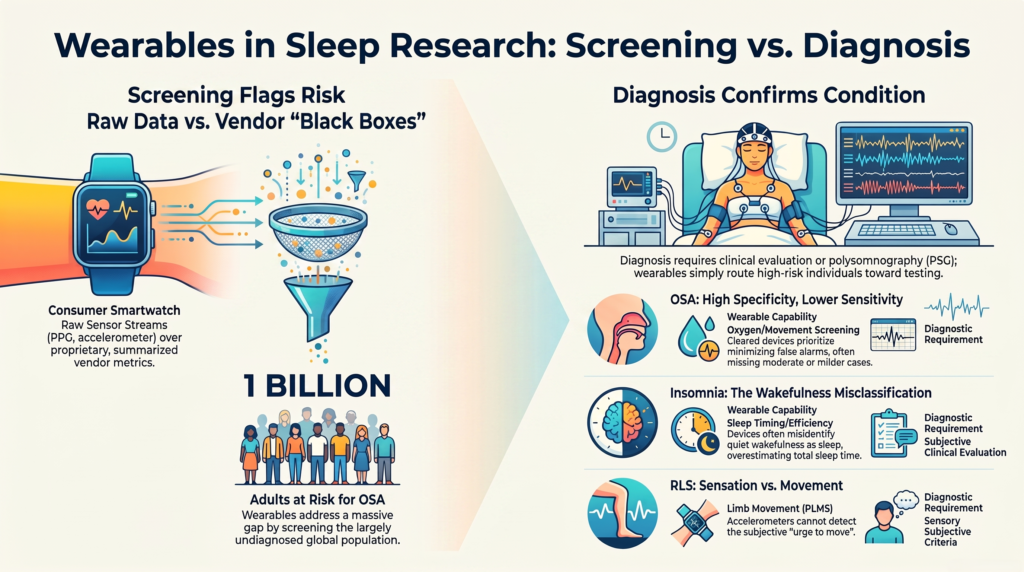
All three conditions remain clinical diagnoses. OSA and periodic limb movement disorder require polysomnography (PSG) or, for OSA, a home sleep apnea test, interpreted alongside a clinical evaluation. Insomnia disorder and RLS are defined by subjective symptoms and daytime distress, not by any single measurable signal. The American Academy of Sleep Medicine (AASM) has been explicit that, absent regulatory clearance and validation, consumer sleep technology cannot be used to diagnose or treat sleep disorders, and that patient-generated data must be interpreted within a comprehensive clinical assessment.
What wearables increasingly can do is flag risk at population scale, which has genuine value precisely because so much sleep-disordered breathing goes unrecognized. Global burden estimates put nearly a billion adults aged 30 to 69 at some level of OSA, with roughly 425 million at moderate-to-severe disease, the large majority undiagnosed.An imperfect but specific screener that routes people toward confirmatory testing addresses a real gap. The trap for researchers is treating a screening output as if it were a diagnostic endpoint.
Sleep apnea: the strongest case, with deliberate trade-offs
OSA is the one condition here with cleared consumer wearable screening. Wearables do not measure airflow directly; they infer respiratory events from proxy signals: oxygen desaturation via reflectance (wrist) pulse oximetry, autonomic surges captured in heart-rate and pulse-rate variability, respiratory rate, and the micro-movements that accompany apnea-related arousals detected by the accelerometer. Dedicated devices add peripheral arterial tone.
The two cleared consumer features take different approaches. Samsung’s Galaxy Watch feature received US Food and Drug Administration (FDA) De Novo authorization in February 2024, the first smartwatch-based sleep apnea detection the agency authorized; it derives an estimated apnea-hypopnea index from PPG-based blood-oxygen dips across two nights.pple’s sleep apnea notification received FDA clearance in September 2024 and estimates breathing disturbances from accelerometer data over a rolling multi-night window.Both are labeled for adults with no prior OSA diagnosis, and both state plainly that they do not replace clinical diagnosis.
The validation figures are worth reading closely, because they reveal a design choice rather than a limitation to be embarrassed about. In Apple’s validation study, the feature reached a weighted specificity of about 98.5 percent but a weighted sensitivity of only about 66.3 percent overall, rising to roughly 89 percent for severe OSA and falling to around 43 percent for moderate cases. Samsung’s pivotal data in the FDA decision summary reported sensitivity of 82.7 percent and specificity of 87.7 percent for moderate-to-severe disease.High specificity is chosen intentionally: when a check repeats month after month, minimizing false alarms matters, but the cost is that many true cases, especially milder ones, are missed. For a screening tool that is an acceptable trade. For an ascertainment endpoint in a study that needs to capture moderate OSA reliably, it is not.
Research-grade and machine-learning approaches do better than off-the-shelf consumer staging. A 2024 systematic review and meta-analysis of wearable artificial intelligence for sleep apnea, pooling 38 studies, found roughly 0.94 sensitivity and 0.75 specificity for detecting apnea and about 0.88 accuracy for estimating an apnea-hypopnea severity score, while the authors still judged performance short of routine clinical standalone use.Deep-learning models built on raw PPG have reported strong agreement with PSG-derived indices, and even accelerometer-only pilots on wrist-worn hardware have identified moderate-or-worse apnea with high per-subject correlation.The signal is there in the raw data; the ceiling is set by what you can access and how you score it.
Insomnia: wearables measure sleep, they do not diagnose the disorder
Wearables estimate the parameters that matter to insomnia reasonably well: sleep onset latency, wake after sleep onset, total sleep time, and sleep efficiency. But insomnia disorder is defined by a subjective complaint plus clinically significant daytime impairment occurring despite adequate opportunity to sleep. No sensor measures distress, which is why paradoxical insomnia, where a patient reports severe insomnia yet shows near-normal objective sleep, cannot be resolved by a device.
There is also a systematic error that lands exactly where it hurts most. Movement-based algorithms misclassify quiet wakefulness, lying still while awake, as sleep. Because insomnia patients characteristically lie still trying to sleep, wearables tend to overestimate total sleep time and sleep efficiency in this population. The pattern shows up consistently: devices reach high sensitivity for detecting sleep but poor specificity for detecting wake, so a validation in chronic-insomnia patients found sensitivity near 90 percent but wake specificity far lower, and the authors cautioned against substituting the tracker for PSG. Actigraphy retains an established, guideline-supported role for characterizing sleep timing and circadian patterns across multiple nights,which is a real strength for insomnia research, but the disorder definition still has to be anchored in validated patient-reported instruments.
Restless legs syndrome: separate the sensation from the movement
RLS is the clearest case of a construct a wearable cannot capture. The International Restless Legs Syndrome Study Group criteria are entirely sensory and subjective: an urge to move the legs, usually with uncomfortable sensations, worse at rest, relieved by movement, worse in the evening or night, and not better explained by another condition. There is no accelerometer trace for an urge.
What wearables can measure is periodic limb movements of sleep (PLMS), a distinct and measurable phenomenon that is present in most but not all RLS patients and also appears commonly in the general population and in OSA. Leg-worn actigraphy validates well for PLMS specifically: a study of a leg-worn actigraph reported a correlation with PSG-scored movement index near 0.98, with sensitivity and specificity above 85 percent, and earlier work showed that toe placement outperformed ankle placement.Placement, in other words, changes the answer. Crucially, the AASM issued a strong recommendation against using actigraphy in place of electromyography to diagnose periodic limb movement disorder. So even the best leg actigraphy is a screening and quantification tool for PLMS, not a diagnosis of the movement disorder, and it says nothing directly about the RLS diagnosis itself. Studies should measure the two constructs separately: leg actigraphy for movements, validated questionnaires for the RLS sensory diagnosis.
Why raw signal access is the decisive research variable
Notice what every strong result above has in common: it was built on raw sensor streams that could be independently scored and re-scored. That is the practical fork in the road for a research team. If you can only retrieve a vendor’s summarized outputs, you inherit that vendor’s proprietary algorithm, its undisclosed error characteristics, and its silent firmware updates, and you cannot develop or validate a detection model of your own. If you can retrieve raw PPG, accelerometer, SpO2, and respiration waveforms, you can build, audit, and reproduce.
This is where the platform choice becomes a methodological choice. Garmin’s Health SDKs stream raw accelerometer data, beat-to-beat interval data, SpO2, and respiration, and the on-device variant keeps data inside the researcher’s own pipeline; combined with raw signal access, no subscription requirement, and accessible entry-level hardware, that makes it a first-class research platform. Apple exposes on-device sensor access through its frameworks. By contrast, several popular consumer platforms, including Oura, are effectively API-only for most researchers, returning derived metrics such as sleep stages and summarized variability rather than the underlying waveforms. Those derived outputs are fine when your endpoint is a validated summary metric for a behavioral trial. They are the wrong foundation when your endpoint depends on a raw waveform you need to score yourself.
A staged decision framework for study design
- Fix your endpoint first, then match the device. If the endpoint depends on a raw waveform (custom apnea detection, PLMS scoring, arousal detection), choose a device with SDK-level raw streaming and budget for the integration work. If the endpoint is a validated vendor summary metric, an API-only device is acceptable and lower-burden.
- For OSA, use wearables to enrich and screen, not to score AHI as truth. Flag likely cases with a cleared feature or a peripheral-arterial-tone device, then confirm with a home sleep apnea test or PSG. Report severity-stratified sensitivity, because a device that misses roughly half of moderate cases will systematically under-ascertain that stratum.
- For insomnia, never treat wearable sleep as ground truth in an insomnia population. Expect overestimation of total sleep time and sleep efficiency, pair objective data with validated patient-reported outcomes, and use multi-night actigraphy for timing and circadian questions.
- For RLS, measure the two constructs separately. Use toe- or ankle-placed leg actigraphy for PLMS quantification and validated criteria-based questionnaires for the RLS diagnosis; reserve electromyography and PSG for any periodic-limb-movement-disorder endpoint.
- Validate every device-metric pairing in your own population, and lock the version. Accuracy varies with device, algorithm version, skin tone, body mass index, and disease severity. Record firmware and algorithm versions and hold them constant for the duration of the study.
Where Centralive fits
The recurring theme across all three conditions is that credible sleep-disorder work in the wild depends on getting to the raw signal and keeping control of how it is scored. That is the layer Centralive is built around: SDK-level access to raw biosignals rather than closed, pre-processed outputs, so that your team can develop, validate, and reproduce its own detection logic instead of inheriting a black box. Screening is a legitimate and increasingly powerful use of wearables. Turning screening into research-grade evidence is a question of signal access and methodological discipline, and that is a question worth settling before the first participant is enrolled.
References
- Khosla S, et al. Consumer Sleep Technology: An American Academy of Sleep Medicine Position Statement. J Clin Sleep Med. 2018. doi:10.5664/jcsm.7128. https://jcsm.aasm.org/doi/full/10.5664/jcsm.7128
- Benjafield AV, et al. Estimation of the global prevalence and burden of obstructive sleep apnoea: a literature-based analysis. Lancet Respir Med. 2019;7(8):687-698. doi:10.1016/S2213-2600(19)30198-5. https://doi.org/10.1016/S2213-2600(19)30198-5
- Samsung. Samsung’s Sleep Apnea Feature on Galaxy Watch, First of Its Kind Cleared by US FDA. 2024. https://news.samsung.com/global/samsungs-sleep-apnea-feature-on-galaxy-watch-first-of-its-kind-cleared-by-us-fda
- Apple. Estimating Breathing Disturbances and Sleep Apnea Risk from Apple Watch. September 2024. https://www.apple.com/health/pdf/sleep-apnea/Sleep_Apnea_Notifications_on_Apple_Watch_September_2024.pdf
- US Food and Drug Administration. De Novo Classification Decision Summary, DEN230041 (Samsung sleep apnea feature). 2024. https://www.accessdata.fda.gov/cdrh_docs/reviews/DEN230041.pdf
- Abd-alrazaq A, et al. Detection of Sleep Apnea Using Wearable AI: Systematic Review and Meta-Analysis. J Med Internet Res. 2024;26:e58187. doi:10.2196/58187. https://pubmed.ncbi.nlm.nih.gov/39255014/
- Detection of sleep apnea using only inertial measurement unit signals from Apple Watch: a pilot study with a machine learning approach. PMC. 2025. https://www.ncbi.nlm.nih.gov/pmc/articles/PMC11787281/
- Validation of Fitbit Charge 4 for assessing sleep in Chinese patients with chronic insomnia: a comparison against polysomnography and actigraphy. PMC. 2022. https://www.ncbi.nlm.nih.gov/pmc/articles/PMC9578631/
- Smith MT, et al. Use of Actigraphy for the Evaluation of Sleep Disorders and Circadian Rhythm Sleep-Wake Disorders: An American Academy of Sleep Medicine Clinical Practice Guideline. J Clin Sleep Med. 2018. doi:10.5664/jcsm.7230. https://aasm.org/actigraphy-guideline-release/
- Spektor A, et al. Validation of a leg-worn actigraph for the detection of periodic limb movements in sleep. Clocks & Sleep. 2024. doi:10.3390/clockssleep6040038. See also Gschliesser V, et al. Actigraphic vs polysomnographic evaluation of periodic limb movements. Sleep Med. 2007. https://pubmed.ncbi.nlm.nih.gov/17767810/
- Garmin Developers. Health SDKs Overview. https://developer.garmin.com/health-sdk/
Sign up for the Centralive Newsletter: https://newsletter.centralive.health/signup