
A device validated in healthy adults arrives with a reassuring spec sheet: low step error, tight heart-rate limits of agreement, published cut-points. Then you put it on a 7-year-old. Children are shorter, step faster, and move in sporadic bursts rather than sustained steady-state effort. Their resting metabolism runs higher per kilogram than an adult’s. Each of these facts quietly violates an assumption baked into adult-derived algorithms and intensity cut-points. This post walks through what the pediatric validation literature actually shows, why Evenson and Trost cut-points exist and still disagree with each other, and how youth-specific wear and compliance patterns shape every number you reportThe short answer
Mostly, no. Adult epochs, adult count cut-points, adult MET definitions, and consumer-device outputs do not transfer reliably to children and adolescents. Worse, the pediatric-specific cut-points developed to fix this still disagree with one another by up to an order of magnitude in estimated moderate-to-vigorous physical activity (MVPA). The defensible approach is to collect raw tri-axial acceleration at short epochs, apply youth-calibrated processing or youth-trained machine-learning models, use youth energy definitions, and treat consumer-device outputs other than steps as unvalidated in this population until shown otherwise.
Why children break adult algorithms
Activity arrives in bursts, not blocks
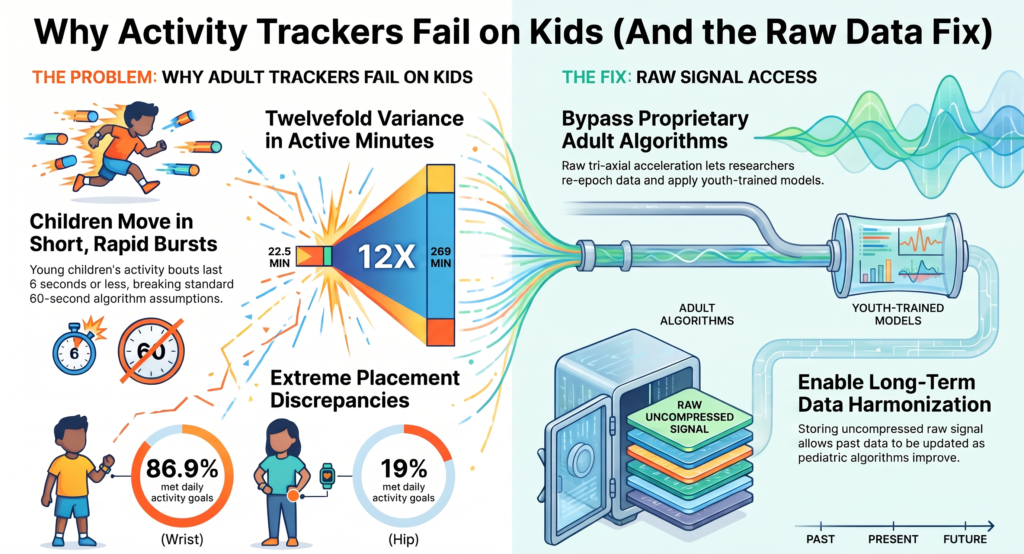
Direct-observation work at 3-second resolution in 6 to 10-year-olds found children’s activity to be highly intermittent, with a median bout length across all intensities of 6 seconds or less.1 Accelerometer data at 1-second resolution in adolescent boys confirm the pattern: mean vigorous bout length was 3.5 plus or minus 2.0 seconds in physical education and 2.5 plus or minus 1.7 seconds in leisure time, with moderate bouts averaging roughly 2 to 3 seconds.2
This breaks epoch-based processing. If a vigorous burst lasts 3 seconds, a 60-second epoch averages it with 57 seconds of lower activity. Depending on the cut-point, that burst is either diluted into “light” or the whole minute is inflated into “moderate.” The bias is not hypothetical. Processing data from 268 children aged 7 to 11 at epochs from 1 to 60 seconds, every intensity category varied significantly by epoch length for all cut-point sets and all wear-time algorithms (all p less than 0.0001), and the authors warned that rescaling cut-points to match a different epoch length introduces significant errors.3 The practical rule in youth: collect raw data or epochs of 15 seconds or shorter, and never apply a cut-point at an epoch it was not calibrated on.
Higher cadence, shorter stride
Shorter legs mean a higher stepping rate at any given intensity, so adult cadence heuristics underestimate what moderate intensity looks like in a young child. The CADENCE-kids study reported moderate-intensity thresholds falling from 128.4 steps per minute in 6 to 8-year-olds to 87.3 steps per minute in 18 to 20-year-olds, with vigorous thresholds from roughly 158 down to 119 steps per minute across the same age span.4 The adult heuristic is 100 steps per minute. For step-detection firmware, children’s high cadences sit at the edge of the frequency bands and amplitude thresholds that adult filters were tuned on, which is one reason step error worsens at faster walking speeds in children.
The pediatric MET problem
Energy expenditure per kilogram at rest and during exercise is higher in children than adults and varies with pubertal status.5 Measured resting oxygen uptake in 7 to 11-year-olds is about 6.0 mL per kilogram per minute, not the adult 3.5 that anchors the standard MET.11 A walking pace defined as “3 METs” with the adult constant is therefore only about 1.75 child-METs, so any adult-MET-anchored threshold mislabels genuinely light activity in children as moderate. The Youth Compendium of Physical Activities addresses this with MET-y values for 196 activities, normalized to child basal metabolic rate.6 Because youth cut-points have been derived under different MET definitions (3 adult METs, 4 adult METs, or MET-y), the thresholds are not interchangeable, and this is a structural cause of the disagreement that follows.
Youth cut-points disagree with each other
The Evenson cut-points are the most widely used, and the most widely misquoted. The familiar values of 2296 and 4012 are counts per minute, not per 15 seconds. The calibration was performed in 33 children aged 5 to 8 against a COSMED K4b2 indirect calorimeter, and the native epoch is 15 seconds.7 The vertical-axis ActiGraph thresholds are:
| Intensity | Counts per 15 s | Counts per minute |
|---|---|---|
| Sedentary | 25 or fewer | 100 or fewer |
| Light | 26 to 573 | 101 to 2295 |
| Moderate | 574 to 1002 | 2296 to 4011 |
| Vigorous | 1003 or more | 4012 or more |
The key independent comparison scored 12 standardized activity trials against indirect calorimetry in 206 participants aged 5 to 15, testing five cut-point sets: Evenson (EV), Freedson/Trost (FT), Treuth (TR), Mattocks (MT), and Puyau (PU).8 Agreement across all four intensity levels was highest for Evenson (weighted kappa 0.68), followed by FT (0.66), TR (0.62), MT (0.54), and PU (0.36). For MVPA classification, EV and FT both reached a ROC area under the curve of 0.90, and the 100 count-per-minute sedentary threshold reached 0.90 as well. Only the Evenson cut-points provided acceptable classification accuracy across all four intensity levels and performed well in children of all ages.
How much does the choice matter? Applying five cut-point sets to the same data from 419 children aged 3 to 6, mean MVPA ranged from 22.5 minutes per day (Puyau) to 269.0 minutes per day (a Freedson equation), a roughly twelvefold difference from identical raw files.10 A systematic review of 11 youth calibration studies reached the same conclusion: applying different cut-points yields vastly different estimates, and only Evenson and Freedson/Trost had sufficient evidence for accurate MVPA classification.9 The operational consequence for epidemiologists is uncomfortable: the prevalence of guideline adherence you report is partly a property of your processing chain, not only of the children, and estimates built on different cut-points should not be compared across studies.
Wrist thresholds and the GGIR default
Moving to the wrist and to raw acceleration does not solve the problem by itself. The Euclidean Norm Minus One (ENMO) metric is sampling-frequency independent and is the GGIR default, and Hildebrand and colleagues published youth ENMO thresholds for several device and placement combinations.12 But an independent evaluation of seven published youth wrist cut-point sets in adolescents, scored against measured youth METs, found weighted kappa of only 0.45 to 0.58.13 Sedentary classification exceeded 95 percent, but light was 3 to 51 percent, moderate 12 to 45 percent, and vigorous 30 to 88 percent. The GGIR-default Hildebrand thresholds misclassified 30 percent of light trials as sedentary and underestimated moderate and vigorous intensity 75 percent of the time. The authors concluded that time-in-intensity estimates from these defaults should be interpreted with extreme caution.
Even raw brand equivalence is not uniform in small bodies. Comparing wrist and hip output from two research-grade brands in 30 children and 30 adults, overall agreement was high (intraclass correlation 0.964 at the hip and 0.976 at the wrist in children), but children showed a significant activity-by-placement-by-brand interaction that was absent in adults.11 One brand read about 10 percent higher at the hip during running and about 9 percent lower at the wrist during stepping and slow walking. In children, moderate-intensity classification accuracy from raw cut-points was only 33 to 55 percent, with stepping and circuit activities the worst. The lesson is that placement matters more on a smaller body, and that moderate intensity is exactly where youth classification is weakest.
Consumer devices in children
Systematic reviews of consumer trackers find acceptable step validity, lower energy-expenditure validity, and sparse intensity data, with most evidence drawn from adults.2324 In free-living children the device-to-device spread is large. In 62 children aged 9 to 12 wearing three wristbands against a hip research accelerometer, step mean absolute percent error (MAPE) was 9.6 percent for one child-marketed Garmin model but 21.1 percent for one Fitbit model, whose lower confidence bound on the intraclass correlation reached 0.00.15 None of the three was valid for MVPA: MAPE ranged from 36.6 to 90.3 percent and kappa for meeting the MVPA guideline ranged from roughly 0 to 0.54.
A careful lab-plus-outdoor study of 59 children aged 9 to 11 found a consumer multi-sensor device undercounted steps by 11.8 steps per minute (limits of agreement plus 39.7 to minus 16.1; MAPE 9.9 percent), with the worst error at the 4 mph treadmill; it overestimated energy expenditure by 0.34 kcal per minute and classified MVPA-versus-lower at 84.8 percent accuracy (kappa 0.65).14 Notably, the device’s platform would not accept users under 13, so the children had to be registered as 13, which illustrates how consumer algorithms can embed adolescent or adult anthropometric defaults. The direction of step error also flips with setting: in treadmill walking, wrist devices tend to undercount at children’s higher cadences, while in free-living play they tend to overcount relative to a hip reference because arm motion during play generates spurious steps. Treadmill validity therefore does not predict free-living validity in children.
Optical heart rate is the weakest link. Pediatric evidence is thin and almost entirely limited to one discontinued wrist model in children aged 5 to 12. Against ECG in one careful study, mean bias was minus 3.58 beats per minute with limits of agreement of minus 19.66 to plus 12.50 and MAPE 3.3 percent, but error grew with heart rate, and cycling produced an 11.4 bpm underestimate with limits spanning roughly 64 bpm.14 Against a chest strap during camp games, the mean absolute percent error was 6.9 percent, yet only 54.4 percent of minute-level readings fell within 5 percent of the criterion.16 A structured-activity study reported an average MAPE of 27.0 percent for the same device class in children.17 The stop-start, arm-intensive nature of children’s play is close to a worst case for photoplethysmography motion artifact. No validation of current Apple Watch, Garmin, or Polar wrist heart rate during exercise against ECG in healthy children or adolescents was identified.
Machine learning trained on youth closes much of the gap
Classifiers trained on children outperform both cut-points and adult-trained models. Artificial neural networks trained in youth exceeded 80 percent accuracy for general activity-type categories, and their intensity classification (63 to 72 percent) beat Freedson/Trost (52 to 57 percent) and Treuth regressions (54 to 59 percent).18 The sharpest demonstration comes from preschoolers under true free-living conditions: models trained on free-living data reached 80.6 percent accuracy at the wrist and 85.9 percent at the hip, versus 60.2 and 64.4 percent for laboratory-trained models, and they significantly outperformed eight published preschool cut-point sets.19 The central lesson is that training data must include children’s real-world movement repertoire; a model, like a cut-point, is only as transferable as the behavior it was calibrated on.
Wear and compliance are youth-specific too
Placement is a trade-off between compliance and construct. In 129 children aged 9 to 10 wearing a wrist and a hip device simultaneously for 7 days, more children met wear criteria at the wrist. But the outcome scale shifted dramatically: MVPA was strongly correlated between devices (r equals 0.83), yet 86.9 percent of children met 60 minutes per day of MVPA by the wrist device versus only 19 percent by the hip device.20 Wrist placement improves adherence and enables 24-hour wear, but it captures arm movement and uses different cut-points, so hip and wrist estimates cannot be pooled or their prevalences compared without a translation model.
Valid-day and valid-week rules are not standardized. The International Children’s Accelerometry Database, pooling data from 20 studies in 10 countries (n equals 27,637, ages 2.8 to 18.4), defined non-wear as 60 or more consecutive minutes of zeros with a 2-minute tolerance, a valid day as 500 or more wear minutes between 07:00 and 22:59, and required at least 3 valid days; the valid-day rule alone excluded 19 percent of days.21 Children also sit still at school and screens for long stretches while still wearing the device, which makes short non-wear windows dangerous: evidence supports windows of 60 minutes or more in this age group. Device removal for swimming and contact sports, where removal is often mandatory, systematically deletes some of children’s most vigorous minutes, so activity logs or imputation for removal periods are essential. Because children are more active on weekdays than weekends, requiring at least one weekend day is not optional for a representative weekly estimate.
Surveillance continuity has its own break. United States national surveillance moved from a hip count-based monitor with 60-second epochs (where 42 percent of 6 to 11-year-olds but only 8 percent of 12 to 19-year-olds met 60 minutes per day) to a non-dominant-wrist monitor sampling at 80 Hz for 7 days, released as Monitor-Independent Movement Summary units.22 Placement, metric, and wear protocol all changed at once, consensus youth intensity thresholds for the new metric do not yet exist, and validity rules differ across analyses. Trending youth prevalence directly across that transition is not defensible.
A staged decision framework
Design
- Decide the primary construct first. If you need defensible time-in-intensity, plan for raw data and a youth-calibrated pipeline, not vendor active minutes.
- Choose placement deliberately. Wrist or taped thigh for compliance and 24-hour coverage; hip if you intend to apply Evenson at its native epoch. Do not mix placements across participants.
- Pre-register wear rules: a sensible default is 10 or more waking wear hours (16 or more for 24-hour protocols), 3 to 4 valid days including at least one weekend day, and a 60-minute non-wear window for counts.
- Budget for lost, damaged, and swapped devices, school-policy restrictions, tamper-resistant or disposable straps, and spares. Plan parental permission plus age-appropriate child assent, and account for consumer-platform minimum-age terms.
Collection
- Record raw tri-axial acceleration at 30 Hz or more (80 to 100 Hz if you plan to compute Monitor-Independent Movement Summary units or run step algorithms).
- Archive the raw files. They can be reprocessed with future youth-trained models; proprietary counts and consumer summaries cannot.
- Capture activity logs for removal during water-based and contact sports so that your most vigorous minutes are not silently deleted.
Analysis
- If you use counts, use hip ActiGraph with Evenson cut-points at the native 15-second epoch, and report a sensitivity analysis with at least one alternative set (for example Freedson/Trost) so readers see how much depends on the choice.
- For wrist data, do not rely on GGIR-default Hildebrand thresholds for intensity outcomes. Prefer cut-point-free metrics (average acceleration, intensity gradient, MX metrics) as primary outcomes, and youth-trained classifiers where intensity minutes are essential.
- Use youth energy definitions (MET-y or a measured or estimated child basal metabolic rate), never the adult 3.5 mL per kilogram per minute constant, when converting to METs or kilocalories.
- Treat consumer-device steps from validated models as tolerable for coarse step outcomes, and treat consumer MVPA, kilocalories, and exercise heart rate as unsuitable for primary endpoints in children without study-specific validation against a criterion measure.
Why raw signal access is the methodological fix
Every failure mode above shares one root cause: a vendor’s filtering, step-detection, and intensity logic is frozen at manufacture and typically tuned on adults. Once activity has been reduced to proprietary counts or “active minutes,” you cannot re-epoch it, you cannot reprocess it with a youth-calibrated threshold, and you cannot retrain a classifier on children’s movement. The information needed to correct the pediatric bias has already been thrown away.
Raw g-unit acceleration is different. It can be re-epoched to 15 seconds or shorter, reprocessed through GGIR with ENMO or MAD, converted to Monitor-Independent Movement Summary units, scored against Evenson at its native epoch, or fed to a youth-trained machine-learning model, and it can be harmonized retrospectively as methods improve. This is the methodological reason to prefer research-grade raw-capable hardware for any pediatric outcome study. It is also why, at Centralive, the raw-signal access exposed through hardware SDKs is the first-class research path. The Garmin Health Companion SDK exposes raw accelerometry and beat-to-beat intervals, and the Apple SDK provides comparable raw access, so the same study can apply a pediatric cut-point today and a better youth classifier next year from the identical archived signal. By contrast, an API-only device that returns processed outputs, such as Oura, is a useful structural counterexample: the processed stream is convenient, but it locks a child’s data into an algorithm that was never calibrated for a child, with no path back to the raw signal. That is a methodological constraint, not a criticism, and in pediatric work it is often decisive.
Two honest caveats. The pediatric calibration base is thin and dated: foundational samples are small (33, 30, and 18 children in the studies above), mostly laboratory-based, and mostly in typically developing children, so generalizability to free-living play, adolescents, children with obesity, and clinical populations is limited. And the claim that raw reprocessing restores comparability rests on strong indirect evidence (brand-equivalence and harmonization studies) rather than a single definitive head-to-head trial in children. Raw access does not guarantee a correct answer; it guarantees that a correct answer remains reachable.
References
- Bailey RC, Olson J, Pepper SL, Porszasz J, Barstow TJ, Cooper DM. The level and tempo of children’s physical activities: an observational study. Med Sci Sports Exerc. 1995;27(7):1033-1041. doi:10.1249/00005768-199507000-00012
- Sanders T, Cliff DP, Lonsdale C. Measuring adolescent boys’ physical activity: bout length and the influence of accelerometer epoch length. PLoS One. 2014;9(3):e92040. doi:10.1371/journal.pone.0092040
- Banda JA, Haydel KF, Davila T, et al. Effects of varying epoch lengths, wear time algorithms, and activity cut-points on estimates of child sedentary behavior and physical activity from accelerometer data. PLoS One. 2016;11(3):e0150534. doi:10.1371/journal.pone.0150534
- Tudor-Locke C, Schuna JM Jr, Han H, et al. Cadence (steps/min) and intensity during ambulation in 6 to 20 year olds: the CADENCE-kids study. Int J Behav Nutr Phys Act. 2018;15:20. doi:10.1186/s12966-018-0651-y
- Harrell JS, McMurray RG, Baggett CD, Pennell ML, Pearce PF, Bangdiwala SI. Energy costs of physical activities in children and adolescents. Med Sci Sports Exerc. 2005;37(2):329-336. PMID:15692331
- Butte NF, Watson KB, Ridley K, et al. A Youth Compendium of Physical Activities: activity codes and metabolic intensities. Med Sci Sports Exerc. 2018;50(2):246-256. doi:10.1249/MSS.0000000000001430
- Evenson KR, Catellier DJ, Gill K, Ondrak KS, McMurray RG. Calibration of two objective measures of physical activity for children. J Sports Sci. 2008;26(14):1557-1565. doi:10.1080/02640410802334196
- Trost SG, Loprinzi PD, Moore R, Pfeiffer KA. Comparison of accelerometer cut points for predicting activity intensity in youth. Med Sci Sports Exerc. 2011;43(7):1360-1368. doi:10.1249/MSS.0b013e318206476e
- Kim Y, Beets MW, Welk GJ. Everything you wanted to know about selecting the “right” Actigraph accelerometer cut-points for youth, but …: a systematic review. J Sci Med Sport. 2012;15(4):311-321. doi:10.1016/j.jsams.2011.12.001
- Bornstein DB, Beets MW, Byun W, Welk G, Bottai M, Dowda M, Pate R. Equating accelerometer estimates of moderate-to-vigorous physical activity: in search of the Rosetta Stone. J Sci Med Sport. 2011;14(5):404-410. doi:10.1016/j.jsams.2011.03.013
- Hildebrand M, Van Hees VT, Hansen BH, Ekelund U. Age group comparability of raw accelerometer output from wrist- and hip-worn monitors. Med Sci Sports Exerc. 2014;46(9):1816-1824. doi:10.1249/MSS.0000000000000289
- Hildebrand M, Hansen BH, van Hees VT, Ekelund U. Evaluation of raw acceleration sedentary thresholds in children and adults. Scand J Med Sci Sports. 2017;27(12):1814-1823. doi:10.1111/sms.12795
- Ahmadi MN, Brookes D, Chowdhury A, Pavey T, Trost SG. Evaluation of wrist accelerometer cut-points for classifying physical activity intensity in youth. Front Digit Health. 2022;4:884307. doi:10.3389/fdgth.2022.884307
- Godino JG, Wing D, de Zambotti M, et al. Performance of a commercial multi-sensor wearable (Fitbit Charge HR) in measuring physical activity and sleep in healthy children. PLoS One. 2020;15(9):e0237719. doi:10.1371/journal.pone.0237719
- Ruiz-Hermosa A, et al. Validity of activity wristbands for estimating daily physical activity in primary schoolchildren under free-living conditions: School-Fit study. Front Public Health. 2023;11:1211237. doi:10.3389/fpubh.2023.1211237
- Brazendale K, Decker L, Hunt ET, et al. Validity and wearability of consumer-based fitness trackers in free-living children. Int J Exerc Sci. 2019;12(5):471-482. PMID 31156762
- Kang S, Kim Y, Byun W, Suk J, Lee J-M. Comparison of a wearable tracker with ActiGraph for classifying physical activity intensity and heart rate in children. Int J Environ Res Public Health. 2019;16(15):2663. doi:10.3390/ijerph16152663
- Trost SG, Wong W-K, Pfeiffer KA, Zheng Y. Artificial neural networks to predict activity type and energy expenditure in youth. Med Sci Sports Exerc. 2012;44(9):1801-1809. doi:10.1249/MSS.0b013e318258ac11
- Ahmadi MN, Pavey TG, Trost SG. Device-based measurement of physical activity in pre-schoolers: comparison of machine learning and cut point methods. PLoS One. 2022;17(4):e0266970. doi:10.1371/journal.pone.0266970
- Fairclough SJ, Noonan R, Rowlands AV, van Hees V, Knowles Z, Boddy LM. Wear compliance and activity in children wearing wrist- and hip-mounted accelerometers. Med Sci Sports Exerc. 2016;48(2):245-253. doi:10.1249/MSS.0000000000000771
- Cooper AR, Goodman A, Page AS, et al. Objectively measured physical activity and sedentary time in youth: the International children’s accelerometry database (ICAD). Int J Behav Nutr Phys Act. 2015;12:113. doi:10.1186/s12966-015-0274-5
- Troiano RP, Berrigan D, Dodd KW, Masse LC, Tilert T, McDowell M. Physical activity in the United States measured by accelerometer. Med Sci Sports Exerc. 2008;40(1):181-188. doi:10.1249/mss.0b013e31815a51b3
- Evenson KR, Goto MM, Furberg RD. Systematic review of the validity and reliability of consumer-wearable activity trackers. Int J Behav Nutr Phys Act. 2015;12:159. doi:10.1186/s12966-015-0314-1
- Fuller D, Colwell E, Low J, et al. Reliability and validity of commercially available wearable devices for measuring steps, energy expenditure, and heart rate: systematic review. JMIR Mhealth Uhealth. 2020;8(9):e18694. doi:10.2196/18694
Sign up for the Centralive Newsletter: https://newsletter.centralive.health/signup