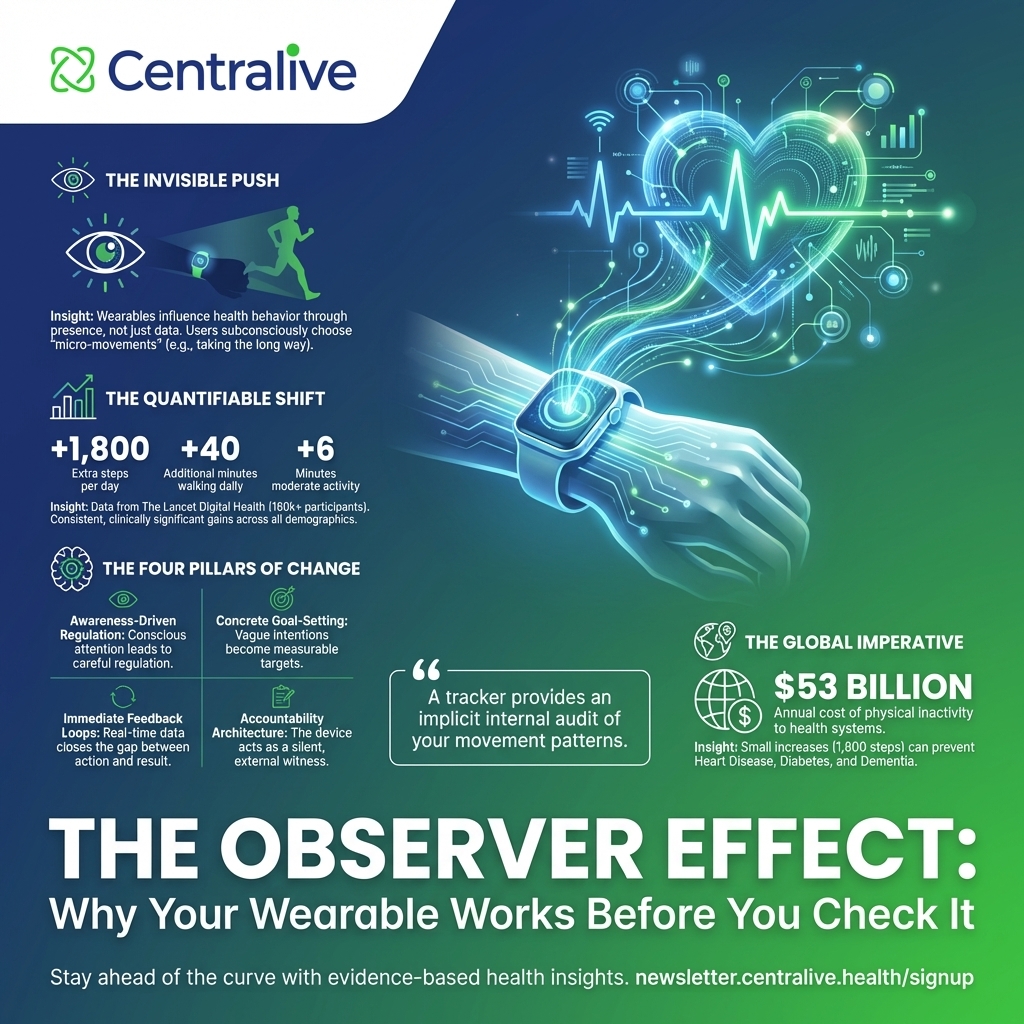
Before you glance at a single number, the act of putting a device on your wrist is already changing how you behave. Here is what the science says — and why it matters.
There is a peculiar effect that happens when you strap a fitness tracker to your wrist for the first time. You have not changed your diet. You have not hired a trainer. You have not signed up for a 5K. You have simply added a small device to your body — and yet, almost immediately, you start taking the long way to the coffee machine. You stand up a little sooner. You pace the hallway before a call. The numbers are not even telling you to do any of this. The tracker is just watching.
This is not a coincidence, and it is not placebo in the dismissive sense of the word. It is one of the most replicated findings in the modern exercise science literature: the simple act of monitoring your physical activity causes you to do more of it. The device works before you even understand it.
The numbers behind the effect
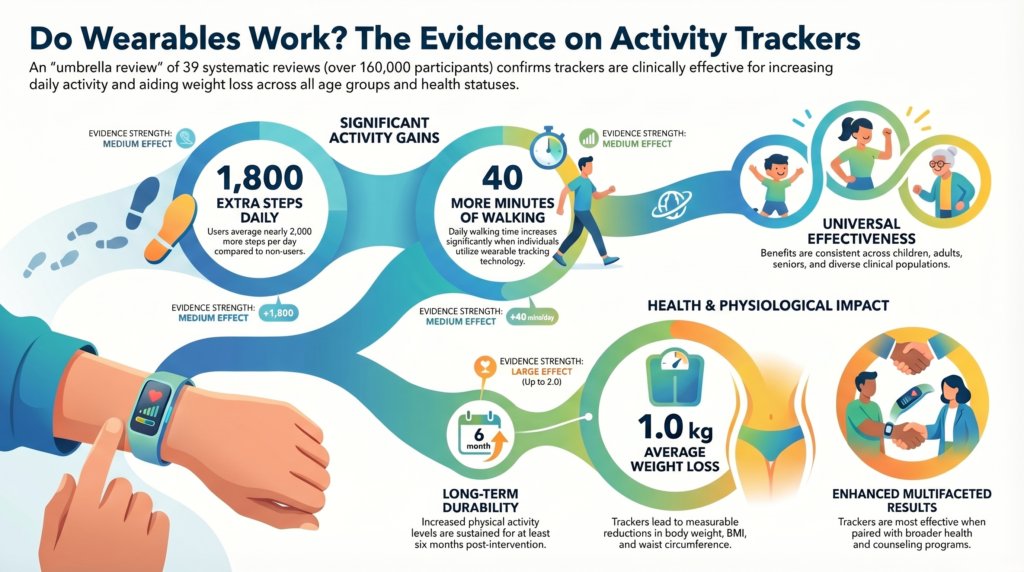
These three figures come from a landmark umbrella review published in The Lancet Digital Health in 2022 — arguably the most comprehensive analysis of wearable activity trackers ever conducted. Researchers at the University of South Australia pooled results from 39 systematic reviews and meta-analyses, covering data from 163,992 participants spanning all age groups, from healthy adults to people managing chronic illness:
- +1,800 extra steps per day on average
- +40 more minutes of walking per day
- +6 additional minutes of moderate-to-vigorous physical activity daily
The conclusion was striking in both its breadth and its consistency: wearable activity trackers reliably increase physical activity, across populations, across health conditions, and across contexts.
The scale of the problem trackers are trying to solve
To appreciate why that finding matters, it helps to understand the scale of the problem sitting beneath it. Physical inactivity is not merely a personal health risk — it is a global public health emergency with a very legible price tag. According to the World Health Organization, nearly 1.8 billion adults worldwide currently fail to meet recommended activity levels, and if that trend continues, inactivity rates are projected to climb to 35% by 2030.
The cost is not abstract. Research published in The Lancet estimates that physical inactivity cost global health-care systems over $53 billion in a single year, with an additional $13.7 billion lost to productivity. Looking forward, if current trends hold, almost 500 million new cases of preventable non-communicable diseases — heart disease, diabetes, certain cancers, dementia — could occur between 2020 and 2030, carrying health-care costs of $520 billion over that decade.
“Physical inactivity is a silent threat to global health, contributing significantly to the burden of chronic diseases.” — Dr. Rüdiger Krech, Director of Health Promotion, World Health Organization
Against that backdrop, any intervention that reliably gets people moving more — affordably, at scale, without requiring a clinic or a coach — is not a minor consumer technology story. It is a public health story. An extra 1,800 steps a day, sustained across millions of users, begins to look like a meaningful dent.
Why watching yourself changes what you do
The psychology driving this effect has been studied for decades under different names — self-monitoring, the observer effect, the Hawthorne effect — but the core mechanism is consistent. When human beings pay conscious attention to a behaviour, they tend to regulate it more carefully. We are, as a species, deeply responsive to feedback about ourselves.
Fitness trackers exploit this tendency with remarkable efficiency. They provide continuous, objective, real-time self-monitoring at essentially zero marginal effort. You do not need to remember to log anything. You do not need to interpret a spreadsheet. The number is simply there, on your wrist, every time you glance down.
Four psychological mechanisms appear to be doing most of the work:
Self-monitoring. Awareness of behaviour drives regulation. Seeing your step count creates an implicit internal audit of your movement patterns throughout the day.
Goal-setting. Trackers convert vague intentions (“I should move more”) into concrete, measurable targets that activate goal-directed behaviour.
Immediate feedback loops. Real-time data closes the gap between action and consequence, making the normally invisible effects of daily movement tangible and reinforcing.
Accountability architecture. The device functions as a silent external witness to your behaviour, triggering a social accountability response even without social features.
Research published in Perspectives on Public Health found that wearable device users had significantly higher rates of walking, moderate physical activity, and total physical activity compared to non-users, and meaningfully lower sedentary time. The researchers noted that wearables inspire motivation and engagement through habit formation — the device does not just prompt you in the moment, it gradually restructures how you think about your day.
A separate qualitative study of young adults found that the ability to track progress in real-time, set personalised goals, and receive immediate feedback were consistently highlighted as the key motivators keeping people accountable. Many participants also noted the social dimension: sharing achievements, participating in challenges, and knowing that others could see their progress added a layer of commitment that the device data alone could not supply.
The numbers are clinically meaningful
It is easy to read “1,800 extra steps” and shrug. In a world of 10,000-step targets, that sounds modest. But exercise scientists are careful about dismissing small consistent increases, because in population health terms, the arithmetic is unforgiving in both directions.
The Lancet umbrella review specifically noted that an increase of 5 to 10 minutes per day of moderate-to-vigorous physical activity is generally considered meaningful at a public health level. The wearable tracker data produced a 6-minute daily increase on average — sitting squarely in that clinically significant range. The review also found improvements in body composition and aerobic fitness, suggesting that the behavioural changes were translating into measurable physiological outcomes, not just step count inflation.
To put that in context: most traditional physical activity interventions — group education programmes, telephone counselling, gym memberships — are effective in the short term, but people fall off. The Lancet analysis found consistent evidence of tracker effectiveness across many different metrics and populations, including people with chronic conditions for whom exercise is particularly important and particularly difficult to initiate.
What the device does that you cannot do yourself
There is a version of the sceptical argument that goes: surely you could just count your own steps? Write down how long you walked? Set a timer to get up every hour? In theory, yes. In practice, the cognitive overhead of manual self-monitoring is substantial, the feedback is delayed and imprecise, and — most importantly — people simply do not do it consistently. Habit consistency is hard to maintain without an environmental prompt, and wearable trackers are, at their most effective, an exquisitely well-designed environmental prompt.
A striking piece of research from Stanford University illustrated just how sensitive people are to the data their device reflects back at them. Participants who received deliberately deflated step counts — seeing fewer steps than they had actually taken — went on to eat more unhealthily, experience more negative affect, report reduced self-esteem, and show elevated blood pressure and heart rate compared to participants receiving accurate data. The numbers were not just informational. They were shaping mood, identity, and downstream health behaviours in real time.
This finding illuminates both the power and the responsibility embedded in the design of tracking interfaces. The device is not a neutral mirror. It is an active participant in how users construct their sense of themselves as healthy or unhealthy, active or sedentary, on track or falling behind.
The tracker alone is not the whole story
It would be dishonest to present this as a simple triumphant technology story, because the research has a more complicated texture. The benefits described above — while real and replicable — are most consistent for general activity levels: how much people walk, how often they move throughout the day, how many minutes of moderate exercise they accumulate. When researchers look specifically at more intense exercise, or at long-term maintenance of behaviour change, the evidence becomes more mixed.
A 2025 systematic review of wearable trackers in school-based settings found no statistically significant effect on moderate-to-vigorous physical activity in adolescents — only on overall step counts. Trackers may motivate low-intensity lifestyle movement more reliably than structured vigorous exercise.
Research from UCLA found that a tracker alone is likely insufficient for sustained behaviour change. Users made the largest and most durable health improvements when the device was paired with personalised, daily feedback from a human coach — text messages that interpreted the data and offered contextualised encouragement. The tracker’s self-monitoring function was necessary but not sufficient.
Long-term adherence remains an open question. Many users report abandoning trackers within months of purchase, and the motivational effects may attenuate once the novelty of the data wears off.
UCLA researchers put it plainly: “Current consumer-grade wearables align well with the behavioural change technique of self-monitoring, but without an action planning and commitment step, they may have less of an impact on actual behavioural change.”
The quiet revolution in population health
Step back from the individual level and the aggregate picture becomes genuinely striking. We are living through a period in which hundreds of millions of people are wearing continuous activity monitors for the first time in human history. Whatever the limitations of any individual device, the collective behavioural signal is detectable and meaningful.
The device on your wrist is not going to solve the physical inactivity crisis by itself. But it turns out that simply paying attention to how you move — having an object that asks, silently, have you moved enough today? — is not a trivial thing. It changes behaviour. And behaviour, accumulated across millions of people and thousands of days, changes outcomes.
You put on the watch. You take the stairs. That is a small loop, imperfectly understood, running quietly in the background of a much larger problem. But the science is clear: the loop is real, and it works.
Sources: Ferguson et al., The Lancet Digital Health (2022); Ding et al., The Lancet (2016); Costa Santos et al., The Lancet Global Health (2022); Zahrt et al., JMIR (2023); Yen et al., Perspectives on Public Health (2021); WHO Global Status Report on Physical Activity (2022).