Self-report instruments have always been constrained by what participants can type or tap. A Likert scale captures intensity but not appearance. A free-text field captures language but not tone, pause, or affect. For many constructs that matter in mobile and digital health research, especially those that are visual, embodied, or temporally rich, text is a lossy compression of the underlying signal.
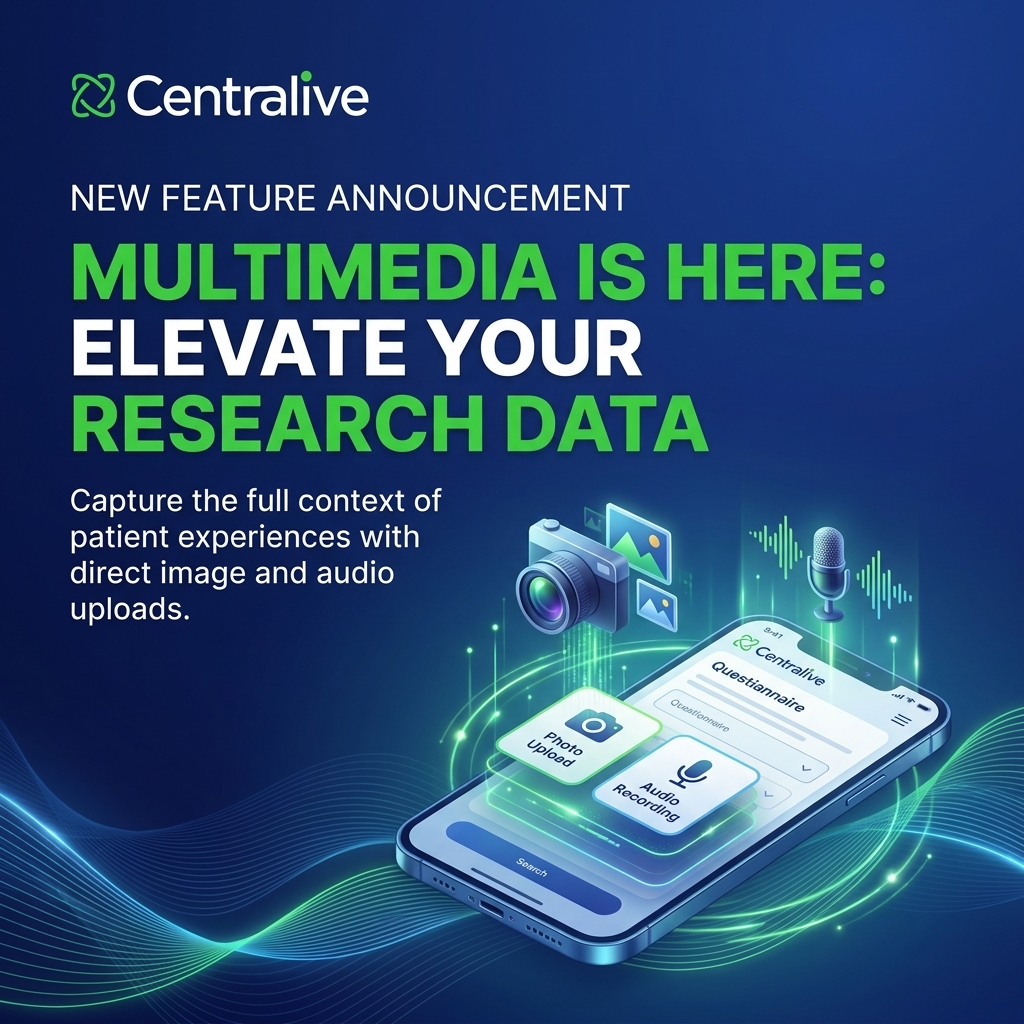
Centralive now supports multimedia file uploads inside questionnaires and ecological momentary assessments (EMAs). Participants can attach images, audio recordings, and other file types directly to individual items, alongside the conventional response formats already supported in the platform. This post walks through the rationale, the implementation, and the study design implications.
Why multimedia matters for EMA-driven research
EMA was built on the premise that in-the-moment capture reduces recall bias and improves ecological validity. The same logic extends to modality. If you are studying dietary behavior, a photograph of the plate is closer to ground truth than a participant’s text description of portion size three hours later. If you are studying wound healing, serial images give you objective progression data that no symptom rating can match. If you are studying mood, prosody and vocal energy carry information that a 0 to 10 slider discards.
The trade has historically been one of feasibility. Asking participants to take photos or record audio used to require either a study-specific app or a clunky out-of-band workflow involving email or cloud storage links. Both options fragment the data, complicate consent, and break the time-stamped chain that makes EMA defensible. Embedding multimedia directly into the item flow closes that gap.
What the feature actually does
Inside the Centralive questionnaire builder, study designers can now add a multimedia item type to any survey or EMA. Each multimedia item can be configured for:
- Image capture, either from camera or library, with optional constraints on source (camera-only is useful when you want a fresh capture rather than a re-uploaded archived photo)
- Audio recording, with configurable maximum duration
- General file upload for cases where participants need to attach documents, lab results, or other artifacts
Files are bound to the response record with the same timestamp, participant ID, and study metadata as any other item, so the multimedia object sits in the same row as the rest of the EMA burst rather than in a separate silo. Uploads are encrypted in transit and at rest and stored under the same access controls as the rest of the study data, which matters for IRB review and for studies operating under HIPAA.
Concrete use cases
A few that we expect to see most often:
Dietary assessment. Replacing or augmenting 24-hour recall with momentary food photography. Studies in nutritional epidemiology have shown that image-based capture reduces underreporting of snacks and portion misestimation, particularly when paired with a brief contextual prompt (“what is this”, “where are you eating”, “are you eating alone”). The photo becomes the anchor; the EMA items add the context that a vision model alone cannot infer.
Wound and skin monitoring. Post-surgical recovery, chronic ulcer management, and dermatologic studies all benefit from longitudinal image series. A weekly or biweekly image prompt embedded in the standard symptom EMA gives clinicians and researchers a visual record they can review asynchronously or pipe into segmentation models for objective area and color metrics.
Medication adherence verification. Visual confirmation of the medication bottle, blister pack, or actual administration step adds a verification layer to self-reported adherence. This is particularly useful in trials where adherence is a known confounder and where the cost of an electronic pill bottle is prohibitive for the sample size.
Voice diaries and affective sampling. For participants, speaking is often faster and more natural than typing, especially during high-burden moments such as pain flares, post-event reflections, or end-of-day diaries. Audio also preserves paralinguistic features that downstream analyses (acoustic biomarkers, sentiment, speech rate) can extract. We see particular promise here for mental health studies, post-concussion symptom tracking, and any protocol where the cognitive load of typing competes with the construct being measured.
Considerations for study design
Three things to plan for before adding multimedia items to a protocol.
First, participant burden. Multimedia items are higher-effort than tapping a Likert option. Use them sparingly, ideally tied to a specific event prompt rather than every EMA burst. A common pattern is to keep the high-frequency EMA short and text-based, and to trigger a multimedia branch only when a participant reports an event of interest.
Second, storage and annotation pipelines. Image and audio data are orders of magnitude larger than text responses, and they typically require downstream processing (manual coding, automated transcription, computer vision) before they enter analysis. Budget for this in the data management plan and decide early whether annotation happens inside the study team or via a vendor.
Third, privacy and identifiability. Photos of food are low-risk. Photos of wounds, medication bottles with prescription labels, and voice recordings are not. Participants should be re-consented or at minimum re-informed at the point of capture about what is being collected and how it will be stored. Centralive supports per-item consent prompts to make this explicit.
Availability
The multimedia item type is available now in the Centralive questionnaire and EMA builder for all active studies. Research teams already using Centralive can enable it on existing instruments without rebuilding flows. If you are scoping a new study and want to discuss whether multimedia capture fits the protocol, we are happy to consult on the design.