Understanding MET: Debunking 5 Common Misconceptions in Exercise Science
Metabolic Equivalent of Task (MET) is a foundational concept in exercise physiology, providing a standardized way to compare the energy costs of different physical activities. However, as MET values have become a staple in fitness trackers and clinical guidelines, several misconceptions have taken root. Understanding these nuances is crucial for anyone looking to optimize their training or accurately track their health data.
1. The Myth of Universal Resting Metabolism
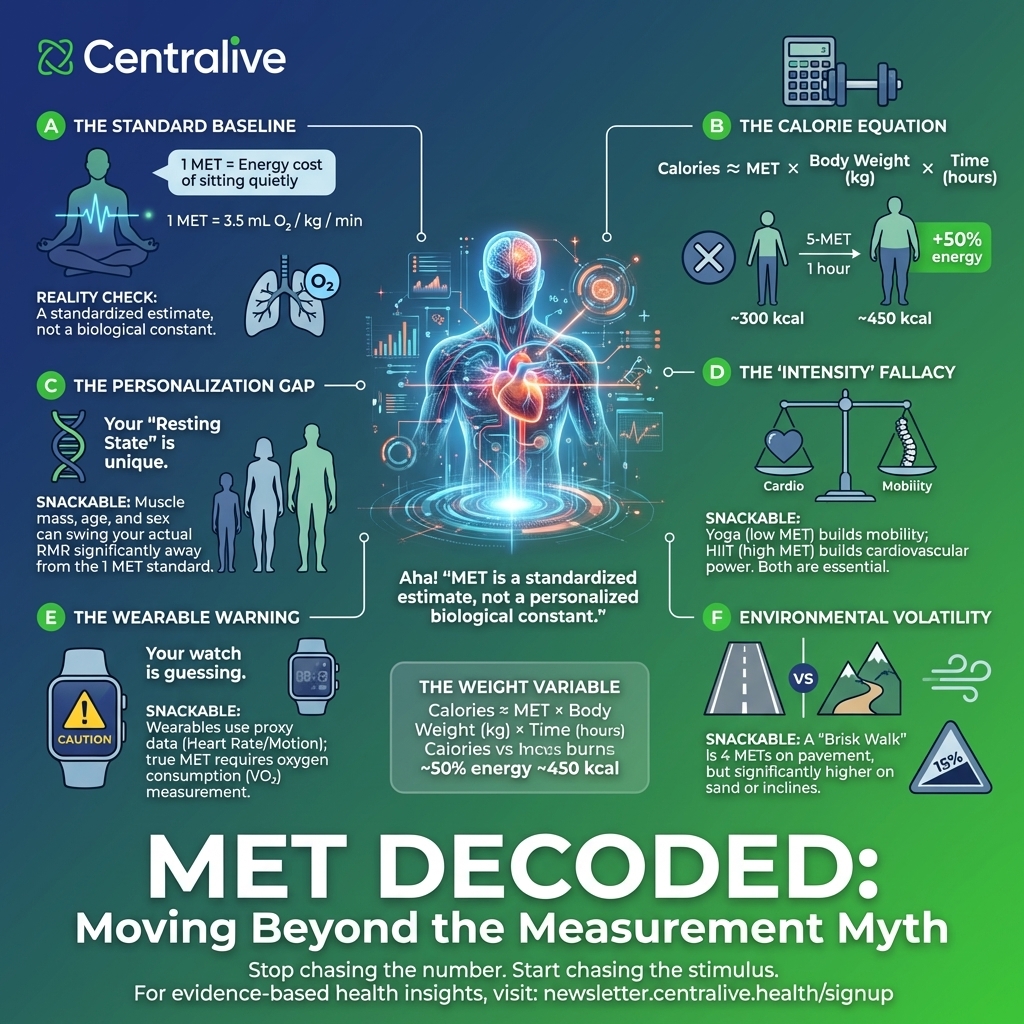
A common misconception is that 1 MET represents the exact same energy expenditure for every person. By definition, 1 MET is approximately 3.5 mL O₂/kg/min. However, this is a standardized baseline. In reality, actual resting metabolic rates vary significantly based on individual factors such as age, sex, body composition, and overall fitness. For instance, an individual with higher muscle mass will often have a higher resting metabolic rate than the standard 1 MET estimate suggests, while older adults may fall below it. MET is an estimate, not a personalized biological constant.
2. Intensity Does Not Equal Effectiveness
Many believe that a higher MET value automatically translates to a “better” workout. While MET measures the intensity of an activity relative to rest, it does not measure the total health benefit or effectiveness. Activities like yoga, Pilates, or heavy resistance training may have lower MET values compared to high-intensity interval training (HIIT), but they are essential for developing flexibility, muscle strength, and metabolic health. Your fitness goals—whether they be recovery, strength, or endurance—should dictate your activity choice, not just the MET score.
3. The Limitation of Wearable Technology
While smartwatches are convenient, they do not directly measure MET. True MET calculation requires measuring actual oxygen consumption (VO₂). Wearables estimate MET using proxy data like heart rate and movement sensors. This estimation often falters during activities with minimal wrist movement (like cycling) or activities that don’t have a linear heart-rate-to-effort relationship (like weightlifting). Treat wearable MET values as rough approximations rather than absolute truths.
4. MET vs. Caloric Expenditure
MET values are often confused with direct calorie counts. However, the calories burned during an activity are a product of the MET value, the individual’s body weight, and the duration of the exercise. The formula is typically: Calories ≈ MET × body weight (kg) × time (hours). This means that a person weighing 90kg will burn significantly more calories performing a 5-MET activity than someone weighing 60kg doing the exact same task.
5. The Dynamic Nature of Activity Values
Finally, it is a mistake to view MET values as fixed for specific activities. A “brisk walk” isn’t always 4 METs; it depends heavily on the pace, terrain, and environmental conditions. Walking uphill or on sand dramatically increases the metabolic demand compared to walking on a flat pavement. MET values are context-dependent and fluctuate based on how the activity is performed.
Conclusion
MET is an incredibly useful tool for categorizing physical activity and understanding metabolic demand, but it is not infallible. By recognizing it as a standardized estimate rather than a precise personal metric, you can use it more effectively to guide your fitness journey.
For more evidence-based health insights, subscribe to our newsletter: https://newsletter.centralive.health/signup