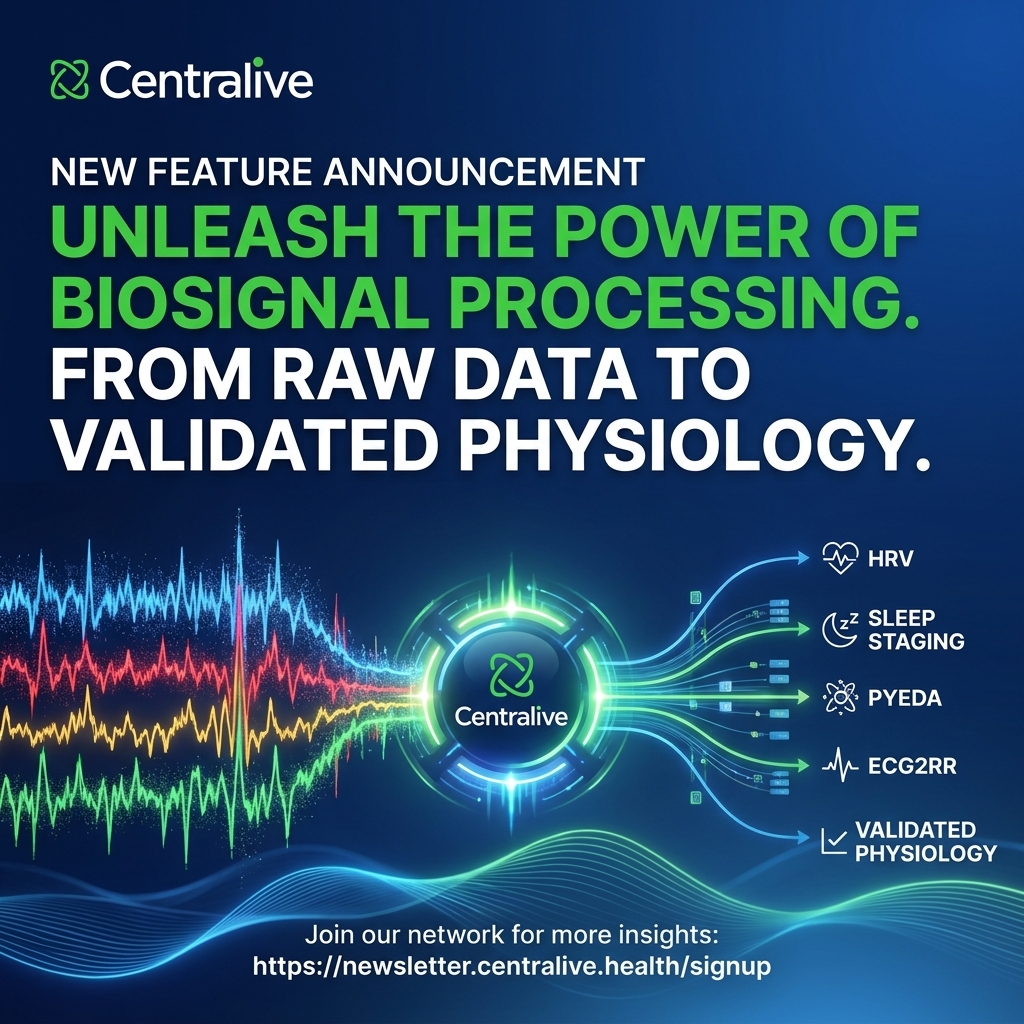
Wearable and clinical sensors generate enormous volumes of raw signal, but raw signal is not the same as physiology. The distance between a noisy voltage trace and a defensible heart rate variability metric is bridged by signal processing, and that is the work Centralive specializes in. Our biosignal processing services span a wide range of modalities, including ECG, EEG, PPG, accelerometry, electrodermal activity (EDA), and respiration, with downstream analytics for sleep, physical activity, and gait. The goal is consistent across all of them: produce measurements that hold up to scrutiny.
Coverage across the full sensor stack
Different physiological questions call for different sensing modalities, and each modality carries its own processing demands. Centralive works across the stack rather than specializing in a single signal type:
- ECG for beat-to-beat cardiac timing, R-peak detection, and arrhythmia-relevant morphology.
- PPG for optical pulse measurement on the wrist and finger, where motion artifact is the central challenge.
- EEG for cortical activity, including sleep-relevant spectral analysis.
- Accelerometry for movement, posture, activity classification, and gait.
- EDA (galvanic skin response) for sympathetic arousal, decomposed into tonic and phasic components.
- Respiration for breathing rate and pattern, often derived alongside cardiac signals.
The hard part is signal quality
In free-living and remote settings, the dominant problem is not extracting features from clean data, it is deciding which data is clean enough to use. Motion artifacts, poor sensor contact, and ambient interference routinely corrupt wrist-worn PPG, and naively computed heart rate or HRV from corrupted segments produces confident nonsense. Our pipelines treat signal quality assessment as a first-class step: classifying reliable versus unreliable segments, reconstructing short noisy windows where appropriate, and only then extracting physiological features.23
The same principle applies to ECG. Robust R-peak detection on noisy ambulatory recordings is a prerequisite for any interbeat interval analysis, and deep learning approaches that model the temporal structure of the signal outperform classical threshold-based detectors when artifact levels are high.4 Respiration rate can be recovered from the same smartwatch PPG and accelerometer streams, but the respiratory component sits in a low-frequency band that is easily swamped by noise. Our team addresses this with a transfer-learning approach that estimates respiration rate robustly from wrist-based signals.6
Comprehensive heart rate variability analysis
Once clean interbeat intervals are in hand, Centralive computes the full complement of heart rate variability metrics across all three standard families. Time-domain measures such as SDNN and RMSSD quantify the overall amount of variability. Frequency-domain measures partition signal energy into low and high frequency bands and their ratio. Nonlinear measures, including Poincare plot descriptors (SD1, SD2) and entropy-based indices, capture the complexity and unpredictability of the interval series that linear metrics miss.5 Reporting across all three families matters because the domains are not interchangeable, and recording length materially affects which metrics are valid.5
Sleep, physical activity, and gait
Higher-level outcomes build on the same processed signals, and sleep staging is an area where our team has published extensively. We have shown that deep learning of PPG together with respiration patterns improves sleep stage prediction from wearable data.7 Our most recent work pairs a transformer-based classifier with a Hidden Markov Model postprocessing step that enforces physiologically plausible stage transitions; on wrist-worn PPG and accelerometry evaluated epoch by epoch against polysomnography, it reaches up to 90.0% accuracy and a Cohen’s kappa of 0.831 for four-stage staging, with the temporal correction step sharply reducing the isolated misclassifications that plague deep-learning-only models.8 This matches expert-level interscorer agreement on healthy cohorts, and independent work points the same direction, with wrist PPG plus accelerometry reaching substantial agreement with reference PSG on multi-class staging.9
Physical activity classification and energy-expenditure estimation draw on the same accelerometry streams. For gait, inertial sensors recover spatiotemporal parameters such as cadence, stride time, and step length, with validation work showing good agreement with optical motion capture for many parameters and greater variability for others, which is exactly why careful processing and honest uncertainty reporting matter.10
We build the tools the field uses
Centralive’s team has not only applied biosignal processing methods, it has helped establish them. We have authored and released open-source Python libraries that are now used across the research community:
- pyEDA: preprocessing and feature extraction for electrodermal activity, including both statistical and autoencoder-based automatic features.1
- E2E-PPG: an end-to-end PPG pipeline covering quality assessment, motion-artifact handling, signal reconstruction, peak detection, and HR/HRV feature extraction.2
- pyPPGqa: a deep learning approach to PPG signal quality assessment for reliable HR and HRV.3
- ecg2rr: robust ECG R-peak detection using LSTM networks for accurate RR-interval extraction.4
Building and maintaining these tools keeps our methods transparent and reproducible, and it means the pipelines we deploy for partners are grounded in peer-reviewed, openly validated work rather than black boxes.
Raw signal access is the foundation
None of this is possible without access to the underlying signal. Many consumer platforms expose only smoothed, vendor-computed summaries, which forecloses independent quality assessment and custom feature engineering. This is where raw-signal platforms earn their place in research workflows. Garmin, for example, functions as a first-class research platform: its developer tooling exposes raw signals such as beat-to-beat intervals and accelerometry, it carries no analytics subscription requirement, and accessible entry-level hardware lowers the barrier for large or remote cohorts. Direct access to raw data is what lets our pipelines apply their own quality control and extract features that off-device summaries simply cannot provide.
Working with Centralive
Whether you are running a clinical study, validating a new device, or building a digital health product, Centralive’s biosignal processing services can take you from raw multi-sensor data to validated, publication-ready physiology. If you would like to discuss a project, we would be glad to talk through your signals, your constraints, and the outcomes you need.
References
- Aqajari SAH, Kasaeyan Naeini E, Asgari Mehrabadi M, Labbaf S, Dutt N, Rahmani AM. pyEDA: An Open-Source Python Toolkit for Pre-processing and Feature Extraction of Electrodermal Activity. Procedia Computer Science. 2021;184:99-106. https://github.com/HealthSciTech/pyEDA
- Feli M, Kazemi K, Azimi I, Wang Y, Rahmani AM, Liljeberg P. End-to-End PPG Processing Pipeline for Wearables: From Quality Assessment and Motion Artifacts Removal to HR/HRV Feature Extraction. 2023 IEEE International Conference on Bioinformatics and Biomedicine (BIBM). 2023. https://github.com/HealthSciTech/E2E-PPG
- A Deep Learning-based PPG Quality Assessment Approach for Heart Rate and Heart Rate Variability. ACM Transactions on Computing for Healthcare. 2023. DOI: 10.1145/3616019. Library: https://github.com/HealthSciTech/pyPPGqa
- Laitala J, Jiang M, Syrjala E, Kasaeyan Naeini E, Airola A, Rahmani AM, Dutt ND, Liljeberg P. Robust ECG R-peak Detection Using LSTM. Proceedings of the 35th Annual ACM Symposium on Applied Computing (SAC ’20). 2020:1104-1111. DOI: 10.1145/3341105.3373945. Library: https://github.com/HealthSciTech/ecg2rr
- Shaffer F, Ginsberg JP. An Overview of Heart Rate Variability Metrics and Norms. Frontiers in Public Health. 2017;5:258. DOI: 10.3389/fpubh.2017.00258
- Kazemi K, Azimi I, Liljeberg P, Rahmani AM. Respiration Rate Estimation via Smartwatch-based Photoplethysmography and Accelerometer Data: A Transfer Learning Approach. Proceedings of the ACM on Interactive, Mobile, Wearable and Ubiquitous Technologies (IMWUT). 2025;9(1):Article 7. DOI: 10.1145/3712280
- Kazemi K, Abiri A, Zhou Y, Rahmani AM, Khayat RN, Liljeberg P, Khine M. Improved sleep stage predictions by deep learning of photoplethysmogram and respiration patterns. Computers in Biology and Medicine. 2024;179:108679. DOI: 10.1016/j.compbiomed.2024.108679
- Kazemi K, Kourkchi E, Rahmani AM, Homayoun H, Liljeberg P. A Hybrid Sleep Stage Detection Using Hidden Markov Chains and Transformers. 47th Annual International Conference of the IEEE Engineering in Medicine and Biology Society (EMBC). 2026 (forthcoming).
- Fonseca P, van Gilst MM, Radha M, et al. It is All in the Wrist: Wearable Sleep Staging in a Clinical Population versus Reference Polysomnography. Nature and Science of Sleep. 2021;13:885-897. DOI: 10.2147/NSS.S306808
- Validity of Wearable Inertial Sensors for Gait Analysis: A Systematic Review. Sensors. 2024. https://www.ncbi.nlm.nih.gov/pmc/articles/PMC11719792/
Sign up for the Centralive Newsletter: https://newsletter.centralive.health/signup