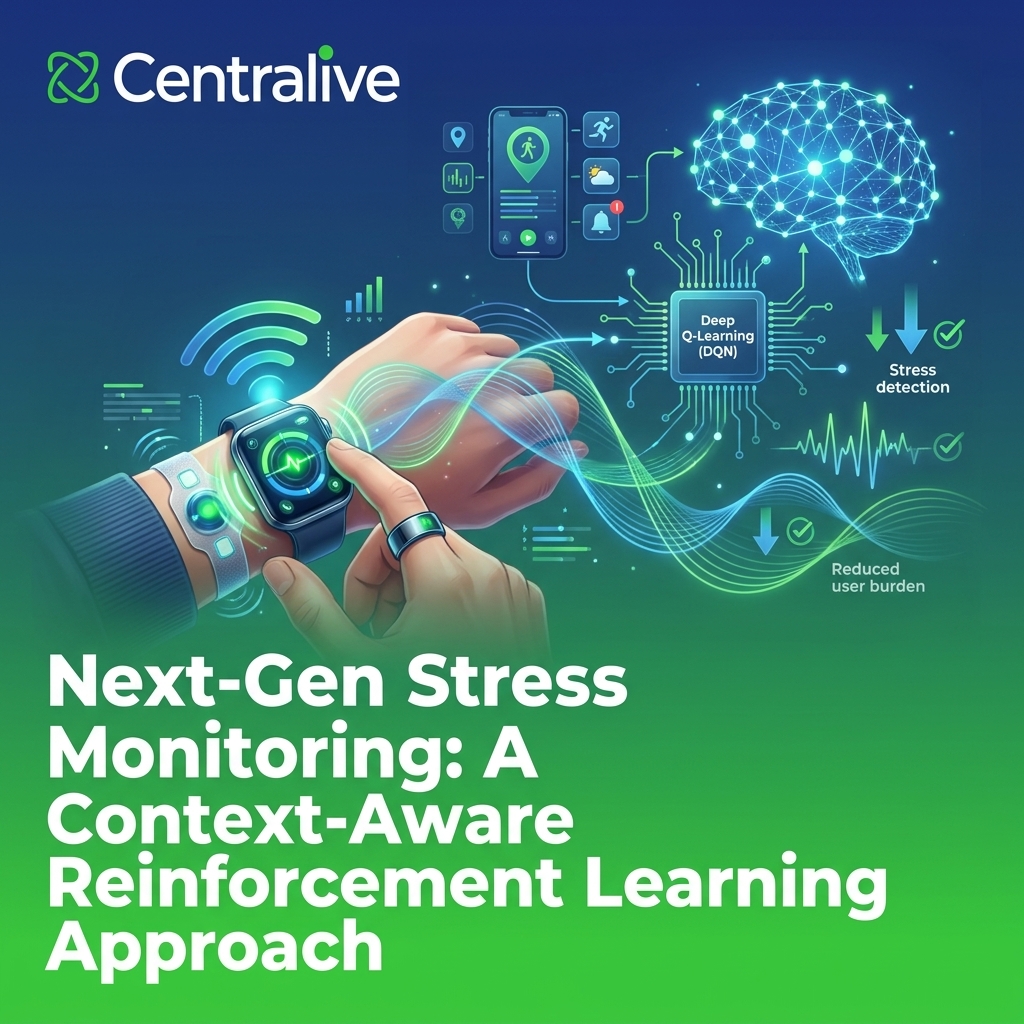
Enhancing Performance and User Engagement in Everyday Stress Monitoring: A Context-Aware Active Reinforcement Learning Approach
Methodology
The researchers developed a three-layer system (Sensor, Edge, and Cloud) called ZotCare. By utilizing Deep Q-Learning (DQN), the system models user behavior as a Markov Decision Process. The algorithm analyzes real-time physiological signals like photoplethysmography (PPG) from smartwatches alongside contextual smartphone data—including screen activity, call history, and time of day—to determine the most appropriate moment to trigger an Ecological Momentary Assessment (EMA).
Findings
The study demonstrated that context-aware triggering significantly outperforms traditional random or time-based methods. Key results include a reduction in required EMAs by up to 88% and a substantial increase in classification performance. Specifically, the Random Forest F1 score rose to 0.36 when contextual features were included, and personalization efforts yielded an AUC increase of up to 0.10 across Random Forest, XGBoost, and SVM classifiers.
Impact
This approach addresses the critical challenge of user burden in longitudinal health studies. By intelligently scheduling assessments based on user context and response history, researchers can maintain high data quality and user engagement, paving the way for more effective, personalized mHealth interventions in mental health and wellness.
This research was powered by the Centralive Platform.
Authors: Seyed Amir Hossein Aqajari, Ziyu Wang, Ali Tazarv, Sina Labbaf, Salar Jafarlou, Brenda Nguyen, Nikil Dutt, Marco Levorato, and Amir M. Rahmani.
Full paper: https://dl.acm.org/doi/epdf/10.1145/3837063
Join our network for deeper insights: https://newsletter.centralive.health/signup