
Centralive Blog
Want to know more about the Centralive features? Read our blog posts here.
Missing Nights in Wearable Sleep Studies: How to Handle Non-Wear When Participants Forget the Device
One of the most common questions researchers ask when designing a wearable sleep study is deceptively simple: what do you do about the nights a participant forgot to put the device on, or the stretch where a sensor quietly stopped recording? Every real-world deployment produces these gaps. The mistake is treating them as a nuisance […]
Read More
What Compliance Rate Should You Set as a Minimum Threshold, and How Do You Enforce It?
Stop guessing your wearable data thresholds. Learn why the 80% rule causes sample bias and how to set evidence-based compliance rules for valid research results.
Read More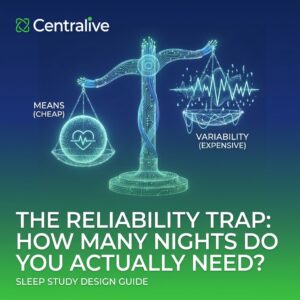
One of the most common questions from researchers designing a wearable sleep study is deceptively simple: how many nights of data do I need before my estimate of a participant’s sleep is stable and representative?
How many nights of wearable data do you really need? Learn why 7 nights is enough for habitual means, but 60+ nights are required for sleep variability study.
Read More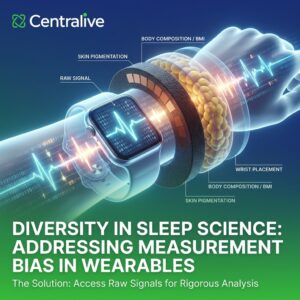
Does Skin Tone, BMI, or Dominant Hand Affect Sleep Measurement Accuracy?
Does skin tone or BMI skew your wearable data? Discover the evidence-based reality of PPG bias and the framework for ensuring accuracy in diverse sleep studies.
Read More
Can Wearables Identify Sleep Disorders Like Insomnia, Sleep Apnea, or Restless Legs?
Can wearables diagnose sleep disorders? Explore the evidence for OSA, Insomnia, and RLS, and why raw signal access is critical for research-grade accuracy.
Read More
Rolling Windows for HRV: How to Tell a Meaningful Change From Daily Noise
Is that daily HRV drop a real signal or just noise? Discover why rolling windows are the gold standard for tracking Heart Rate Variability in remote monitoring.
Read More
How Do Wearables Handle Unusual Sleep? Shift Work, Naps, Bed-Sharing, and Irregular Schedules
Consumer sleep wearables assume your participants sleep alone at night in one bout. Learn how shift work, naps, and partners distort data, and how to fix it.
Read More
Does the Device Algorithm Get Updated, and Could That Change Your Results Mid-Study?
Did a silent device algorithm update just invalidate your wearable sleep study? Learn why firmware changes threaten research and how to protect your data.
Read More
When to Use Actigraphy and When to Use Machine Learning for Sleep Analysis
Deciding between classic actigraphy and machine learning for sleep analysis? Discover when to use heuristic models versus AI for raw signal processing.
Read More
How Raw Multimodal Signals Beat the Black-Box Sleep Score
Wearable sleep scores are often black boxes. Discover why raw multimodal signals and off-device modeling are essential for transparent, auditable research.
Read More