
A fixed-schedule prompt (every day at 2 pm, three times a day, every two hours) is easy to build and easy to ignore. The harder and more useful question for anyone designing a mobile health intervention is behavioral, not logistical: how do you deliver support at the moment a person both needs it and is able to act on it, rather than when the clock happens to strike? That is the organizing idea behind the just-in-time adaptive intervention (JITAI), and it turns on two states that are easy to conflate and must be kept separate: vulnerability and receptivity. This post walks through how the literature defines those states, how researchers choose the tailoring variables that detect them, and what the evidence says about how well any of this actually works.
The mechanism: six elements, two states
The foundational framework describes a JITAI as an intervention that adapts the type, amount, and timing of support “to the dynamics of an individual’s internal state and context,” with the goal of acting “at the moment and in the context that the person needs it most and is most likely to be receptive.”1 It is built from six elements: a distal outcome (the ultimate clinical goal), proximal outcomes (the short-term targets the intervention can plausibly move), decision points (when a decision to act or not is made), intervention options (what can be delivered, including nothing), tailoring variables (the information used to decide), and decision rules (the if-then logic linking variables to options).1
The proximal outcome is the anchor. Timing in a JITAI is event-based rather than clock-based: the answer to “when is the right time?” is defined by conditions, such as approaching a high-risk location, rather than by a time of day.1 Because those conditions recur irregularly, the system has to monitor the person continuously, and the flip side of right-time support is providing nothing when the time is wrong.1
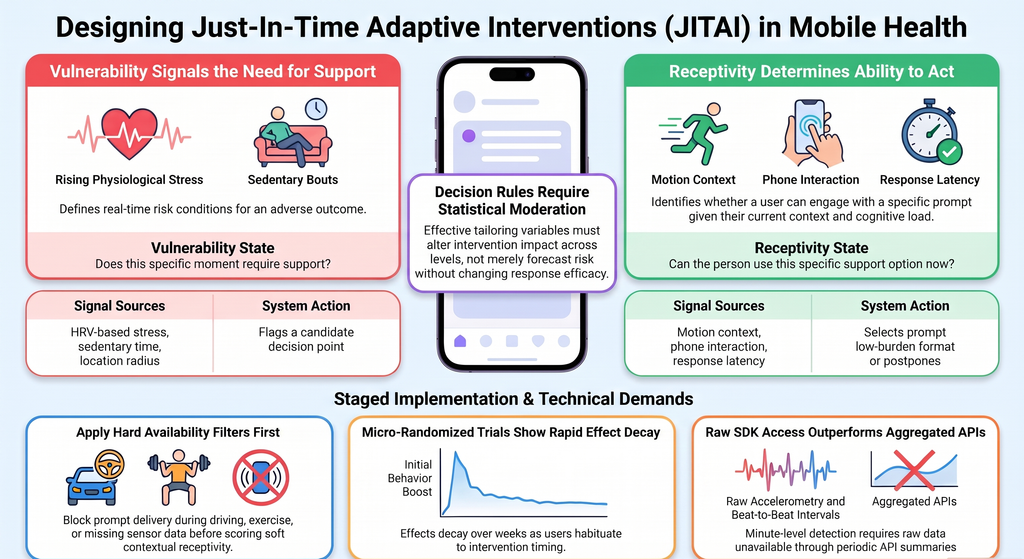
That is where the two states come in. A 2025 update to the framework defines them precisely:2
- Vulnerability is a set of conditions that represent risk for an adverse proximal outcome (rising stress before a smoking lapse, prolonged sitting, proximity to a favorite bar during recovery).
- Opportunity is a set of conditions in which delivering an intervention is expected to promote a desirable outcome (just after a self-monitoring task, a teachable moment). Some states are both.
- Receptivity is the set of conditions in which the person is likely to effectively engage with a specific intervention option.
The distinction is the whole game. Vulnerability answers “does this moment need support?” Receptivity answers “can this person use this support right now?” Peak craving can coincide with driving, a work meeting, or cognitive overload. Deliver anyway and you waste the prompt and risk fatigue and disengagement; withhold at every non-receptive vulnerable moment and you miss the window.1,2 The original framework makes receptivity concrete with a simple example: a person in a meeting may be receptive to a text message but not a phone call, and when it is raining, receptive to an indoor-exercise suggestion but not a walk.1 Crucially, receptivity is intervention-specific. To operationalize it, you list every stimulus and task in an option and ask what has to be true to engage with each. For a prompt that asks someone to notice a work emotion and take a short walk, receptivity requires the ability to engage with the message (not driving), with emotional awareness (not absorbed in a demanding task), and with walking (not in a meeting).2
Choosing tailoring variables
Tailoring variables are the signals the decision rule reads. They fall into a few families: internal states (affect, stress, craving, usually self-reported through ecological momentary assessment, increasingly inferred), context (location, time, weather, social setting), physiological signals (heart rate, heart rate variability, respiration, sleep), and behavioral signals (steps, sedentary time, app use, phone interaction). Engagement indicators (non-response, recent prompt dose, response latency) are tailoring variables too.
The selection logic is theory-driven first, then data-tested. Variables are chosen because evidence shows they help decide when and how to intervene, guided by the proximal outcome.1 There is an important subtlety here that separates a useful tailoring variable from a merely predictive one. Predicting risk tells you who is vulnerable. What a decision rule actually needs is moderation: a variable where the intervention’s effect differs across its levels. A signal can forecast a lapse perfectly and still be useless for tailoring if prompting does not help more in the high-risk state than the low-risk one. The practical path is to use theory and prior intensive-longitudinal data to nominate candidate precursors of the proximal outcome, prefer the ones measurable at the decision-point timescale with low burden, and then test whether each actually moderates the effect.
Passive sensing is attractive because it lowers burden and enables continuous decision points, but it carries measurement error and missingness. The Sense2Stop smoking study, which used chest and wrist sensors to classify minute-level stress, only randomized episodes it could actually classify, requiring fewer than half the minutes in a window to be missing or confounded by physical activity.3 Hybrid rules that pair a passive trigger with a one-tap self-report confirmation (proximity to a liquor store and a reported urge) are a pragmatic compromise when sensors are noisy.1
What the evidence actually shows
Two things are true at once: the moment matters, and the effects are small and fragile. Both deserve to sit in front of anyone planning a study.
Receptivity can be predicted, but only moderately well. In a six-week study of 189 participants receiving real physical-activity prompts, in-the-moment receptivity was associated with day and time, phone battery, phone interaction, physical activity, and location, and machine-learning classifiers improved the F1 score by up to 77 percent over a biased random classifier.4 A follow-up deployment found that a learned timing model improved receptivity by up to roughly 40 percent compared with sending messages at random times.5 Earlier work established the minimum viable receptivity filter: response delay to prompts, modeled from more than 2,000 hours of sensor data, was predictable from location, affect, activity type, stress, time, and day of week.6 A separate model showed that being interruptible is not the same as being able to comply with a behavioral request, which is why receptivity has to be defined per option rather than as a single “available” flag.7
Proximal effects are real, but they decay. HeartSteps, a 42-day micro-randomized trial with up to five decision points a day, is the clearest window into this. Averaged over all suggestions, delivering a prompt versus nothing raised step count in the next 30 minutes by 14 percent (about 35 steps on a 253-step base, p = .06).8 Walking suggestions did better, at roughly 24 percent (about 59 steps, p = .02), and better still at the very start of the study, where they produced about 271 additional steps (a 107 percent lift) before the effect shrank over the following weeks.8 Anti-sedentary suggestions had no detectable effect on the 30-minute step count, even though participants said they liked them.8 The authors’ conclusion is the design lesson: sustaining benefit requires a delivery schedule that minimizes habituation.8
Across studies, the picture is promising but immature. A systematic review of physical-activity JITAIs found 19 papers covering 14 unique interventions, typically three to four weeks long, with mixed evidence on behavior and, tellingly, no study sufficiently powered to detect it.9 A widely cited meta-analysis reported large pooled effects (for example, Hedges g of 1.65 versus waitlist), but it pooled true JITAIs with less adaptive ecological momentary interventions, so those figures are best read as optimistic.10 A more recent and tighter meta-analysis in mental health found a small effect (g = 0.15, 95 percent CI 0.05 to 0.26) across 23 studies and 2,563 participants, with moderate-to-high risk of bias.11 Treat JITAI benefits as plausible and proximal, not as established long-term clinical outcomes.
A staged framework for need-and-receptivity delivery
Design: write the states down before choosing a sensor
Start from the proximal outcome and the conceptual model (distal to proximal to mechanisms to options to decision points to the conditions that facilitate or inhibit benefit), and only then choose data streams.2 Set decision-point frequency by how fast the vulnerability state changes: minutes for stress and smoking, hours for physical activity, twice daily for something like tooth-brushing. Define each vulnerability or opportunity state as an explicit, time-bounded condition with a threshold (“60 or more minutes sitting,” “stress likelihood above a cut point,” “within a set radius of a user-flagged location”). Then specify receptivity per option by listing its stimulus and tasks, and budget the dose: cap prompts per day and enforce refractory periods, lowering delivery probability as recent dose rises.2,8
Collection: a hard availability filter plus soft receptivity scores
Implement a hard availability filter that blocks delivery when the person is driving, already walking or exercising, asleep, has paused the intervention, or when sensor data are missing, exactly as HeartSteps did by randomizing only at “available” decision points.12 Layer soft receptivity signals on top (time, location type, phone unlock and interaction, recent response latency), and match option burden to receptivity rather than only gating: at a vulnerable-but-low-receptivity moment, offer a lower-effort option or defer within a short window, treating “postpone” as a legitimate decision-rule choice.5 Log every decision point with its context and its randomization probability, because that log is what the analysis depends on.
Analysis: test moderation, then graduate to learned rules
The micro-randomized trial is the workhorse: randomize each person to options hundreds or thousands of times, at each available decision point, so you can estimate the causal proximal effect of an option and test whether it is moderated by a candidate tailoring variable or by time.12 Plan sample size with methods built for this design.13 To control over-prompting formally, randomize under a soft daily budget (“just-in-time but not too much”), as Sense2Stop did by targeting roughly one treatment at stressed times and about 1.5 at non-stressed times per day and none when the state was unknown.14 When you have enough data, graduate from static if-then rules to a learned policy: a contextual bandit initialized with priors from your micro-randomized data solves the cold-start problem, as in Personalized HeartSteps.15 Keep some randomization so the system keeps learning, and verify statistically that it actually personalized rather than drifted, since apparent personalization can be an artifact of algorithmic randomness.16
Why raw signal access is the methodological constraint that matters
Everything above depends on one thing: time-aligned, high-resolution streams available fast enough to drive an event-based decision. This is where the platform layer stops being an implementation detail and becomes a study-design constraint. Detecting a vulnerability state like physiological stress needs beat-to-beat intervals, not a once-nightly summary heart-rate figure; detecting a sedentary bout or the motion context that governs receptivity (still, walking, in a vehicle) needs raw accelerometry, not a processed daily step total. The decision point itself needs a timestamped log of context and randomization probability at the moment of action.
This is the practical difference between SDK-level and API-level access. A hardware SDK such as the Garmin Health Companion SDK or the Apple SDK exposes raw accelerometry and beat-to-beat intervals, which is what minute-level vulnerability and receptivity detection requires. An API-only model that returns processed, aggregated outputs imposes a latency and granularity ceiling that an event-based JITAI cannot work under, however good the decision rule is. At Centralive, raw-signal access through hardware SDKs is the piece that makes need-and-receptivity delivery a measurement problem you can actually solve, rather than a design you can only approximate. The highest-value assets for this work are paired streams: vulnerability signals (HRV-based stress, sedentary bouts, sleep debt) time-aligned with receptivity signals (phone state, motion context, location type, response latency), plus the decision-point log that micro-randomized analysis and reinforcement-learning policies both require.
A note on limits
Pooled effect sizes vary enormously with the comparator and the definition, and the largest ones mix JITAIs with simpler ecological momentary interventions.10,11 Much of the receptivity evidence comes from a single physical-activity chatbot ecosystem and from proxy tasks (prompt response) rather than clinical interventions, and it captures mostly contextual, not internal, receptivity.4,5 Sense2Stop is a well-designed example of sensor-triggered stress intervention, but its primary results are not yet available as a full peer-reviewed paper, so it should not be cited for effect sizes.3 The honest summary is that need-and-receptivity timing is a sound principle with a real but modest and decaying payoff, and the engineering that makes it measurable (raw signals, clean decision-point logs, budgeted randomization) is where most of the leverage sits.
References
- Nahum-Shani I, Smith SN, Spring BJ, Collins LM, Witkiewitz K, Tewari A, Murphy SA. Just-in-Time Adaptive Interventions (JITAIs) in Mobile Health: Key Components and Design Principles for Ongoing Health Behavior Support. Annals of Behavioral Medicine. 2018;52(6):446-462. DOI: 10.1007/s12160-016-9830-8
- Nahum-Shani I, Murphy SA. Just-in-Time Adaptive Interventions: Where Are We Now and What Is Next? Annual Review of Psychology. 2026;77:679-703. DOI: 10.1146/annurev-psych-121024-044244
- Battalio SL, Conroy DE, Dempsey W, Liao P, Menictas M, Murphy S, Nahum-Shani I, Qian T, Kumar S, Spring B. Sense2Stop: A micro-randomized trial using wearable sensors to optimize a just-in-time-adaptive stress management intervention for smoking relapse prevention. Contemporary Clinical Trials. 2021;109:106534. DOI: 10.1016/j.cct.2021.106534
- Kuenzler F, Mishra V, Kramer J-N, Kotz D, Fleisch E, Kowatsch T. Exploring the State-of-Receptivity for mHealth Interventions. Proceedings of the ACM on Interactive, Mobile, Wearable and Ubiquitous Technologies. 2019;3(4):Article 140. DOI: 10.1145/3369805
- Mishra V, Kuenzler F, Kramer J-N, Fleisch E, Kowatsch T, Kotz D. Detecting Receptivity for mHealth Interventions in the Natural Environment. Proceedings of the ACM on Interactive, Mobile, Wearable and Ubiquitous Technologies. 2021;5(2):Article 74. DOI: 10.1145/3463492
- Sarker H, Sharmin M, Ali AA, Rahman MM, Bari R, Hossain SM, Kumar S. Assessing the Availability of Users to Engage in Just-in-Time Intervention in the Natural Environment. Proceedings of the 2014 ACM International Joint Conference on Pervasive and Ubiquitous Computing (UbiComp). 2014:909-920. DOI: 10.1145/2632048.2636082
- Choi W, Park S, Kim D, Lim Y-K, Lee U. Multi-Stage Receptivity Model for Mobile Just-In-Time Health Intervention. Proceedings of the ACM on Interactive, Mobile, Wearable and Ubiquitous Technologies. 2019;3(2):Article 39. DOI: 10.1145/3328910
- Klasnja P, Smith S, Seewald NJ, Lee A, Hall K, Luers B, Hekler EB, Murphy SA. Efficacy of Contextually Tailored Suggestions for Physical Activity: A Micro-randomized Optimization Trial of HeartSteps. Annals of Behavioral Medicine. 2019;53(6):573-582. DOI: 10.1093/abm/kay067
- Hardeman W, Houghton J, Lane K, Jones A, Naughton F. A systematic review of just-in-time adaptive interventions (JITAIs) to promote physical activity. International Journal of Behavioral Nutrition and Physical Activity. 2019;16:31. DOI: 10.1186/s12966-019-0792-7
- Wang L, Miller LC. Just-in-the-Moment Adaptive Interventions (JITAI): A Meta-Analytical Review. Health Communication. 2020;35(12):1531-1544. DOI: 10.1080/10410236.2019.1652388
- von Luetzow U, Neuendorf NL, Scherr S. Effectiveness of just-in-time adaptive interventions for improving mental health and psychological well-being: a systematic review and meta-analysis. BMJ Mental Health. 2025;28:e301641. DOI: 10.1136/bmjment-2025-301641
- Klasnja P, Hekler EB, Shiffman S, Boruvka A, Almirall D, Tewari A, Murphy SA. Microrandomized trials: An experimental design for developing just-in-time adaptive interventions. Health Psychology. 2015;34(S):1220-1228. DOI: 10.1037/hea0000305
- Liao P, Klasnja P, Tewari A, Murphy SA. Sample size calculations for micro-randomized trials in mHealth. Statistics in Medicine. 2016;35(12):1944-1971. DOI: 10.1002/sim.6847
- Liao P, Dempsey W, Sarker H, Hossain SM, al’Absi M, Klasnja P, Murphy SA. Just-in-Time but Not Too Much: Determining Treatment Timing in Mobile Health. Proceedings of the ACM on Interactive, Mobile, Wearable and Ubiquitous Technologies. 2018;2(4):Article 179. DOI: 10.1145/3287057
- Liao P, Greenewald K, Klasnja P, Murphy SA. Personalized HeartSteps: A Reinforcement Learning Algorithm for Optimizing Physical Activity. Proceedings of the ACM on Interactive, Mobile, Wearable and Ubiquitous Technologies. 2020;4(1):Article 18. DOI: 10.1145/3381007
- Ghosh S, Kim R, Chhabria P, Dwivedi R, Klasnja P, Liao P, Zhang K, Murphy S. Did we personalize? Assessing personalization by an online reinforcement learning algorithm using resampling. Machine Learning. 2024;113(6):3961-3997. DOI: 10.1007/s10994-024-06526-x
Sign up for the Centralive Newsletter: https://newsletter.centralive.health/signup