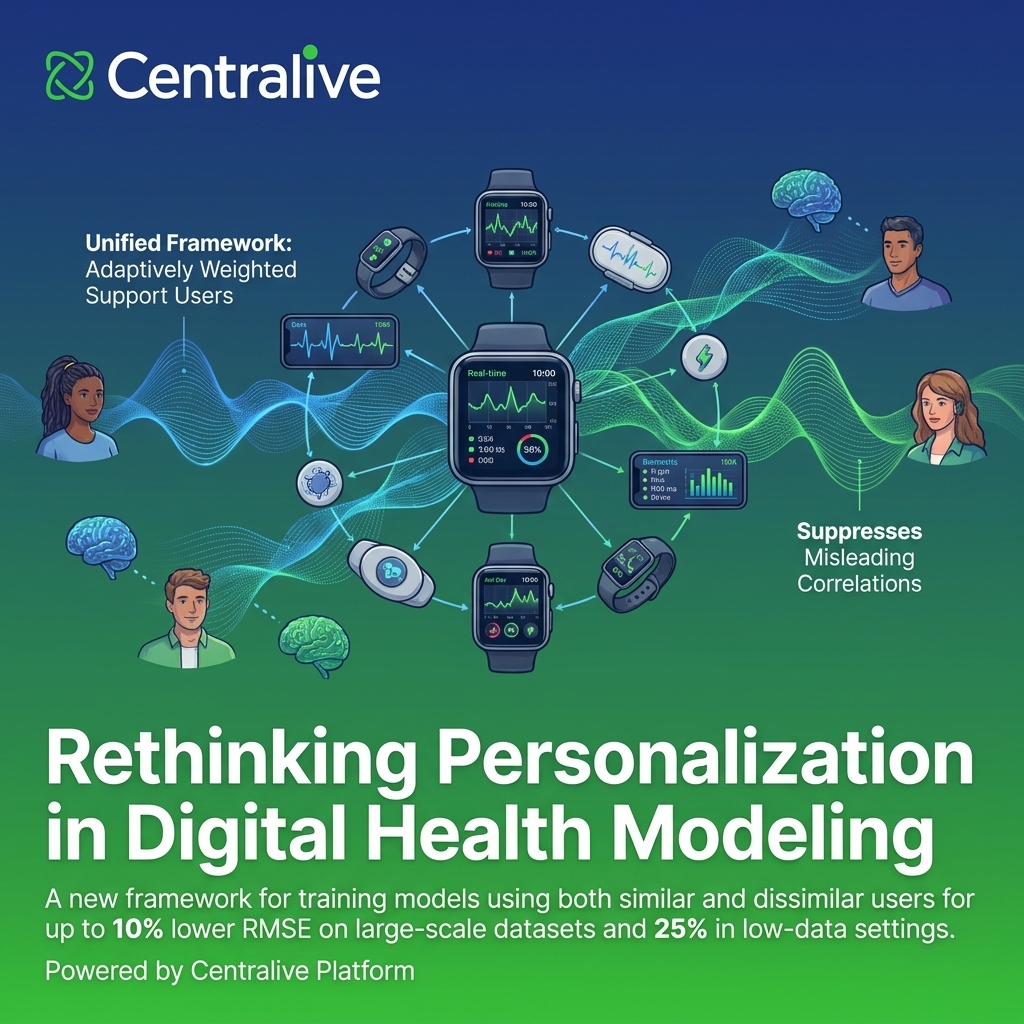
Personalized Digital Health Modeling with Adaptive Support Users
Personalized machine learning is a cornerstone of effective digital health interventions. Because physiological and behavioral responses vary dramatically among individuals, generalized population models often fall short. However, training models on sparse, noisy user-specific data presents a significant challenge.
Methodology
Most existing approaches attempt to solve data scarcity by pooling data exclusively from users deemed similar to the target individual. In our latest study, we challenge this paradigm. We propose a unified personalization framework that integrates data from both similar and dissimilar individuals.
Our approach leverages an iterative optimization algorithm that jointly updates model parameters alongside adaptive similarity weights. While similar users provide aligned patterns to reinforce personal tendencies, dissimilar users supply a critical counterfactual structure. This contrastive regularization helps the model suppress misleading correlations and biases that purely similarity-based approaches might ignore.
Findings
We rigorously tested this framework on six predictive tasks across four diverse, real-world digital health datasets (measuring metrics like loneliness, affect, glucose responses, and sleep). The results were compelling:
- Significant Error Reduction: The method achieved up to 10% lower Root Mean Square Error (RMSE) on large-scale datasets.
- High Data Efficiency: In low-data settings, the model exhibited approximately a 25% lower RMSE compared to traditional baselines.
- Interpretable Guidance: The learned adaptive weights provide actionable, interpretable guidance for targeted data selection in the future.
Impact
By adaptively identifying and integrating support users, this framework paves the way for more robust, data-efficient, and accurate personalized health monitoring systems. It proves that diversity in data—even conflicting or dissimilar data—can be harnessed to refine individual predictions.
Authors: Zhongqi Yang, Mahkameh Rasouli, Neda Mohseni, Yong Huang, Iman Azimi, and Amir M. Rahmani
This research was powered by the Centralive Platform.
Read the full paper here: https://arxiv.org/abs/2605.02004
Join our network for deeper insights: https://newsletter.centralive.health/signup